
As a business owner in Western Pennsylvania or Eastern Ohio, you're juggling a dozen priorities every day. The last thing you need is a technology problem grinding your operations to a halt. When your network crashes or customer data is at risk, you're not just losing time; you're losing money and momentum. If you're tired of the costly surprises that come with fixing tech after it breaks, there’s a better way.
Managed IT support services are all about proactive, comprehensive technology management for a predictable monthly fee. Instead of scrambling when something breaks, a managed service provider (MSP) becomes your trusted technology partner, constantly monitoring, maintaining, and securing your systems to prevent problems before they ever impact your business.
Moving Beyond Break-Fix IT Support
Picture this: it’s the last day of the quarter, and your entire network crashes. Customer orders are piling up, your team can't work, and every single minute of downtime is costing you real money. This chaotic, emergency-driven approach is what we call the ‘break-fix’ model, and it's a huge—and expensive—pain point for small to medium-sized businesses (SMBs).
That old way of thinking forces you to see your technology as a ticking time bomb—something you only deal with after it explodes. It leads to unpredictable repair bills, frustrates your employees, and leaves your business wide open to security threats that could have been easily avoided.
The Shift to Proactive Partnership
Managed IT support services are a complete mindset shift. Instead of a vendor you only call when you're in trouble, an MSP becomes your strategic technology partner. Think of us as the dedicated property manager for your entire IT infrastructure—we're there to keep things running smoothly, not just fix leaks when they happen.
The core idea is simple: it’s always better to prevent a fire than to fight one. Proactive IT management focuses on keeping your systems healthy and secure from the start, minimizing disruptions and maximizing your team's productivity.
This model completely flips the script. In the break-fix world, an IT company profits when you have problems. With managed IT services, your provider is financially motivated to keep your systems running flawlessly because our success is tied directly to yours.
We've seen this transition from reactive problem-solving to proactive partnership become essential for businesses in Western Pennsylvania and Eastern Ohio looking to compete and grow. The market backs this up, with SMBs increasingly seeking out reliable, scalable solutions. In fact, the global managed services market is on track to hit $329.1 billion by 2025, a surge driven by small businesses aiming to slash downtime by up to 90% through proactive management. You can dive deeper into the managed IT services market trends from Veritis.
This proactive approach brings several immediate wins for SMBs:
- Predictable Budgeting: Swap surprise, budget-busting repair bills for a flat, manageable monthly fee.
- Enhanced Security: Get access to enterprise-grade security tools and the expertise needed to defend against modern cyber threats.
- Increased Uptime: Proactive maintenance and 24/7 monitoring mean your critical systems stay online when you need them most.
- Strategic Focus: Free your team from wrestling with tech issues so they can focus on what they do best—growing your business.
To really understand the difference, let's look at the old way versus the new way side-by-side.
Reactive Break-Fix IT vs Proactive Managed IT Support
This table breaks down the fundamental differences between the outdated, reactive model and the modern, proactive approach that defines managed IT support services.
| Feature | Break-Fix IT Support | Managed IT Support Services |
|---|---|---|
| Cost Structure | Unpredictable, hourly rates plus parts. You pay when things break. | Predictable, flat monthly fee. Aligns our goals with yours. |
| Service Approach | Reactive. Waits for a problem to occur, then fixes it. | Proactive. Focuses on prevention through continuous monitoring. |
| Downtime | High. Problems are only addressed after they cause an outage. | Minimal. Issues are often resolved before they impact users. |
| Budgeting | Impossible to budget for. A single issue can be very costly. | Easy to budget. A fixed cost covers all support and maintenance. |
| Security | Basic and reactive. Addresses threats after an attack. | Comprehensive and proactive. Multi-layered security is built-in. |
| Strategic Focus | None. The relationship is purely transactional. | Strategic partnership. Provides vCIO guidance to align tech with goals. |
The takeaway is clear: while break-fix IT might seem cheaper upfront, the hidden costs of downtime, lost productivity, and security vulnerabilities quickly add up. A proactive managed IT model is an investment in stability, security, and long-term growth.
What a Modern Managed IT Partnership Includes
So, what do you actually get when you sign on for managed IT support services? It’s a world away from just having a number to call when a printer acts up. Think of it as a complete technology management framework, built from the ground up to keep your business secure, productive, and always moving forward. A genuine partnership is built on several key pillars that all work together.
At the heart of any solid managed IT partnership is a strong foundation in IT Service Management (ITSM), a set of proven practices for how we deliver our services. This structure is what guarantees you get consistent, high-quality support every single time, no matter what the issue is.
Let’s pull back the curtain and look at what those components look like in the real world.
The image below really captures the core shift from the old, unpredictable break-fix model to the stability you get with managed IT.
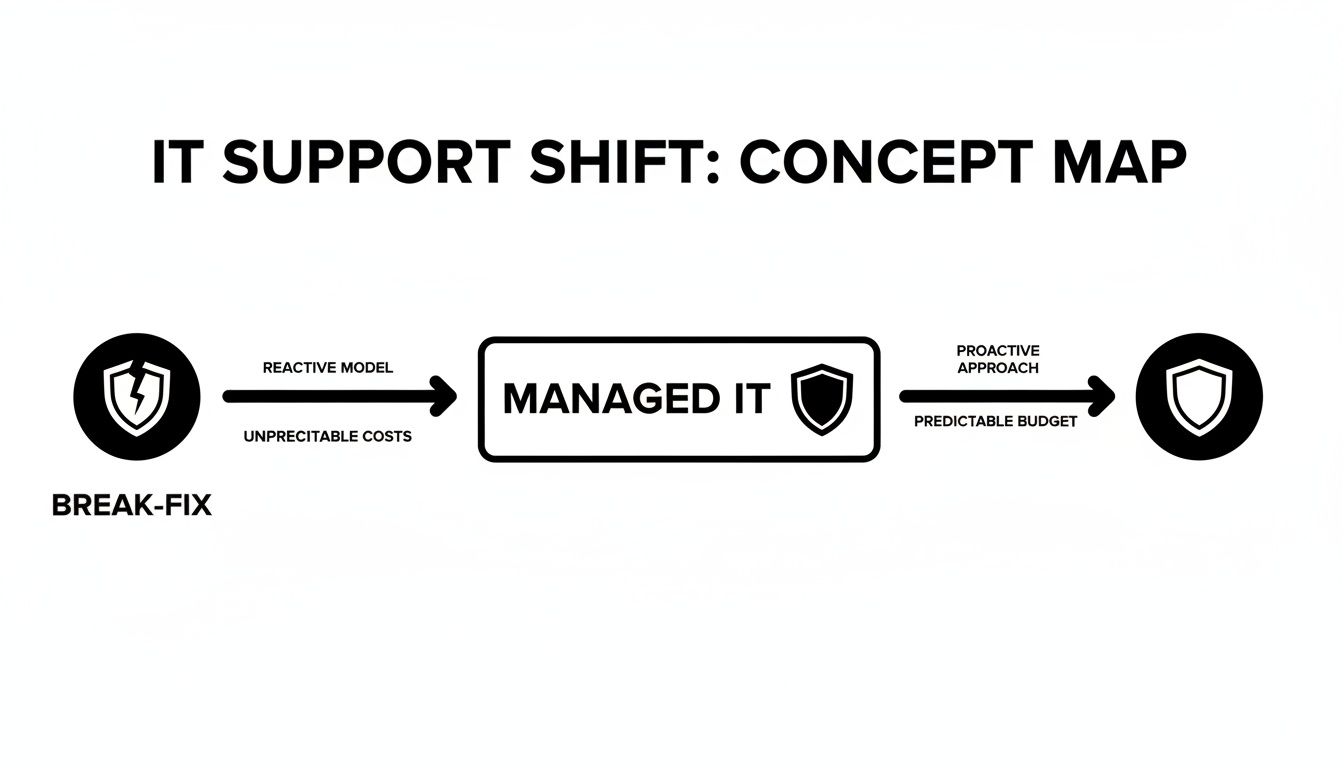
It’s all about transforming your IT from a reactive, unpredictable expense into a proactive, strategic asset that helps your business grow.
Proactive Monitoring and Maintenance
This is the silent guardian of your network. Instead of waiting for a critical server to crash or for your system to grind to a halt, we use specialized software to keep an eye on the health of your entire IT environment, 24/7/365. This software is always watching for the earliest warning signs of trouble.
These signs can be anything from a server's hard drive getting close to full, to unusual network traffic that could signal a security breach. By catching these problems before they cause downtime, we keep your business running smoothly. It's the difference between your mechanic regularly checking your car's oil and just waiting for the engine to seize up on the highway.
Responsive Helpdesk Support
When someone on your team has a question or hits a technical snag, they need fast, effective help from people who actually know what they’re doing. A core piece of any managed IT service is providing a responsive helpdesk—a single, reliable point of contact for every tech need.
Whether it’s a frustrating issue with Microsoft 365, a software glitch, or a spotty internet connection, your employees get direct access to a team of IT pros. This completely eliminates the lost productivity and sheer frustration of staff trying to play tech support themselves.
Server and Computer Management
Your servers, desktops, and laptops are the workhorses of your business. To keep them performing at their best, they need consistent, expert care. This component covers everything required to keep your hardware optimized, secure, and reliable day in and day out.
This includes absolutely critical tasks like:
- Patch Management: We’re talking about regularly applying security patches and software updates to shield you from known vulnerabilities. A solid patching process is non-negotiable for a strong security posture. You can learn more in our detailed guide that answers, "What is Patch Management?"
- Performance Tuning: Making sure your devices are running efficiently and identifying hardware that might need an upgrade before it fails and brings work to a standstill.
- Asset Management: We keep a detailed inventory of all your tech assets, which is essential for smart budgeting and future planning.
Multi-Layered Cybersecurity
For SMBs here in Western Pennsylvania and Eastern Ohio, cybersecurity isn't some luxury add-on; it's a fundamental necessity. A modern managed IT partner provides a robust, multi-layered security strategy designed to defend your business from every possible angle. This goes way beyond just installing antivirus software and calling it a day.
A strong defense is built in layers. If one security measure fails, another is right there to stop the threat. This approach is the best way to protect against sophisticated attacks like ransomware and phishing.
This includes a whole suite of essential security tools and practices, such as:
- Next-Generation Firewalls
- Endpoint Detection and Response (EDR)
- Email Filtering and Phishing Protection
- Employee Security Awareness Training
Virtual CIO (vCIO) Strategic Guidance
Finally, a true IT partner helps you think strategically about the future. A Virtual Chief Information Officer (vCIO) provides the high-level guidance your business needs to make smart, forward-thinking technology decisions. We sit on your side of the table, acting as your trusted advisor to help you align IT investments with your long-term business goals.
This service is what helps you answer the big questions, like, "When is the right time to move to the cloud?" or "What technology do we need to invest in to support our five-year growth plan?" It's about making technology work for you, not the other way around.
What Are the Real-World Benefits for Your Business?
Switching to a managed services model isn't just about finding a new way to fix computers. It's a strategic move that delivers real, measurable results for your bottom line. As a business leader in Western Pennsylvania or Eastern Ohio, you're probably asking, "What's really in it for me?" The answer is simple: you get to turn your IT from a chaotic, unpredictable expense into a powerful asset that fuels growth.
The positive effects show up almost immediately across your entire company, tackling the common headaches that many small and midsize business owners just assume are part of the deal. From locking in your budget to building a digital fortress around your data, managed IT support services deliver value you can actually see.

Lock in Predictable Monthly Costs
Every business owner I've ever met dreads the surprise IT bill. One minute everything is fine, the next a server dies or your network goes down, and suddenly you're staring at an unexpected invoice for thousands of dollars. It completely wrecks your budget and cash flow.
Managed IT support gets rid of that volatility for good.
You shift from a reactive, capital expense nightmare to a stable, predictable operational expense. For one flat monthly fee, you get all the support you need without ever having to sweat a massive, unplanned bill. This makes financial planning incredibly straightforward and frees up capital for you to invest in growing your business.
Get an Entire Team of Experts for Less Than One Hire
Hiring a single, senior-level IT professional is a huge financial commitment. Once you add up the salary, benefits, ongoing training, and paid time off, you're easily looking at a six-figure annual cost. And even then, all your technology relies on the knowledge and availability of just one person. What happens when they go on vacation or get sick?
A managed IT partnership gives you access to a whole team of certified specialists for a fraction of that price. You get experts in networking, cloud solutions, and cybersecurity all keeping a close eye on your systems.
Partnering with an MSP is like having a deep bench of IT talent on-demand. You get enterprise-level expertise in areas like hybrid cloud and endpoint management without the massive capital investment, allowing you to focus on your core business.
This team-based approach means you always have the right person with the right skills ready to tackle any challenge, whether it's a simple helpdesk request or a complex strategic project.
Slash Costly Downtime
Let's be blunt: every minute your systems are offline, you are losing money. Your team can't work, you can't serve your customers, and operations grind to a halt. The proactive monitoring and maintenance that are core to managed services are designed to stop these outages before they ever start.
The data speaks for itself. Small and midsize businesses can often cut IT costs by 30-50% by working with an MSP. Even better, proactive management has been shown to reduce system failures by up to 70%. By catching and fixing potential problems early, we keep your business running smoothly and your people productive.
Fortify Your Security and Compliance
Cyber threats are a constant worry for every business today, and attackers often see smaller companies as easy targets. A good managed services provider builds a tough, multi-layered security strategy to protect your sensitive data, your reputation, and your customers. This proactive stance is also essential for meeting compliance standards like HIPAA or CMMC.
We handle the heavy lifting of managing firewalls, endpoint protection, and continuous security monitoring, giving you genuine peace of mind. As technology evolves, so do the tools for efficiency; exploring the benefits of AI chatbots in customer service can show how automation complements security efforts. When you offload security to experts, you can be confident your defenses are always ready for the latest threats.
How to Choose the Right IT Services Provider
Picking a partner for your managed IT support services is a huge decision, and let me be upfront: not all providers are the same. Far from it. The right choice can feel like adding a secret weapon to your team, fueling your growth. The wrong one? It’s a fast track to headaches, wasted money, and serious risk. This isn't about hiring just another vendor; it's about finding a true partner, and that means you need to do your homework.
You have to look past the slick sales pitch and start asking the tough questions. Having a solid set of criteria helps you cut through the noise and see which providers can actually walk the talk, especially for a business operating right here in Western Pennsylvania or Eastern Ohio.

Evaluate Their Local Presence and Expertise
For a small or midsize business, there's a real advantage to having a partner who gets the local business scene. A provider with deep roots in Western PA and Eastern OH is more than just a voice at the end of a phone line. They're part of your community, and when things get ugly, they can be on-site to get you back up and running.
Beyond just their location, you need to dig into the skills of their technical team.
- Ask about certifications: Are their technicians certified by industry leaders like Microsoft or CompTIA? This isn't just a piece of paper; it shows they’re committed to staying sharp and meeting professional standards.
- Inquire about industry experience: Have they worked with businesses like yours? Whether you're in manufacturing, healthcare, or professional services, a provider who already knows your world will understand your unique challenges and compliance headaches from day one.
Scrutinize Their Security Protocols
Cybersecurity is the one area where you absolutely cannot afford to cut corners. Any potential IT partner worth their salt must have a clear, tough-as-nails security strategy that goes way beyond just installing antivirus software. Your goal is to understand exactly how they plan to defend your business from the threats we all hear about, like ransomware and email scams.
A provider's own security is a mirror of how they'll protect you. If they get squirrelly when you ask about their internal security measures, that’s a massive red flag.
Don’t be shy about getting specific. What kind of firewall do they use? Do they offer security awareness training for your employees? What’s their game plan when a security incident happens? Their answers (or lack thereof) will tell you everything you need to know about how seriously they take protecting your company.
Verify Their Track Record and Responsiveness
A provider's reputation is everything—it's built on years of real-world performance. Ask them for client testimonials you can actually verify and detailed case studies showing how they've helped businesses similar to yours solve real problems. A provider who is confident in their work will be eager to share success stories and might even offer to connect you with a current client for a reference.
Just as important is the Service Level Agreement (SLA). This isn't just fine print; it's the contract that spells out their promises to you in black and white.
Pay close attention to these key metrics in the SLA:
- Guaranteed Response Time: How fast will they jump on your support ticket?
- Resolution Targets: What’s their goal for actually fixing different kinds of problems?
- System Uptime Guarantees: Do they promise your critical systems will be available a certain percentage of the time (e.g., 99.9%)?
A solid SLA creates accountability and sets clear expectations. Managing these relationships effectively is crucial, and you can get more insight by checking out our guide on IT vendor management best practices to make sure all your partnerships are built to last. When you get this choice right, you're not just hiring an IT company—you're building a resilient and secure foundation for your business's future.
Demystifying Pricing Models and Service Agreements
Figuring out how managed IT support services are priced is one of the most important first steps in finding the right partner. You need a clear, predictable model that eliminates hidden fees and nasty budget surprises, effectively turning a chaotic capital expense into a stable operational one. This kind of transparency is the bedrock of a smart financial decision that actually supports your business goals.
There are a few common ways providers structure their pricing, and each is built to fit different business needs. The goal is to find a model that makes sense for how you operate, so you're only paying for what you genuinely need.
Common MSP Pricing Models Explained
Choosing the right pricing model really boils down to aligning cost with value. A manufacturing firm in Eastern Ohio with a ton of shared workstations on the shop floor would probably save money with a per-device model. On the other hand, a professional services firm in Western Pennsylvania with a hybrid team would likely find a per-user model much more cost-effective.
It’s all about finding the right fit for your specific operations. Here’s a quick breakdown of what you’ll likely encounter:
| Pricing Model | How It Works | Best For |
|---|---|---|
| Per-User Pricing | A flat monthly fee is charged for each employee account supported. This single fee covers all of their devices—desktop, laptop, and mobile. | Businesses with employees who use multiple devices, especially those with remote or hybrid teams. It makes budgeting simple because it scales with your headcount. |
| Per-Device Pricing | A flat monthly fee is charged for each managed device (e.g., server, desktop, firewall). It doesn’t matter how many people use a single device. | Companies with more devices than users. Think manufacturing floors, retail environments, or any business with shared computer kiosks. |
| Tiered Pricing | Service packages (like Bronze, Silver, Gold) are offered with escalating levels of support. Basic tiers cover the essentials, while premium tiers add in advanced security or vCIO services. | Organizations that want to pick a predefined package that fits their budget and specific service needs without much customization. |
Getting a handle on these options is a great start. For a deeper dive into managing your technology spending, our guide on IT cost optimization strategies offers some really practical advice for SMBs.
Decoding the Service Level Agreement
Beyond the price tag itself, the Service Level Agreement (SLA) is the most important document you'll sign. This is the contract that spells out the provider's commitments in clear, measurable terms. It’s your guarantee of service quality and sets the ground rules for the entire relationship.
Honestly, a vague or non-existent SLA is a massive red flag. Any provider worth their salt will proudly stand behind their commitments in writing.
Your SLA is the blueprint for accountability. It translates a provider’s promises into tangible metrics, ensuring you know exactly what level of service you can expect for response, resolution, and system availability.
When you're reviewing an SLA, you need to look for specific, quantifiable promises. Don't settle for vague language. Here are the key metrics to focus on:
- Guaranteed Response Time: This tells you exactly how quickly the provider commits to acknowledging your support ticket and actually starting work on it.
- Resolution Time Targets: This outlines the provider's goal for solving the issue. It's often broken down by priority level (e.g., critical, high, medium), which makes perfect sense—a server outage needs faster attention than a password reset.
- System Uptime Percentage: This is a crucial number. It’s a guarantee that your critical systems will be operational a certain percentage of the time, like 99.9%.
A strong SLA isn't just a piece of paper; it's the peace of mind that comes from knowing you have a reliable partner committed to keeping your business up and running.
A True Strategic Partner for Your Business
Making the switch to managed IT support services is one of the most powerful moves a small or midsize business can make. I’ve seen it time and time again. It’s about so much more than just handing off your tech problems—it’s about building a resilient, secure foundation that lets you grow without constantly looking over your shoulder. When you leave the old, reactive break-fix model behind, the results are immediate and tangible.
By embracing a proactive partnership, you get the financial stability of a predictable monthly cost and the peace of mind that comes from knowing your critical data is protected. You also gain access to a level of specialized expertise that’s simply too expensive to hire in-house. Suddenly, your technology stops being a source of constant headaches and becomes the competitive edge it was always meant to be.
A Local Partner Who Understands Your World
For businesses here in Western Pennsylvania and Eastern Ohio, working with a local provider like Eagle Point Technology Solutions is a game-changer. We're not some faceless national call center. We live here. We understand the regional economy, the specific challenges you're up against, and the opportunities waiting right in our own backyard. We’re your neighbors, and we’re genuinely invested in seeing you succeed.
A true IT partnership isn't just about fixing what’s broken. It’s about getting strategic guidance that lines up your technology with your actual business goals, making sure every dollar you spend on IT is pushing you forward. That local insight and commitment is what turns a simple service provider into a real strategic partner.
Ultimately, our goal with managed IT support is to empower you to do what you do best—run your business. Let us handle the complex, ever-changing world of technology so you don't have to.
I invite you to see for yourself how a strategic IT partnership can completely change how you operate. Let's work together to build a more secure, efficient, and resilient future for your company.
Ready to take that next step? Schedule a no-obligation consultation with our team today. We’ll help you take a hard look at your current technology, find opportunities for improvement, and map out a clear path to a stronger technological foundation.
Your Top Questions About Managed IT Services, Answered
Even after seeing all the benefits laid out, you probably have a few questions rolling around in your head. That's completely normal. Let’s tackle some of the most common ones we hear from business owners in our area who are considering making the switch to managed IT support services.
What’s the Real Difference Between Managed Services and Old-School IT Support?
The biggest difference is the entire mindset. Traditional IT support is purely reactive—you only call for help after something has already gone wrong. This model pretty much guarantees you’ll have downtime, and the repair bills are completely unpredictable. One bad server crash can blow your budget for the quarter.
Managed IT support services, on the other hand, are proactive. Our job is to constantly monitor and maintain your technology to stop problems before they ever start. Everything is covered under one predictable, flat monthly fee, which means our success is directly tied to yours. If your systems are running smoothly, we're doing our job right.
How Much Do Managed IT Support Services Usually Cost?
The final number will always vary a bit based on how many people are on your team, how many devices you have, and the overall complexity of your IT setup. But the pricing structure is almost always a straightforward flat monthly fee, typically calculated per user or per device.
This model gives you incredible cost predictability, which is a massive relief when you're trying to budget. For most small to midsize businesses, it's far more affordable than hiring a single in-house IT specialist once you factor in their salary, benefits, vacation time, and the constant need for expensive training.
Think about it this way: a managed IT partnership gives a small business access to an entire team of certified experts—specialists in cybersecurity, cloud services, and network management—for less than the cost of one senior hire. It’s the most efficient way to get enterprise-level expertise without the enterprise-level price tag.
Do We Really Need This If We're Just a Small Business?
Absolutely. In fact, you might need it more. Small businesses are often seen as easy targets by cybercriminals who assume you have weaker defenses. The financial fallout and reputational damage from a single security breach or a major system outage can be devastating, even fatal, for an SMB.
Managed IT support services completely level the playing field. You get access to the same powerful security tools and expert support that large corporations depend on, all at a price point that makes sense for an SMB budget. It allows you to stop putting out tech fires and get back to focusing on what you do best—running your business. The market shows this is the new standard; the U.S. managed services market is projected to hit USD 116.25 billion by 2030. That incredible growth is being driven by SMBs, with 78% of them now outsourcing cybersecurity to fight threats and improve productivity. You can see more on the growth of managed services for SMBs on infrascale.com.
What Does the Onboarding Process Look Like?
We’ve worked hard to make our onboarding process as smooth and invisible as possible. The last thing you need is another operational headache. We know your team is busy, and our goal is to make this transition feel effortless.
It’s a clear, structured path that looks like this:
- Discovery: We start by taking a deep dive into your current technology, workflows, and business goals. We have to understand your world before we can improve it.
- Deployment: Next, we carefully deploy our secure monitoring and management tools across your network and devices. This is all done quietly in the background.
- Securing the Perimeter: Our team immediately gets to work securing your network, implementing critical security layers, and ensuring your data is protected from day one.
- Transition: Finally, we systematically transition all support responsibilities to our team and give your staff clear, simple instructions on how to get help whenever they need it.
We handle all the technical heavy lifting behind the scenes. Our job is to ensure a seamless cutover, keeping you in the loop at every step without ever getting in the way of your day-to-day work.
At Eagle Point Technology Solutions, we know the unique challenges businesses face here in Western Pennsylvania and Eastern Ohio. If you're ready to turn your IT from a source of frustration into a powerful asset, we're here to help.
Ready to talk? Schedule your free consultation today.