For small and mid-sized businesses in Western Pennsylvania and Eastern Ohio, the cloud is a powerful engine for growth. It offers scalability and efficiency that were once exclusive to large enterprises, powering everything from daily operations on Microsoft 365 to innovative applications. However, this transition also opens new avenues for sophisticated cyber threats. As a business owner or IT manager, you're focused on running your company, not becoming a full-time cybersecurity expert.
Many leaders mistakenly believe their cloud provider handles all security, but this is a dangerous misconception rooted in the shared responsibility model. While providers like Amazon and Microsoft secure the underlying infrastructure—the physical data centers and servers—you are ultimately accountable for securing your data, applications, and access within the cloud. Relying solely on the provider’s security is like a bank securing its vault but leaving the key under your doormat. A simple password is no longer enough to protect your most critical business assets from a breach.
This article cuts through the technical jargon to provide a prioritized, practical list of the 10 most critical cloud computing security best practices you can implement today. We will move beyond generic advice to give you actionable steps and real-world examples to fortify your cloud environment against ransomware, data breaches, and other costly disruptions. This guide is your roadmap to building a resilient and secure cloud foundation, so you can focus on growing your business.
1. Implement Multi-Factor Authentication (MFA) Across All Cloud Access
Multi-Factor Authentication (MFA) is a foundational layer of security that requires users to provide two or more verification factors to gain access. Think of it as a digital double-check; even if a cybercriminal steals a password (something the user knows), they are stopped because they don't have the second factor, like a code from an authenticator app (something the user has) or a fingerprint scan (something the user is). For an SMB, where a single compromised account can lead to a significant data breach, MFA is one of the most effective and affordable controls you can implement.

This practice is essential because stolen credentials are the primary target of most cyberattacks. Implementing MFA dramatically reduces the risk of unauthorized access from phishing, credential stuffing, and other common threats. It's a non-negotiable step in any serious cloud computing security strategy.
How to Implement MFA Effectively
Getting started with MFA doesn't have to be complicated, even for a small team. The key is a phased and strategic rollout that prioritizes your most critical assets first.
- Start with Privileged Accounts: Immediately enable MFA for all administrator and executive accounts. These "keys to the kingdom" for your Microsoft 365, AWS, or Google Workspace environments are high-value targets.
- Use Authenticator Apps: While SMS-based MFA is better than nothing, it's vulnerable to SIM-swapping attacks. Encourage employees to use more secure authenticator apps like Microsoft Authenticator or Google Authenticator, which are free and easy to set up.
- Educate Your Team: Explain that MFA protects sensitive company data, not just their individual accounts. Frame it as a collective responsibility to secure the business and protect client information.
- Implement Conditional Access: For more advanced security, use conditional access policies (available in platforms like Microsoft 365 Business Premium). This allows you to require MFA only under specific, riskier conditions, such as when a user signs in from an unfamiliar location or an unknown device.
- Maintain Recovery Codes: Ensure users safely store their one-time backup codes. This prevents lockouts if they lose their primary MFA device, avoiding disruptions to productivity.
2. Encrypt Data Both in Transit and at Rest
Data encryption is the process of converting your sensitive information into an unreadable code, making it useless to anyone without the specific key to unlock it. This practice is non-negotiable for any business operating in the cloud. Encryption protects your data in two critical states: "in transit," as it travels between your computer and a cloud server, and "at rest," while it's stored in cloud databases or backups. For businesses in manufacturing, healthcare, or professional services, where protecting customer and proprietary data is paramount, this dual-layered encryption is a fundamental part of any effective cloud computing security best practices strategy.
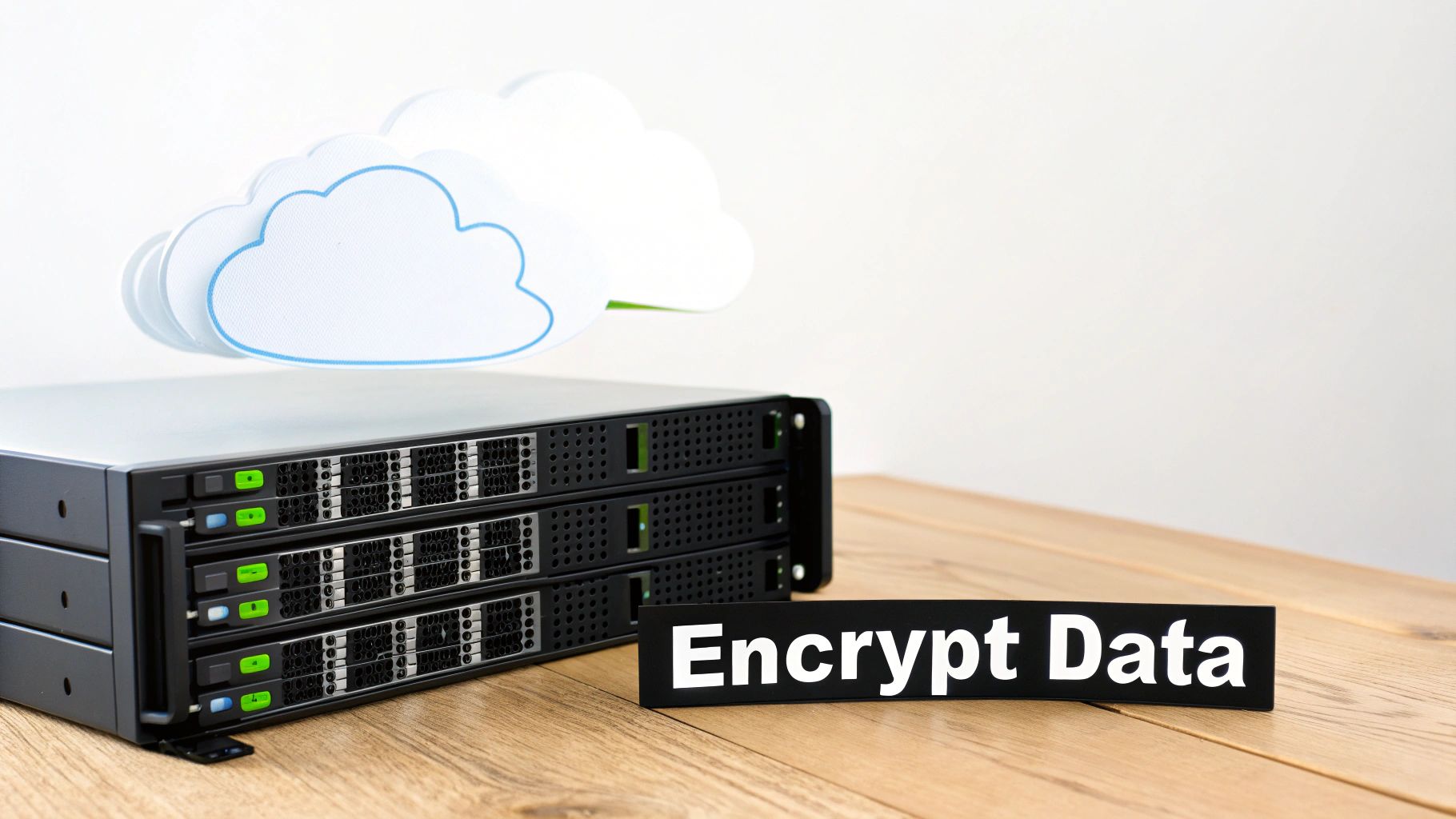
Think of it this way: even if a cybercriminal manages to bypass other security controls and access your stored files, strong encryption renders that data completely worthless to them. This is a critical safeguard against data breaches and a core requirement for many compliance frameworks like HIPAA and CMMC. Without it, your most valuable assets are left exposed.
How to Implement Encryption Effectively
Major cloud providers like Microsoft Azure and AWS offer robust, built-in encryption tools, making implementation more accessible than ever for SMBs. The key is to ensure these features are enabled and configured correctly across your entire cloud footprint.
- Enable Encryption by Default: Configure all your cloud storage services (like AWS S3 or Azure Blob Storage) and databases to automatically encrypt new data as it is saved. This creates a secure baseline and prevents accidental exposure.
- Secure Data in Transit: Mandate the use of strong protocols like TLS 1.2 or higher for all connections to your cloud applications. This protects data from being intercepted as it moves across the internet.
- Use Customer-Managed Keys for Sensitive Data: For highly regulated or critical information, consider using customer-managed encryption keys (CMEK) via services like Azure Key Vault or AWS KMS. This gives you direct control over key access and rotation, adding a powerful layer of security and auditability.
- Regularly Audit Key Access: Monitor who is accessing your encryption keys and when. Unusual activity could indicate a compromised account, allowing you to respond quickly before a breach occurs.
- Test Your Decryption Process: Don't just assume your encrypted backups are usable. As part of your disaster recovery testing, regularly test the restoration and decryption process to ensure your keys are accessible and work as expected.
3. Establish Least Privilege Access (Zero Trust) Controls
The Principle of Least Privilege (PoLP) dictates that users and applications should only be granted the minimum permissions necessary to perform their required tasks, and nothing more. This concept is the heart of a modern security strategy, which assumes that threats can originate from anywhere, both inside and outside the network. By strictly limiting access, you drastically reduce the potential damage a compromised account or insider threat can cause. For businesses in our region, this is a critical step in securing sensitive client data stored in cloud environments like Microsoft 365.
This practice is essential because over-privileged accounts are a goldmine for attackers. Once they compromise a user with excessive permissions, they can move across your cloud infrastructure, access sensitive data, and deploy ransomware. To truly establish least privilege, understanding and implementing the principles of Zero Trust Security is paramount. This modern approach to cybersecurity is a non-negotiable part of any robust cloud security plan.
How to Implement Least Privilege Effectively
Implementing a least privilege model requires a deliberate shift from a "trust by default" to a "verify first" mindset. It's about ensuring every access request is authenticated and authorized.
- Audit and Document Roles: Begin by identifying every user role within your organization—from sales to accounting to operations. Document exactly what cloud resources and data each role needs to access to perform their job functions.
- Implement Just-in-Time (JIT) Access: For administrative tasks, use tools like Microsoft 365's Privileged Identity Management (PIM) to grant temporary, elevated permissions. This ensures admin rights are only active when explicitly needed and for a limited duration.
- Use Role-Based Access Control (RBAC): Instead of assigning permissions to individual users, create roles with predefined access levels (e.g., "Billing Admin," "Sales Associate"). Assign users to these roles, making it easier to manage and audit permissions as your team grows.
- Conduct Quarterly Access Reviews: Schedule regular reviews of all user permissions. As employees change roles or leave the company, their access rights must be updated or revoked immediately to prevent "privilege creep."
- Monitor All Privilege Escalation: Log and monitor every instance where a user is granted temporary elevated access. This creates an audit trail that is invaluable for security investigations and ensuring compliance.
4. Enable Cloud-Native Monitoring and Logging
Effective cloud security hinges on visibility; you cannot protect what you cannot see. Cloud-native monitoring and logging provide this essential visibility by continuously capturing detailed activity logs, system metrics, and security events across your entire cloud infrastructure. Think of it as a comprehensive security camera system for your digital assets, recording every access attempt, configuration change, and data transfer. For a busy SMB, this centralized insight is critical for rapidly detecting threats and maintaining compliance without needing a 24/7 security team.
Without robust logging, responding to a security incident is like investigating a crime with no witnesses or evidence. Centralized platforms like Microsoft Sentinel collect and analyze data from multiple sources, allowing you to spot anomalies, conduct forensic analysis, and prove due diligence to auditors. This proactive approach is fundamental to a modern cybersecurity strategy.
How to Implement Cloud Monitoring and Logging
Setting up a powerful monitoring system is more accessible than ever with tools built directly into cloud platforms. The goal is to collect the right data and turn it into actionable intelligence.
- Activate Foundational Logging: Immediately enable services like AWS CloudTrail, Azure Monitor, or Google Cloud's Operations Suite for all accounts and services. These tools record API calls and administrative actions, providing a crucial audit trail.
- Establish Log Retention Policies: Configure log retention to meet your compliance needs. Regulations like HIPAA or CMMC often require logs to be stored for a specific period, typically ranging from 90 days to several years.
- Create Automated Alerts: You can't manually watch logs 24/7. Set up automated alerts for critical security events, such as multiple failed login attempts, privilege escalations, or unauthorized access to sensitive data folders in SharePoint.
- Integrate and Centralize: For businesses with a mix of on-site and cloud systems, integrate cloud logs with your other security tools. This creates a single pane of glass for unified threat detection across all your systems.
- Regularly Review and Test: Periodically review logs for suspicious activity and test your alerting mechanisms. As part of your disaster recovery plan, ensure you can access and search logs effectively to support a real-world incident investigation.
5. Conduct Regular Cloud Security Assessments and Penetration Testing
You can't protect against threats you don't know exist. Regular security assessments and penetration testing are like a comprehensive health check-up for your cloud environment, designed to proactively find vulnerabilities and misconfigurations before cybercriminals can exploit them. For SMBs that often lack dedicated security teams, this practice is one of the most effective ways to gain a clear picture of your actual security posture in complex cloud platforms like AWS or Microsoft Azure.
This process involves using automated scanning tools and manual "ethical hacking" techniques to simulate an attack on your infrastructure and applications. The goal is to identify weaknesses in your defenses, from an overlooked server patch to an insecure application setting. Implementing this as a core part of your cloud computing security best practices provides an unbiased, evidence-based view of your risks, enabling you to prioritize fixes based on real-world impact and budget.
How to Implement Effective Security Testing
A successful assessment program combines continuous monitoring with periodic deep-dive testing. It provides the actionable intelligence needed to make informed security decisions and demonstrate due diligence for compliance requirements.
- Schedule Annual Penetration Tests: At a minimum, conduct a full, expert-led penetration test once a year. This should test your defenses from both an external (internet-facing) and internal (employee-level) perspective to uncover different types of vulnerabilities.
- Implement Continuous Vulnerability Scanning: Use tools from providers like Tenable or Qualys to continuously scan your cloud assets for new vulnerabilities. This automates the process of finding known security flaws and misconfigurations.
- Create and Maintain a Risk Register: Document every finding from your tests and scans in a risk register. This central document should track each vulnerability, its severity, the remediation plan, and its current status. A well-organized register is crucial, and you can get started by using a cybersecurity risk assessment template to structure your findings.
- Assess Both Infrastructure and Applications: Don't just scan your servers and networks. Ensure your testing program also includes your cloud-based applications (like Microsoft 365) and any custom-developed software to check for configuration flaws.
- Use Results to Improve Defenses: Treat the findings not as a failure, but as an opportunity. Use the assessment report to guide your security investments, patching priorities, and employee training programs.
6. Implement Cloud Access Security Brokers (CASB) Solutions
A Cloud Access Security Broker (CASB) acts as an intermediary or gatekeeper between your employees and the cloud services they use. It enforces your security policies as users access cloud-based resources, regardless of whether they are on the corporate network or working remotely. For businesses in our region, where the use of unsanctioned cloud apps (known as "shadow IT") is a growing risk, a CASB provides critical visibility and control.
Think of it as a security checkpoint for all your cloud traffic. For instance, if an employee tries to upload sensitive company data to a personal file-sharing site, the CASB can see this activity and block it in real time. As your team adopts more SaaS applications, your security perimeter dissolves, making centralized policy enforcement a key part of any modern cloud security strategy.
How to Implement a CASB Solution Effectively
Deploying a CASB doesn't have to disrupt your business operations. A phased approach allows you to gain control without hindering employee productivity.
- Start with Discovery Mode: Before enforcing any rules, run the CASB in a monitoring-only mode. This will reveal all the cloud applications your employees are using, including unsanctioned services. You might be surprised by the extent of "shadow IT."
- Prioritize High-Risk Applications: Focus your initial policies on high-risk application categories, such as file-sharing, collaboration tools, and personal email. These are common channels for accidental or intentional data leaks.
- Balance Security with Productivity: Create granular policies. Instead of blocking an application entirely, you might allow access but prevent certain actions, like downloading sensitive files to an unmanaged device or sharing data with external users.
- Integrate with Your Security Stack: Connect your CASB alerts to your central security information and event management (SIEM) system or incident response platform. This ensures anomalous behavior, like a user logging in from two countries simultaneously, triggers an immediate investigation.
- Educate and Provide Alternatives: Use CASB findings as a teaching moment. Inform users about the risks of shadow IT and guide them toward company-approved, secure applications that meet their needs.
7. Maintain Secure Cloud Backup and Disaster Recovery Plans
A secure cloud backup strategy is your ultimate safety net against data loss from ransomware, accidental deletion, or system failures. Simply having backups isn't enough; a comprehensive disaster recovery plan is what ensures business continuity and enables a rapid return to operations. For an SMB, where downtime can be financially crippling, your cloud backups must be isolated, encrypted, and regularly tested to be effective.
This practice is critical because cyberattacks increasingly target backup files to prevent recovery and force a ransom payment. A robust backup and recovery strategy is a non-negotiable component of modern cloud computing security best practices. It shifts the conversation from "if" a disaster happens to "when," ensuring your team is prepared to restore critical systems and data with minimal disruption.
How to Implement Secure Backups and Disaster Recovery
A strong backup plan is built on proven principles and consistent testing. It should be treated as a core business function, not just an IT task.
- Follow the 3-2-1 Backup Rule: Maintain three copies of your data on two different types of storage media, with at least one copy stored offsite or in a separate, isolated cloud environment. This diversification protects against both local and cloud-based disasters.
- Implement Immutable Backups: Use backup solutions that support immutability. This feature makes backup data unchangeable for a set period, preventing ransomware from encrypting or deleting your recovery points.
- Test Your Restores Quarterly: A backup is only valuable if it can be successfully restored. Regularly test the recovery process for critical applications to verify data integrity and confirm your team can execute the recovery plan. This also helps you understand your realistic Recovery Time Objectives (RTOs).
- Encrypt Your Backups: Backups should be encrypted both in transit and at rest using encryption keys that are managed separately from your production environment keys. This prevents unauthorized access even if the backup storage itself is compromised.
- Document and Communicate the Plan: A detailed recovery plan is essential for an orderly response during a crisis. It should clearly outline roles, responsibilities, and communication steps for your team.
8. Enforce Cloud Security Governance and Compliance Policies
Cloud security governance establishes the rulebook for how your organization uses the cloud. It involves creating and enforcing policies, standards, and controls that dictate how cloud resources are deployed and managed. For businesses in healthcare or manufacturing navigating compliance requirements like HIPAA or CMMC, a strong governance framework isn't just good practice; it's a necessity. It ensures your cloud environment aligns with regulatory standards and your own internal security requirements.
This structured approach is essential for maintaining control as your cloud footprint grows. Without governance, you risk "configuration drift," where security settings degrade over time due to manual changes, leading to vulnerabilities. Enforcing clear policies ensures that every new deployment and every change adheres to your security baseline, making it a critical part of your cloud computing security best practices.
How to Implement Cloud Governance Effectively
Building a governance framework is about creating guardrails that allow your team to innovate safely within the cloud. The goal is to automate enforcement and reduce manual oversight.
- Start with Your Compliance Needs: Identify all relevant regulatory and industry standards (e.g., HIPAA, CMMC, PCI-DSS). Build your governance policies backward from these requirements to ensure compliance is baked into your cloud architecture from day one.
- Leverage Native Cloud Tools: Use platform-specific services to enforce broad controls. In AWS, you can use Service Control Policies (SCPs) to set permission guardrails for all accounts. In Azure, Management Groups serve a similar purpose, allowing you to apply policies across multiple subscriptions.
- Adopt Policy-as-Code (PaC): For more advanced setups, integrate policy enforcement directly into your deployment pipelines. This approach treats your security rules like software code; they are versioned, tested, and automatically applied, drastically reducing human error.
- Establish a Formal Exception Process: Not every rule fits every situation. Create a documented process for requesting and approving exceptions to security policies. This process should require clear business justification and a defined expiration date for the exception.
- Automate Monitoring and Remediation: Use tools like Azure Policy or AWS Config to continuously monitor for non-compliant configurations. Where possible, implement automated remediation to instantly correct deviations from your baseline, such as re-enabling logging on a storage account that was turned off.
9. Manage Cloud Identity and Access with Federated Identity Systems
Federated Identity Management simplifies the user experience by allowing employees to use a single set of credentials to access multiple cloud services. Think of it as a digital master key; instead of juggling a dozen different passwords for Microsoft 365, your CRM, and other SaaS apps, your team uses one trusted identity to securely access everything. For an SMB, this centralization is a powerful tool for streamlining operations and enhancing security.
This practice is critical because it dramatically simplifies user lifecycle management. When an employee joins or leaves the company, you can grant or revoke access to all connected cloud applications from a single dashboard. This prevents orphaned accounts—a common security gap—and is an essential component of modern cloud computing security best practices. By centralizing authentication, you gain a single point of control for enforcing security policies like MFA.
How to Implement Federated Identity Effectively
Deploying a federated identity system establishes a strong foundation for secure and scalable cloud access. The goal is to create a seamless yet secure experience for users while giving IT centralized control.
- Choose a Central Identity Provider (IdP): Select a core platform to act as your single source of truth for identities. Microsoft Entra ID (formerly Azure AD) is a common choice for businesses using Microsoft 365, while platforms like Okta offer robust, vendor-neutral solutions.
- Integrate Critical Applications First: Start by connecting your most important SaaS applications, such as your CRM, ERP, and primary cloud platform (AWS, Azure, etc.). This delivers immediate security and productivity benefits.
- Combine with Strong Authentication: Federation is most powerful when paired with Multi-Factor Authentication. Enforce MFA at the identity provider level to protect all connected applications simultaneously.
- Automate Provisioning and Deprovisioning: Use protocols like SCIM (System for Cross-domain Identity Management) to automate the creation and removal of user accounts in downstream applications. This ensures access is terminated immediately upon an employee's departure.
- Regularly Audit Trust Relationships: Periodically review the connections between your identity provider and your service providers. Remove any applications that are no longer in use to reduce your potential attack surface.
10. Implement Network Security Controls and Cloud Incident Response Procedures
Effective cloud security requires robust controls to protect data in transit and a clear plan for what to do when something goes wrong. Network security controls like virtual private networks (VPNs) and cloud firewalls act as the digital guardians for data moving between your office and the cloud. Paired with a cloud-specific incident response plan, these controls create a comprehensive defense-in-depth strategy.
This dual approach is crucial because a network breach can happen quickly, and the cloud's dynamic nature demands a response plan tailored to its architecture. For businesses in our region, having a pre-defined strategy to detect, contain, and recover from a security event is not just a best practice; it's a critical component of business continuity and one of the most important cloud computing security best practices to master.
How to Implement Network Controls and Incident Response
A proactive stance on network security and incident readiness significantly reduces the potential impact of a breach. The goal is to build resilient network pathways and an agile response capability.
- Secure Cloud Connectivity: Use secure, private connections like Azure ExpressRoute or AWS Direct Connect for reliable links between your on-premises infrastructure and the cloud. For most SMBs, a properly configured site-to-site VPN provides a secure and cost-effective solution.
- Segment Your Network: Use cloud-native tools like AWS Security Groups or Azure Network Security Groups (NSGs) to create micro-segments. This isolates workloads and prevents an attacker from moving laterally across your cloud environment if one system is compromised.
- Deploy a Web Application Firewall (WAF): Place a WAF in front of all public-facing web applications. This specialized firewall filters traffic to block common attacks like SQL injection and cross-site scripting before they reach your servers.
- Develop a Cloud-Specific Incident Response Plan: Your on-premises plan won't translate directly to the cloud. A cloud-centric plan must account for the shared responsibility model, API access, and the specific tools your cloud provider offers for forensics. You can find excellent starting points in various incident response plan examples that can be adapted for cloud environments.
- Practice and Refine: Don't let your plan sit on a shelf. Conduct regular tabletop exercises that simulate cloud-specific attack scenarios, such as a compromised administrator account or a ransomware event. Use these drills to identify gaps and refine your procedures.
From Best Practices to Action: Partnering for a Secure Cloud Future
Navigating the complexities of cloud security can feel overwhelming, especially for small and midsize businesses where you're juggling countless priorities with a limited budget and staff. Throughout this guide, we have explored ten critical cloud computing security best practices, from foundational controls like MFA and data encryption to more advanced strategies involving Zero Trust principles, cloud monitoring, and incident response planning. Each practice represents a vital layer in a robust defense, designed to protect your valuable data, maintain operations, and ensure regulatory compliance.
The journey doesn't end with a checklist. True security comes from integrating these practices into a cohesive and continuously managed security posture. Security is not a "set it and forget it" project; it's an ongoing process of assessment, adaptation, and improvement. The digital threat landscape evolves daily, and as your business grows—adding new applications and employees—your cloud footprint changes, introducing new risks that must be managed proactively.
Turning Knowledge into Resilient Security
For business leaders in Western Pennsylvania and Eastern Ohio, the challenge is clear: how do you translate these essential practices from a list on a page into a living part of your organization's operations? The answer lies in shifting from a reactive stance to a proactive one.
- From Checkboxes to Culture: Instead of viewing security as a technical hurdle, see it as a business enabler. A secure cloud environment builds trust with your clients, protects your reputation, and provides a stable platform for growth.
- From Annual Audits to Continuous Monitoring: Relying solely on periodic checks leaves significant gaps for attackers to exploit. Embracing continuous monitoring and regular scanning allows you to identify and address threats in near real-time, drastically reducing your window of exposure.
- From Disjointed Tools to a Unified Strategy: A secure cloud is not built with a single product. It requires the strategic integration of identity management, network controls, data protection, and incident response. This unified approach ensures that your defenses work together, providing overlapping protection rather than isolated, easily bypassed silos.
The ultimate goal is to build resilience. It’s about creating an environment that can not only withstand an attack but can also detect it quickly, respond effectively, and recover with minimal disruption. This is the hallmark of a mature security program and the standard that every modern business should strive for.
The Strategic Advantage of Expert Partnership
Implementing and managing this comprehensive security framework requires specialized expertise, time, and constant vigilance—resources that are often in short supply at growing businesses. This is precisely where a strategic partnership can transform your security from a source of stress into a competitive advantage. An expert Managed Service Provider (MSP) doesn't just install software; we provide the strategic oversight and hands-on management needed to keep your cloud environment secure, compliant, and aligned with your business objectives.
By engaging a partner, you gain access to a team of dedicated security professionals whose sole focus is mastering the tools and techniques needed to defend against modern threats. This allows your internal team to focus on core business functions—driving innovation and serving your customers—confident that your digital assets are protected by a proactive, expert-led security program.
Ready to transform your cloud security from a list of best practices into a powerful, managed reality? The team at Eagle Point Technology Solutions specializes in implementing and managing these exact strategies for businesses like yours across Western Pennsylvania and Eastern Ohio. We provide the expertise and proactive support to build a secure, compliant, and resilient cloud foundation, so you can focus on what you do best. Contact us today for a no-obligation consultation to discuss your cloud security needs.