As a business owner, you know the feeling. A customer needs help, but your team is swamped, or it's after hours. That delay can mean a lost sale or a frustrated client. What if you could provide instant, 24/7 assistance without hiring a massive support team? That's the promise of AI-powered chatbots for customer support. These smart digital assistants automatically handle common customer questions, freeing your staff to focus on the complex, high-value problems that truly need a human touch.
This guide is for business owners and managers in Western Pennsylvania and Eastern Ohio who are looking for practical ways to improve their customer service without breaking the budget. Let's explore how this accessible technology can become your most reliable new team member.
The New Frontline of SMB Customer Service

If you’re running a small or medium-sized business, offering round-the-clock support probably feels out of reach. You're juggling a limited staff, a tight budget, and a never-ending list of priorities. When a customer has a question after hours or your team is already stretched thin, it often leads to a missed opportunity or, worse, a frustrating experience for the customer.
This is exactly the problem AI-powered chatbots were built to solve. Don't think of a chatbot as some complicated piece of science fiction. Instead, picture it as your most reliable, tireless employee—one that never takes a break, never gets overwhelmed, and is always ready to help.
Beyond Basic Question-Answering
Today’s AI chatbots have come a long way from the simple, pre-programmed bots of the past. They're designed to understand conversational language, figure out what a customer is actually asking for, and provide accurate answers in seconds. This capability completely changes the dynamic of your customer service.
Instead of forcing customers to wait for an email response or sit on hold, a chatbot can immediately help with routine questions. This creates a much better experience for your customers and buys back your team's valuable time.
Here are the key benefits you’ll see right away:
- 24/7 Availability: Your business can provide answers and support even when your doors are closed, helping you capture leads and keep customers happy at any hour.
- Instantaneous Responses: Customers get the information they need without waiting, which dramatically boosts satisfaction and makes them less likely to turn to a competitor.
- Reduced Team Workload: By automating repetitive queries, you empower your skilled employees to concentrate on serious problem-solving, building customer relationships, and other tasks that actually drive growth.
A well-implemented chatbot acts as an intelligent filter. It efficiently resolves the majority of routine inquiries, ensuring that only the most complex or sensitive issues ever need to reach your human agents. This leads to a more productive team and a smarter support system.
This kind of technology isn't just for massive corporations anymore. It has become an accessible and practical tool that allows SMBs to punch above their weight. For a comprehensive resource tailored specifically to SMBs, check out our guide to an AI chatbot for small business.
By bringing this technology on board, you’re not just adding a cool feature to your website; you're building a more resilient and responsive frontline for your entire customer service operation.
How AI Chatbots Actually Understand Your Customers
To really appreciate why AI-powered chatbots for customer support are such a game-changer, you have to look "under the hood." It’s easy to lump them in with those old, frustrating automated menus we’ve all yelled at on the phone. But the technology driving modern chatbots is a completely different beast—and far more capable.
Think of a basic, rule-based chatbot like a simple phone tree. It only knows what you’ve explicitly told it, following a rigid, pre-programmed script. If a customer asks a question using a word it doesn't recognize, the system grinds to a halt. This is why older bots felt so clunky and unhelpful.
An AI-powered chatbot, on the other hand, is more like hiring a sharp, adaptable new team member who learns on the job. Instead of a fixed script, it uses a powerful technology called Natural Language Processing (NLP).
The Brains Behind the Conversation: Natural Language Processing
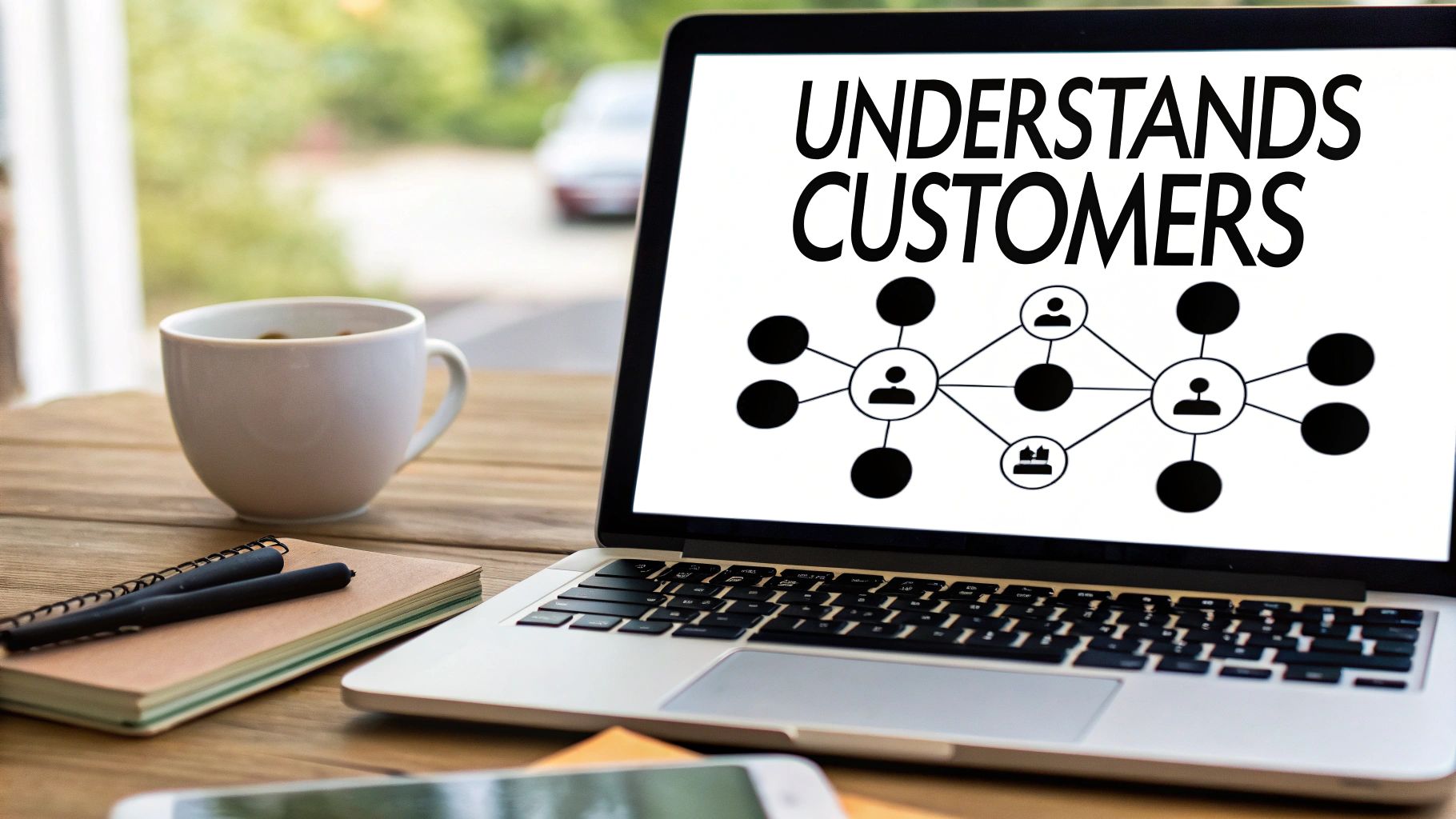
Natural Language Processing is the "brain" that lets a chatbot understand human language as it’s actually spoken—slang, typos, and all. It doesn’t just hunt for keywords; it analyzes the entire sentence to figure out what the customer is truly trying to accomplish.
For instance, a customer might type:
- "Where's my order?"
- "Can you track my package?"
- "Status on shipment #12345?"
A rule-based bot would need a specific command programmed for each of those variations. But an AI chatbot using NLP instantly recognizes that all three questions are asking for the same thing: an order update. It grasps the intent behind the words, not just the words themselves.
This allows for a much more natural, back-and-forth experience. Your customers don’t have to guess the magic phrase to get help; they can just ask their questions normally, and the AI understands.
Natural Language Processing allows AI chatbots to interpret, understand, and respond to human language in a way that is both meaningful and contextually aware. It’s the key difference between a bot that follows commands and one that holds a conversation.
Learning From Every Single Interaction
Here’s where AI really pulls away from the pack: its ability to learn and improve over time through a process called machine learning. Every conversation the chatbot has is a new learning opportunity, helping it get smarter and more effective.
If the chatbot successfully resolves a customer's issue, it remembers that successful path. If it gets stuck and has to escalate to a human agent, it learns from how your team member eventually solved the problem. This constant feedback loop ensures the chatbot's accuracy grows right alongside your business.
This means the AI chatbot you launch on day one will be even more valuable six months down the road. It adapts to your customers’ common questions, learns the unique quirks of your business, and constantly refines its ability to provide fast, accurate support. For any SMB owner, this is the core of a strategic technology investment—one that delivers compounding returns over time.
The Real-World Benefits for Your Business Operations
It’s one thing to understand the technology, but what really matters is how it impacts your bottom line. For small and mid-sized businesses, every investment must deliver a clear, measurable return. Bringing AI-powered chatbots for customer support into your workflow isn’t just about adding a modern feature to your website; it's about making tangible improvements to how your business runs day-to-day.
Let’s shift from theory to reality and look at the direct benefits that solve the everyday challenges you face with limited staff and resources.
Immediate and Measurable Cost Savings
One of the most compelling reasons to adopt an AI chatbot is the immediate relief it provides to your budget. Think about the time your team spends answering the same handful of questions over and over—"What are your hours?", "Where is my order?", "How do I reset my password?". Each of those conversations costs you in employee time and focus.
An AI chatbot takes over these repetitive tasks, letting you scale up your support without adding headcount. It can handle dozens, or even hundreds, of conversations at the same time, freeing up your human team to tackle complex issues that require critical thinking and a personal touch.
For a small business, this isn't a minor tweak. It's a strategic advantage. You get the power of a larger support team without the salaries and overhead, directly boosting your operational profitability.
Dramatic Gains in Operational Efficiency
Efficiency is the lifeblood of any successful business, especially when you’re trying to do more with less. An AI chatbot acts as a force multiplier for your team, working tirelessly around the clock.
This 24/7 availability means your business is always "on," ready to help customers long after your team has gone home. A potential client browsing your services at 10 PM on a Friday can get their questions answered instantly instead of waiting until Monday morning and possibly moving on to a competitor.
This isn't just a convenience; it's a competitive edge. Studies show that AI can handle up to 70% of routine customer inquiries, allowing your team to focus on high-value interactions. When chatbots resolve issues faster and more accurately, your entire operation becomes more productive.
An Enhanced and Consistent Customer Experience
In today's market, customer experience is what sets you apart. Nothing loses a customer's trust faster than long wait times and inconsistent answers. AI chatbots solve both problems at once.
They provide immediate responses, eliminating the frustration of sitting on hold or waiting for an email reply. That instant gratification meets modern expectations and shows you value your customers' time.
Even better, a chatbot delivers the same accurate, brand-approved answer every single time. There’s no risk of a new employee giving out the wrong information or an overwhelmed agent sounding frustrated. This consistency builds trust and reinforces a professional, reliable image.
Here’s a quick summary of how these benefits stack up for SMBs:
Practical Tip: A Quick Benefits Checklist for Your Business
| Benefit Area | Impact on Operations | Example for an SMB |
|---|---|---|
| Cost Savings | Reduces the need for additional support staff by automating repetitive inquiries. | An e-commerce store saves on hiring two extra agents by letting a bot handle 80% of order status and return questions. |
| Operational Efficiency | Provides 24/7 support, increasing lead capture and customer satisfaction without human intervention. | A local service provider captures three new leads overnight from prospects who got instant answers after business hours. |
| Customer Experience | Delivers instant, consistent, and accurate answers, eliminating wait times and building trust. | A healthcare clinic reduces phone traffic by 40% as patients get instant answers on appointment prep and insurance FAQs. |
These aren't just abstract concepts; they are practical improvements that strengthen your business from the inside out.
For a deeper dive into streamlining support, see our guide on what helpdesk support truly entails.
Real-World AI Chatbot Examples for Local Businesses
Alright, let's get down to brass tacks. The real power of an AI-powered chatbot for customer support shines when you see it solving actual problems for businesses like yours. We can skip the tech-speak and look at practical, day-to-day scenarios where this technology becomes a genuine workhorse for companies right here in Western Pennsylvania and Eastern Ohio.
This isn't about replacing your team—it’s about giving them a powerful assistant that handles the routine work, freeing them up to focus on what people do best.
For Manufacturing and Distribution Companies
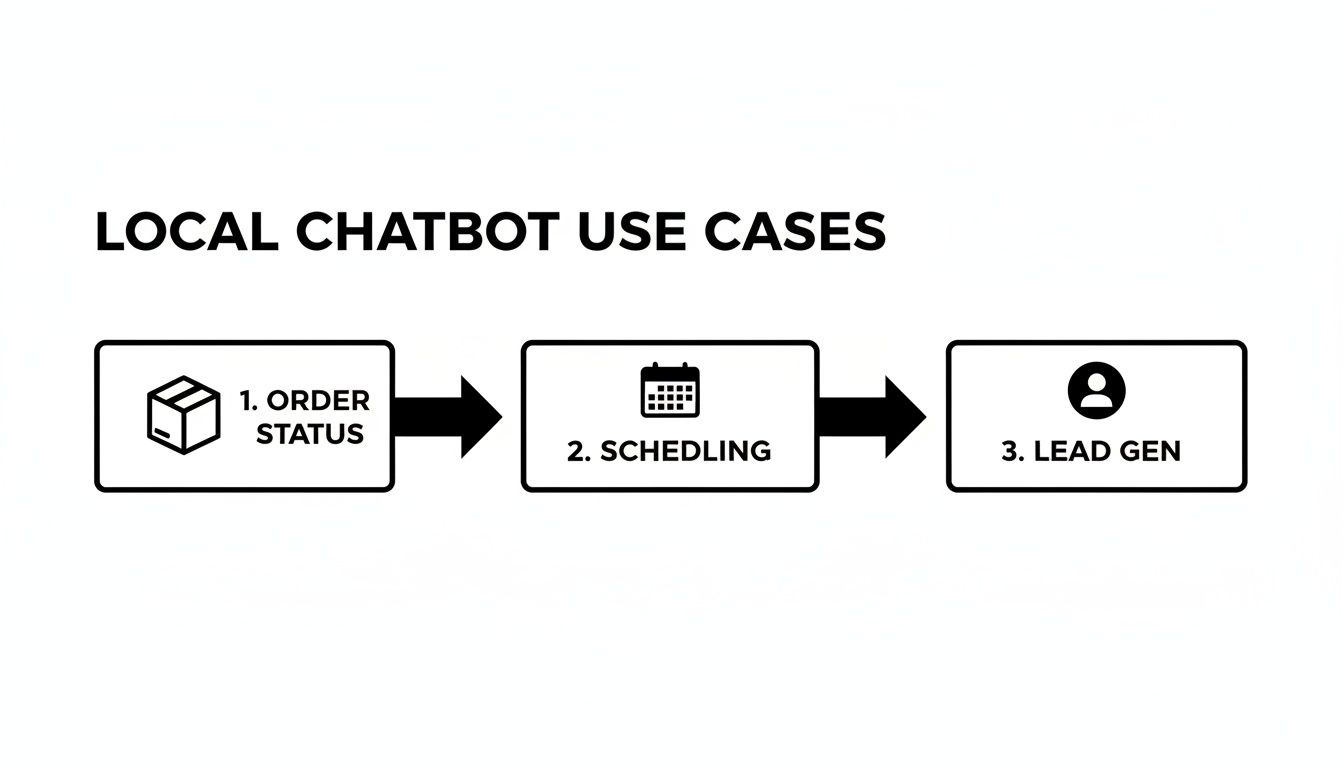
One of the biggest time-sinks for manufacturers is the constant stream of questions from distributors and clients. I'm willing to bet your team spends a huge chunk of its day answering the same things over and over: "What's my order status?", "Can you send me the spec sheet?", "Is this part in stock?".
An AI chatbot can take that entire load off their shoulders. Picture this: a distributor in Erie, PA, needs the technical specs for a specific component at 7 PM on a Tuesday. Instead of being stuck until morning, they can just ask the chatbot on your website and get an immediate, correct answer.
Here’s how that plays out in the real world:
- 24/7 Order Tracking: Your partners and customers can get instant status updates on shipments just by typing in an order number. No more phone calls.
- Instant Document Access: The chatbot acts like a digital librarian, instantly pulling up technical spec sheets, safety data sheets (SDS), or installation guides on demand.
- Inventory Checks: Distributors can check product availability in seconds without tying up your internal sales or support staff.
For Healthcare Providers and Clinics
For healthcare practices across our region, the administrative burden is a massive challenge. Your front desk is constantly fielding calls about appointment times, insurance coverage, and pre-visit instructions. That's valuable time that could be spent focused on patient care.
A secure, HIPAA-compliant AI chatbot can serve as an invaluable first point of contact.
Think about a patient in Youngstown, Ohio, trying to confirm their appointment and figure out if your clinic accepts their insurance. A chatbot handles these routine questions securely and instantly. That means less time your staff spends on the phone and less time patients spend waiting on hold.
By automating these common administrative questions, a chatbot doesn't just improve your clinic's workflow. It dramatically improves the patient experience by giving people the information they need, right when they need it.
Key uses in healthcare include:
- Appointment Scheduling and Reminders: Patients can request, reschedule, or confirm appointments through a simple, conversational chat.
- Insurance and Billing FAQs: The bot can instantly answer common questions like, "Do you take my insurance?" or explain your billing policies clearly.
- Pre-Appointment Instructions: It can provide patients with the right forms or instructions to prepare for their visit, making sure they show up ready to go.
For Professional Services and Retail Firms
If you run a law firm, an accounting practice, or a local retail shop, you know that capturing and qualifying new leads is everything. But let's be honest, not every person who visits your website is a serious prospect. Your team can burn precious hours chasing down inquiries from people who just aren't a good fit.
An AI chatbot is the perfect tool for this—it acts as a smart filter. When someone lands on your site, the bot can engage them with a few targeted questions to understand what they need, what their budget is, and how soon they're looking to act.
This means that when a conversation gets handed over to your sales team, it's with a pre-qualified, high-potential lead.
For instance, a potential client lands on a Pittsburgh-based law firm's website. The chatbot could ask about their specific legal issue. Based on the answers, the bot can either schedule a consultation with the appropriate attorney or, if it's not a match, provide helpful resources. It’s a process that respects everyone's time and focuses your team’s energy where it counts the most.
Your Step-By-Step Implementation Roadmap