For business owners in Western Pennsylvania and Eastern Ohio, keeping up with regulatory compliance can feel like trying to solve a puzzle that keeps changing shape. You’re juggling operations, managing your team, and serving customers—who has the time to become an expert on HIPAA, CMMC, or data privacy laws? This is a common pain point we see every day, and it's where Compliance as a Service (CaaS) comes in. It’s a modern approach where you partner with an expert team that handles those complex requirements for you, blending technology and specialized knowledge into a straightforward, predictable service.
Untangling the Web of Business Regulations

If you're running a small or mid-sized business, your plate is already full. Trying to add the weight of regulations like HIPAA for healthcare, CMMC for defense contractors, or PCI DSS for retailers can feel impossible, especially when you're working with a lean IT staff and an even leaner budget. This is a challenge we understand intimately because we work with SMBs facing it every day.
The reality is, ignoring compliance isn't an option. The consequences are significant, carrying both financial and reputational risks. A single misstep can lead to crippling fines, but the loss of customer trust can be even more damaging. For most SMBs, the core problem is that they simply don't have a dedicated compliance officer on the payroll to manage this full-time.
The Headaches of Old-School Compliance
This is exactly where the traditional way of handling compliance falls apart for most businesses. It’s usually a frantic, last-minute scramble to get ready for an audit or react to a new rule. It’s stressful, inefficient, and honestly, it just doesn't work. For many businesses, this cycle creates a few consistent pain points:
- Sky-High Costs: The price of one-off audits, potential fines, and hiring specialized consultants for short-term projects adds up fast.
- Wasted Time: Your team ends up spending hours they don't have trying to decipher dense legal jargon instead of focusing on what they do best—running your business.
- Constant Uncertainty: Without someone watching over it full-time, how can you be sure you’re truly protected day in and day out? A huge part of untangling these rules involves specific data protection laws, as this practical AI GDPR compliance guide details.
This reactive approach leaves your business vulnerable. Real compliance isn’t a one-and-done project; it’s a living, breathing part of your business that demands constant attention.
But what if you could tap into enterprise-level compliance management without that enterprise-level price tag? That's the promise of Compliance as a Service. It’s a proactive partnership that transforms a regulatory headache into a strategic advantage, giving you the clarity and tools needed to build a stronger, more resilient business.
What Compliance as a Service Really Means

Let's cut through the jargon. Compliance as a Service (CaaS) isn't another piece of software you buy off the shelf. Think of it more like having a dedicated tax firm on retainer, but instead of navigating the IRS, they handle the complex world of industry regulations for you. It's a true partnership, blending powerful technology with deep human expertise to manage your compliance from top to bottom.
This model is quickly becoming a necessity, not a luxury. The global CaaS market is on track to explode from $8.84 billion in 2024 to a staggering $31.30 billion by 2032. What's driving this massive growth? Ever-tightening regulations and the critical need for airtight data security. You can dig deeper into these trends by reading the full research on the CaaS market.
At its core, CaaS bundles everything a small or midsize business needs to stay compliant into a single, predictable subscription. No more juggling different vendors, pricey consultants, and confusing software. You get one point of contact and a unified strategy.
The Core Components of a CaaS Partnership
A real CaaS solution is far more than just a tool; it’s a complete operational framework. It’s built to take the heavy, often frustrating, burden of compliance off your team so you can get back to what you do best: running your business.
This service really stands on a few key pillars:
- Continuous Risk Assessments: This isn't a one-and-done checkup. Your CaaS partner is constantly scanning your systems and processes for weak spots, making sure you know about potential risks before they turn into full-blown crises.
- Automated Security and Compliance Monitoring: Specialized tools are working around the clock—24/7—to watch your network, track who's accessing what, and flag any activity that breaks the rules. This automation is vital for catching issues the second they happen.
- Policy Development and Management: Creating and maintaining compliant policies is a huge job. A CaaS partner helps you write, document, and update every necessary procedure to meet the specific standards your industry demands.
The real magic of Compliance as a Service is the blend of automated tools with a human expert’s oversight. It’s having someone on your side who understands both the technology and the fine print of your industry's regulations.
Expert Guidance at Every Step
Perhaps the single most valuable part of CaaS is getting access to strategic expertise, often through a virtual Chief Information Security Officer (vCISO) or virtual Chief Information Officer (vCIO). For most SMBs, hiring a full-time executive for this role just isn't financially feasible.
A vCIO gives you that high-level guidance without the C-suite salary. They step in to:
- Translate dense regulatory language into a clear, actionable game plan.
- Help you prepare for and confidently handle official audits.
- Make sure your compliance efforts actually support your bigger business goals.
This guidance turns compliance from a painful, technical chore into a strategic advantage. When you partner with a CaaS provider, you're not just buying a service; you’re adding a dedicated expert to your team who is focused on protecting your business and helping it grow securely.
Gaining a Competitive Edge with CaaS
Knowing what Compliance as a Service (CaaS) is sets the stage, but the real story is what it can do for your business. For small and mid-sized companies here in our region, CaaS isn't just about ticking boxes on a regulator's checklist. It's a strategic move that sharpens efficiency, hardens your security, and opens doors to new opportunities.
This mindset flips compliance from a purely defensive cost center into a proactive advantage. There’s a reason the Compliance as a Service market is booming—it gives SMBs a clear path to navigate complex rules without having to build a massive internal department. The market is set to hit USD 12,500 million globally by 2025, growing at a blistering 15% annually, all thanks to the ever-growing maze of data privacy and cybersecurity regulations. You can dig into the numbers behind this explosive growth and see how businesses are responding by learning more about these market insights.
Slashing Costs and Boosting Efficiency
Let’s be honest: one of the first things that jumps out about CaaS is the potential for serious cost savings. Trying to build a compliance team from scratch is a massive financial undertaking for any SMB. You're not just paying salaries for hard-to-find experts; you're also on the hook for constant training and expensive monitoring software.
CaaS turns that entire model on its head. Instead of a huge upfront capital investment, compliance becomes a predictable, manageable operating expense. This shift gives you access to enterprise-grade expertise and tools for a fraction of the cost, and you can say goodbye to those surprise bills from one-off audits or emergency consulting gigs.
Fortifying Your Cybersecurity Defenses
Compliance and cybersecurity are two sides of the same coin—you really can't have one without the other. A smart CaaS strategy directly strengthens your security posture because it forces your defenses to align with the specific regulations you face, whether that's HIPAA, CMMC, or PCI DSS.
Instead of applying generic, one-size-fits-all security measures, a CaaS provider ensures your protocols are purpose-built to meet legal standards. This targeted approach is incredibly effective at closing critical security gaps that might otherwise go unnoticed. Your compliance framework literally becomes an active layer of defense against threats like ransomware and data breaches.
Turning Compliance into a Growth Engine
Perhaps the most powerful benefit of all is how CaaS frees up your team to focus on what actually moves the needle: innovation and growth. When your key people are no longer drowning in the tedious, time-sucking work of compliance management, they can pour that energy back into improving products, delighting customers, and chasing new market opportunities.
By automating and managing the compliance lifecycle, CaaS removes a major operational bottleneck. It lets you operate with more agility, knowing your regulatory duties are being handled by seasoned pros.
This operational freedom builds something invaluable: trust. When you can confidently show customers, partners, and investors that you’re serious about compliance, you're sending a powerful message. It says you're a reliable, secure, and professional organization—a huge differentiator in a crowded market.
To put it all in perspective, let’s see how this modern approach stacks up against the old way of doing things.
Comparing In-House Compliance vs. Compliance as a Service
The choice between building an in-house team and opting for CaaS comes down to cost, expertise, and your ability to adapt. For most SMBs, the comparison makes the decision pretty clear.
| Factor | Traditional In-House Team | Compliance as a Service (CaaS) |
|---|---|---|
| Cost Structure | High upfront costs (salaries, software, training) and unpredictable expenses for audits. | Predictable monthly subscription fee, turning a large capital expense into a manageable operational cost. |
| Expertise & Staffing | Requires hiring and retaining expensive, specialized full-time employees who are hard to find. | Provides instant access to a team of certified experts with broad industry experience. |
| Scalability | Scaling is slow and costly; requires hiring new staff as business or regulations change. | Easily scales up or down as your business grows or new compliance needs arise. |
| Focus & Resources | Diverts internal resources and leadership focus away from core business operations and growth. | Frees up your internal team to concentrate on innovation and serving customers. |
Ultimately, while an in-house team might seem like the ultimate form of control, CaaS offers a more practical, affordable, and scalable path for businesses focused on growth. It allows you to leverage top-tier expertise without the associated overhead, turning a regulatory burden into a true competitive advantage.
How CaaS Strengthens Your IT Foundation
Think of Compliance as a Service not as some separate, bolted-on feature, but as the blueprint for your entire IT infrastructure. It’s a strategic layer that weaves itself into the core IT services you already use, making sure everything is built not just for performance, but for resilience and regulatory alignment.
You might have a top-of-the-line firewall and the fastest server money can buy. But without an integrated compliance strategy, are they configured to meet the specific, detailed demands of HIPAA or CMMC? Probably not. CaaS is what closes that gap. It transforms your IT from a box of disconnected parts into a single, unified system where every decision is made with your compliance obligations front and center.
Integrating Compliance into Your Cybersecurity Strategy
Your cybersecurity and your compliance goals should be two sides of the same coin. A CaaS provider makes sure they are, building a security posture that’s not only strong but also fully defensible when the auditors come knocking.
This is about much more than just installing antivirus software. It’s about strategically aligning every single security measure you have with specific regulatory controls.
- Firewall and Network Security: CaaS dictates how firewall rules are set up to guard sensitive data, ensuring access controls are tight enough to meet standards like PCI DSS.
- Endpoint Protection: It provides the playbook for securing every laptop, server, and mobile device connected to your network—a critical piece of any modern security plan. To get a better handle on this, you can learn more about comprehensive endpoint security management.
- Employee Security Training: Compliance rules often mandate very specific training topics. This turns your team from a potential vulnerability into your first line of defense against phishing and other social engineering attacks.
Aligning Server Management with Data Regulations
How you store data—and where you store it—is a massive focus for nearly every compliance framework out there. CaaS provides the critical oversight to ensure your server management practices are up to snuff with strict data handling and retention rules.
This means your servers are managed not just for uptime, but for security and compliance. Your CaaS partner helps put the right controls in place to protect sensitive information, whether your servers are in a closet down the hall or in the cloud. They make sure data is encrypted, access is logged, and your backup procedures are solid enough to meet regulatory demands for disaster recovery.
The infographic below really drives home how this integrated approach delivers real, tangible benefits across the entire organization, from keeping costs in check to boosting security and enabling growth.
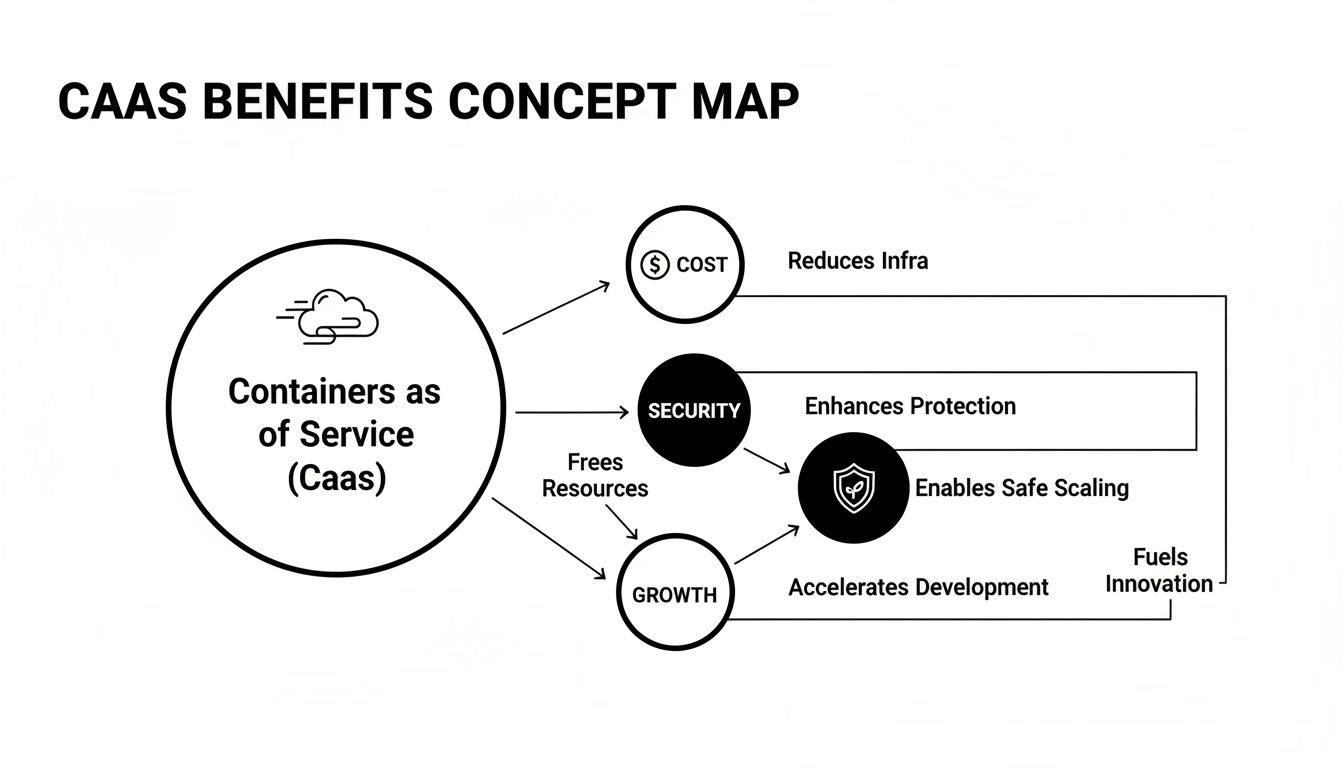
When compliance is baked into your IT strategy from the start, the result is a stronger, more efficient business that’s built to last.
Enhancing vCIO Guidance with Compliance Data
Many small and mid-sized businesses lean on a virtual Chief Information Officer (vCIO) for strategic tech guidance. When you arm that vCIO with the hard data from a CaaS platform, their recommendations suddenly become ten times more powerful.
Instead of offering generic advice, a compliance-focused vCIO can build a precise, defensible IT roadmap for your business. They use risk assessment data to prioritize investments, making sure your budget is spent where it’s needed most—plugging the most critical security and compliance gaps first.
A vCIO uses CaaS insights to turn complex regulatory language into a clear, actionable technology plan. This ensures your IT strategy doesn't just support the business; it actively protects it from regulatory risk.
This creates a powerful feedback loop. The vCIO’s strategic plan shores up your compliance, and the continuous compliance monitoring provides the data needed to tweak and refine that strategy over time. Many modern CaaS platforms come packed with sophisticated risk compliance software that automates much of this work, cutting down on manual effort and giving you a clear paper trail of due diligence.
At the end of the day, weaving CaaS into your core IT services proves that solid management and strong compliance aren’t separate goals—they’re one and the same, creating a secure and resilient foundation for your business.
How to Choose the Right CaaS Partner

Picking a provider for Compliance as a Service isn't like buying a new piece of software. It’s a significant decision. You’re essentially bringing a new partner into your business, one who will become a key part of your security and operational strategy.
The right partner acts as a trusted advisor, someone who genuinely understands the unique hurdles faced by businesses here in our region. The wrong one? They'll just leave you with generic tools and disappear when you need real-world support. To make the right call, you have to look past the sales pitch. You need an ally who can act as an extension of your team, delivering both the technology and the expert guidance to navigate tricky rules like HIPAA or CMMC.
Look for Deep Industry and Regional Expertise
The very first filter should be experience. You need someone who has worked with businesses just like yours. Compliance isn’t a one-size-fits-all game; the rules for a manufacturing plant in Western Pennsylvania are worlds away from those for a healthcare clinic over in Eastern Ohio.
Don’t be shy about asking direct questions about their track record:
- Industry Focus: Have they actually guided other companies in your specific industry (e.g., manufacturing, healthcare, professional services) through audits? Can they talk fluently about the regulations you deal with every single day?
- Regional Knowledge: Do they get the local business climate? Are they aware of any state-specific data privacy laws that might affect you?
- Case Studies: Can they show you real-world examples or share testimonials from businesses of a similar size?
A partner with proven experience in your sector won't waste your time—or your money—learning the basics. They’ll come to the table with a ready-made playbook and a solid grasp of your specific risks. That’s a massive head start.
Evaluate Their Technology and Integration Capabilities
While human expertise is critical, the technology platform is what makes everything run. The tools need to be powerful enough for continuous monitoring and reporting but simple enough that your team can actually understand and use them.
When you’re evaluating providers, dig into how their system really works:
- System Integration: How smoothly does their platform plug into your existing IT setup—your firewall, servers, and cloud services? A seamless integration is non-negotiable.
- Reporting and Dashboards: Does their platform give you clear, easy-to-read reports that show your compliance status in real-time? You should be able to see your risk level at a glance.
- Automation: How much of the compliance monitoring and evidence gathering is automated? The more automation, the less tedious manual work for your people.
A partner’s technology should make complex things simple, not add another headache. This whole evaluation process is a core part of managing any third-party relationship. For more on this, check out our guide on IT vendor management best practices.
Your ideal partner is one whose technology supports and simplifies your operations, providing clear visibility into your compliance efforts without creating unnecessary friction for your team.
Finding the right CaaS provider means finding a long-term partner who is committed to your security and success. Look for a team that prioritizes clear communication, demonstrates deep expertise, and offers a tech solution that fits your specific business.
Your Practical CaaS Provider Checklist
To help you vet and compare potential partners, we've put together this practical checklist. Use it to structure your conversations and make sure you're covering all the important bases.
| Evaluation Criteria | Key Questions to Ask | Notes or Vendor Score |
|---|---|---|
| Industry & Regulatory Expertise | Do you have experience with [Your Industry]? Which specific regulations (e.g., HIPAA, CMMC, PCI DSS) do you specialize in? Can you provide case studies from similar businesses? | |
| Technology & Platform | Can we see a live demo of your platform? How does it integrate with our current systems (firewall, cloud, etc.)? What level of automation is involved in monitoring and reporting? | |
| Onboarding & Implementation | What does the implementation process look like? How long does it typically take? What resources will we need to provide from our end? | |
| Support & Partnership Model | Who is our main point of contact? What are your support hours and service level agreements (SLAs)? How do you handle a failed audit or compliance incident? | |
| Reporting & Visibility | What kind of reports can we generate? Are the dashboards customizable? How do you help us prepare for an audit? | |
| Pricing & Contract Terms | What is included in the monthly fee? Are there any hidden costs for implementation or support? What are the contract length and termination clauses? | |
| Local Presence & Understanding | Do you have clients in Western PA or Eastern OH? Are you familiar with any local or state-level regulations that might apply to us? |
After going through this checklist with a few potential providers, a clear winner should start to emerge—one that not only ticks the boxes but also feels like the right cultural fit for your team.
Your Path to Simplified Compliance
For too long, small and mid-sized businesses in Western Pennsylvania and Eastern Ohio have treated regulatory compliance like a recurring nightmare—a costly, reactive burden that does little more than check a box. But what if that approach is all wrong? The truth is, navigating the world of regulations doesn't have to be a roadblock. With the right strategy, this complex challenge can become a powerful advantage, strengthening your entire operation from the inside out.
That's where Compliance as a Service (CaaS) comes in. It’s the key to shifting your business away from frantic, last-minute audit preparations and into a state of continuous readiness. By partnering with an expert provider, you're getting far more than just peace of mind; you're building a more efficient, resilient, and trustworthy organization. A proactive compliance posture is a core part of a healthy IT environment, just like keeping your systems updated. To see how this fits into the bigger picture, you can explore our guide on what is patch management.
From Burden to Business Advantage
Ultimately, Compliance as a Service isn’t a separate, siloed task. It integrates deeply with your overall security and IT management, creating a unified foundation for success. You’re not just dodging fines—you’re protecting your customers’ data, defending your hard-earned reputation, and freeing up your team to focus on what they do best: innovation and growth. This proactive stance turns a former operational headache into a clear competitive edge.
The journey to simplified compliance starts with a simple conversation. Here at Eagle Point Technology Solutions, we help businesses across our region understand their unique compliance posture and build a clear, actionable roadmap forward.
Let us show you how a tailored CaaS solution can protect your business today and support your long-term goals for tomorrow.
Ready to turn your compliance challenges into a strategic asset? Contact us today for a consultation and discover how we can help secure your business's future.
Frequently Asked Questions About CaaS
Even with a clear picture of the benefits, we get it—jumping into a new service model like Compliance as a Service always raises questions. As a trusted advisor to SMBs across Western Pennsylvania and Eastern Ohio, we hear the same practical concerns from business leaders time and again. Getting clear, straightforward answers is the first step toward making a confident decision for your company’s future.
We've put together some of a few common questions we field about CaaS right here.
What Regulations Can CaaS Help With?
One of the first things business owners ask is, "What exactly can you handle for me?" The answer is that a good CaaS solution isn't a one-size-fits-all product. It’s a flexible service built around the specific regulations impacting your industry.
While it’s not an exhaustive list, a capable CaaS partner can help your business get right with a wide range of common frameworks, including:
- HIPAA: Absolutely essential for any healthcare practice, clinic, or any business associate that touches protected health information (PHI).
- CMMC: A non-negotiable requirement if you're in the Department of Defense (DoD) supply chain—from prime contractors down to the small local machine shops.
- PCI DSS: If your company accepts, processes, stores, or transmits credit card information in any way, this applies to you.
- Data Privacy Laws: We provide guidance on navigating the maze of state-specific regulations like California's CCPA/CPRA and other emerging privacy laws that dictate how you handle customer data.
The key takeaway is that Compliance as a Service is a partnership designed to address your specific regulatory headaches, not someone else's.
Is CaaS Only for Large Companies?
This is probably the biggest misconception out there. Many small and mid-sized business owners see the enterprise-level expertise CaaS provides and assume it comes with a painful, enterprise-level price tag. The reality is the complete opposite.
CaaS is specifically built to be scalable and affordable, making it a perfect fit for SMBs. It gives you access to a team of compliance pros and sophisticated monitoring tools for a predictable monthly fee. This helps you avoid the massive capital expense of hiring a full-time compliance officer, whose salary can easily top six figures. The model delivers the expertise you desperately need without the overhead you can't afford.
How Long Does It Take to Implement a CaaS Solution?
Setting realistic expectations here is crucial. While CaaS simplifies compliance in the long run, getting started isn’t like flipping a switch. The timeline really depends on where your company is today—your current compliance maturity, your size, and how complex the regulations are that you're facing.
Generally, you can expect a phased approach:
- Initial Assessment & Gap Analysis (1-4 weeks): First, we do a deep dive into your current policies, procedures, and tech to see where you stand and identify the gaps.
- Remediation & Policy Development (4-12 weeks): Based on that assessment, we work with you to fix vulnerabilities, write the required policies, and put the necessary controls in place.
- Ongoing Monitoring & Management: Once that foundation is solid, the service shifts into a continuous cycle of monitoring, reporting, and making sure you stay on track.
A good partner will give you a clear, transparent roadmap from day one. We’ll work alongside you to make the process as smooth as possible, keeping disruptions to your day-to-day operations to a minimum.
Is CaaS Different Than Just Buying Compliance Software?
Yes, and this is a critical distinction. Buying compliance software is like buying a truck full of high-end power tools. The tools might be fantastic, but they don't do you much good if you don't have a skilled carpenter who knows how to use them.
Compliance software gives you the "what"—the platform for tracking tasks and storing evidence. Compliance as a Service provides the "who" and the "how"—the expert guidance, strategic planning, and hands-on support you need to actually interpret regulations, make smart decisions, and manage the entire process.
Software can’t sit with you during an audit. It can't translate a regulator’s confusing request into actionable steps, and it certainly can't build a strategic compliance roadmap for your business. A CaaS partner does all of that. This human element is the single biggest differentiator and where the real value lies.
Ready to transform your compliance from a burden into a strategic advantage? The team at Eagle Point Technology Solutions is here to provide the expert guidance and support your business needs to thrive securely.