
That complex insurance renewal questionnaire sitting on your desk? It’s more than just another form to fill out—it's a sign of a massive shift in how we think about business risk. For small and medium-sized businesses across Western Pennsylvania and Eastern Ohio, getting a handle on cybersecurity insurance requirements has become just as critical as managing general liability. Insurers are now demanding specific, verifiable security controls before they’ll even consider offering you a policy.
Why Cyber Insurance Is No Longer Optional for Your Business
It wasn't that long ago that cyber insurance felt like an optional add-on, something only the big corporations really needed. Today, for any business trying to thrive in our region, it’s an essential safety net. The reason is simple: the frequency and sophistication of cyber threats have exploded, and insurers are reeling from the massive financial losses paid out in claims.
This new reality can feel pretty overwhelming for SMBs. You're not just trying to run a business anymore; you're now expected to maintain a sophisticated security posture just to stay in the game, often with limited time and a tight budget.
The Real-World Threats Targeting Businesses Like Yours
Cybercriminals have small businesses square in their sights. Why? Because they know you often have fewer security resources than a massive corporation, making you a "soft target" for attacks that are incredibly profitable. Insurers are on the front lines of these incidents, and the requirements they’re setting are a direct reflection of the threats they see impacting businesses like yours every single day.
The biggest driver behind these tough new rules is ransomware. One click is all it takes to halt your operations in an instant, locking up everything from your customer data to your accounting files. The costs can be absolutely devastating and go way beyond the ransom demand itself:
- Financial Loss: You're on the hook for ransom payments, yes, but also potential regulatory fines and steep legal fees.
- Operational Downtime: Imagine being unable to manufacture your product, serve customers, or even process payments for days or weeks. For an SMB, that kind of disruption can be a knockout blow.
- Reputational Damage: Losing the trust of your customers and partners can cause long-term damage that's harder to measure but just as destructive as the financial hit.
Underwriters aren't just pulling these rules out of thin air. They're using mountains of claims data to pinpoint the absolute minimum security controls needed to stop the most common and costly attacks. Their requirements are, in effect, a road map to building a stronger defense.
This means cyber insurance is no longer just a financial product. The application process itself now acts as a critical security audit. Failing to meet these baseline cybersecurity insurance requirements doesn't just leave you without coverage; it’s a flashing red light that your business is dangerously vulnerable. Your ability to get insured is now directly tied to how seriously you take these foundational security practices.
Decoding the Top Cybersecurity Insurance Requirements
Think of applying for cyber insurance like getting a home inspection. Before a sale, an inspector checks for working smoke detectors, solid locks, and a good roof to make sure the house is a safe bet. In the same way, insurance underwriters are inspecting your digital "house." They're looking to see if you have the fundamental protections in place to keep the bad guys out.
Those technical terms on the application aren't just there to confuse you; they're the digital deadbolts and alarm systems that insurers know from experience are effective at stopping the most common—and costly—cyberattacks. Let's break down a few of the non-negotiables you'll find on almost every cybersecurity insurance requirements list.
Multi-Factor Authentication (MFA)
This is a big one. MFA is a security step that forces users to prove their identity in more than one way before they can get into your network or applications. It’s just like using an ATM—you need your bank card (something you have) and your PIN (something you know).
Why do insurers insist on it? Because stolen passwords are the number one way criminals simply walk right into your network. MFA acts as a powerful second lock on the door, making a compromised password almost useless by itself. For most carriers, no MFA is a deal-breaker, plain and simple.
Endpoint Detection and Response (EDR)
Think of EDR as a high-tech security guard actively monitoring every single company device—laptops, servers, you name it. It's a huge step up from traditional antivirus software, which mostly just checks for a list of known threats. EDR, on the other hand, watches for suspicious behavior, allowing it to spot and shut down new or advanced attacks before they can cause any real damage.
Insurers see endpoints as the front lines of the cyber war. EDR gives you the eyes and ears needed to contain a breach the moment it happens, which dramatically shrinks the potential damage and, by extension, the size of an insurance claim.
Secure and Verifiable Data Backups
This isn't just about having copies of your data. It’s about having multiple copies, with at least one stored completely offline or "air-gapped" where malware can't touch it. Even more important, insurers want to see proof that you regularly test your backups to make sure you can actually restore your files when you need them most.
Ransomware is the single biggest driver of cyber insurance claims today. A clean, isolated backup is your get-out-of-jail-free card, letting you restore operations without paying a massive ransom. It’s the ultimate safety net, and underwriters prioritize it heavily.
To give you a better sense of what's at stake, this diagram shows how a single cyber incident can ripple across your entire business.
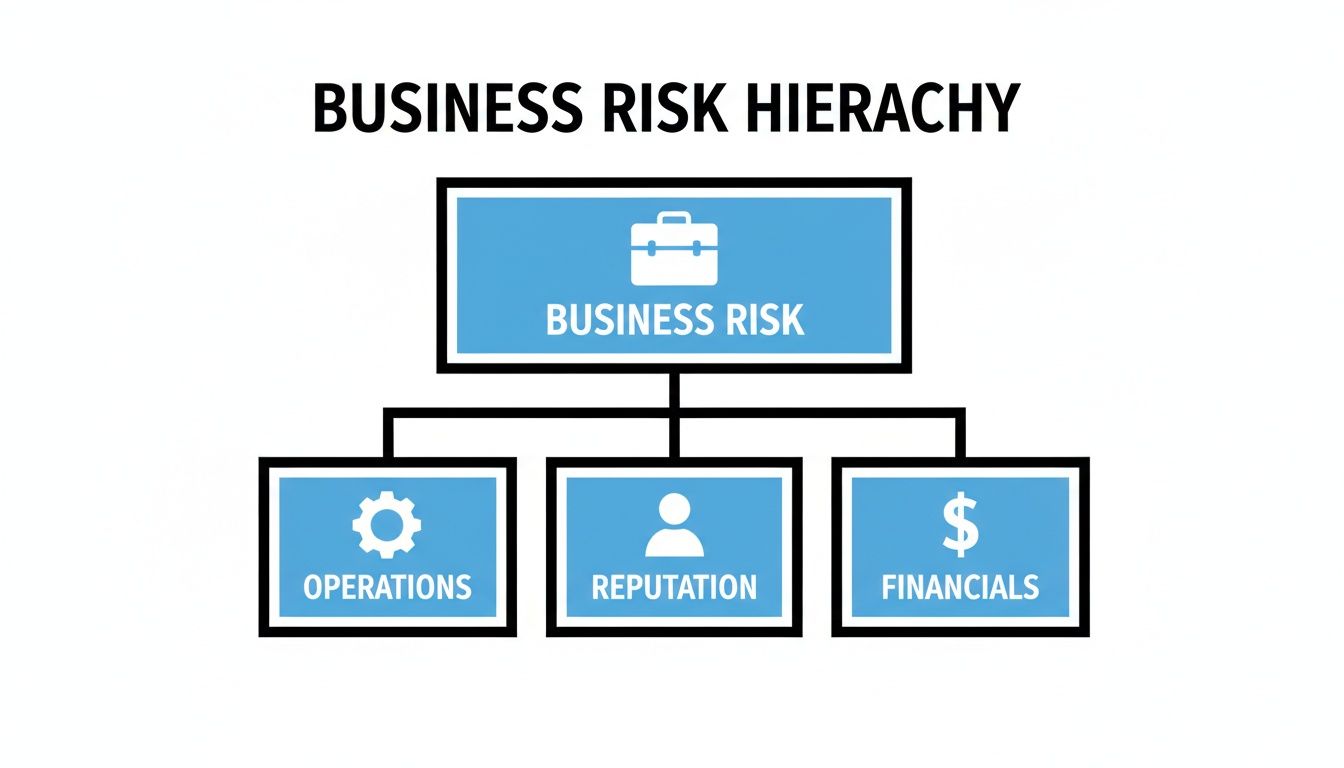
As you can see, this isn't just an IT problem. A cyberattack directly hits your operations, your finances, and your reputation in the community.
Employee Security Awareness Training
At the end of the day, your team is your first line of defense—but they can also be your biggest vulnerability. Security awareness training involves teaching your employees how to spot and report threats like phishing emails, which are designed to trick them into giving up passwords or clicking on malicious links. This should always include simulated phishing tests to see who takes the bait.
Insurers know that a savvy, well-trained employee can stop a breach before it even starts. Having documented, ongoing training shows you're serious about reducing the risk of human error, which is a factor in the vast majority of all cyber incidents.
For many companies, these controls are also connected to broader regulatory rules. For example, proving you have strong internal security is a key part of Sarbanes-Oxley cyber security compliance, and those standards often overlap with what insurance underwriters are looking for. Each of these requirements works together to build a layered defense that protects your business and gives insurers the confidence to underwrite your policy.
How Insurers Verify Your Cybersecurity Controls
In the early days, getting cyber insurance might have felt pretty straightforward—a simple transaction based mostly on your company’s size and industry. Not anymore. Today, insurers act a lot more like auditors. They aren’t just taking your word for it; they’re digging in to verify your security controls with a level of scrutiny that often catches business owners by surprise.
If you want to land a policy, you need to understand exactly how they check your work.

This shift from "trust" to "verify" isn't happening in a vacuum. It's a direct response to the massive financial hits insurers have taken from paying out cyber claims. An underwriter's entire job is to price risk accurately, and they simply can't do that without hard proof that your defenses are what you say they are. This means their verification process now involves a mix of methods designed to get a crystal-clear picture of your security posture.
The Underwriting Toolkit
When you apply for a new policy or go to renew your existing one, insurers pull from a standard toolkit to validate the information you’ve provided. You should expect to see at least one of these methods, and quite often, all three.
- Detailed Questionnaires: This is where it all starts. Forget simple yes/no questions. Modern applications are lengthy, technical documents that demand specifics about your security tools, how they’re configured, and what your policies look like. You’ll have to formally attest that controls like MFA and EDR are rolled out across the entire organization, not just parts of it.
- Documentation Requests: Get ready to show your homework. Underwriters will frequently ask for copies of key documents to back up your claims on the questionnaire. This usually includes your formal Incident Response Plan, disaster recovery procedures, and records from employee security training. Having this paperwork organized and ready to go shows them you have a mature, proactive security program.
- External Vulnerability Scans: This one is becoming more common. Some insurers will now run their own non-intrusive scans on your company's internet-facing systems. These scans hunt for obvious weaknesses—things like open ports or outdated software—that a hacker could easily spot and exploit. A clean scan gives them powerful, independent proof of your basic security hygiene.
Think of the verification process as an open-book test. The insurer tells you exactly what they're looking for. Your job is to provide clear, accurate, and verifiable answers that prove you have the required controls in place and are actively managing them.
Why Documentation Matters So Much
For many small and medium-sized businesses with lean IT teams, creating and maintaining formal documentation can feel like a major administrative headache. We get it. But from an insurer's point of view, it's non-negotiable. It’s the only real proof they have that your security practices are intentional and repeatable, not just stuck in one person’s head.
A well-documented security program signals to underwriters that you're serious about managing risk. It proves you have procedures to guide your team during a crisis, which drastically reduces the chances of a chaotic and costly response.
If you’re just starting to formalize your procedures, looking at some incident response plan examples can give you a fantastic framework to build from. This kind of proactive work doesn't just make the application process smoother; it can also position your business as a lower-risk client, potentially leading to better policy terms and more favorable premiums.
Navigating the Tough New Cyber Insurance Market
If you’ve recently tried to renew your cyber insurance policy and been hit with some serious sticker shock, you’re definitely not alone. Premiums are shooting up, the application forms are getting longer and more complicated, and the insurance companies are asking much tougher questions than they used to.
This isn’t just some random price gouge. It's a direct result of a market that has been completely shaken up by the staggering number and cost of recent cyberattacks. Understanding what’s happening behind the scenes helps you reframe your security spending. It stops being a grudge purchase and starts being a strategic tool to get the coverage you need at a price you can actually afford.
A Classic Case of Supply and Demand
What's happening in the cyber insurance world is a textbook example of supply and demand. Just a few years back, major attacks were less common and the payouts were manageable. Insurers were happy to write policies left and right, which meant there was a high supply of coverage available.
Fast forward to today, and that picture has been turned completely upside down. Ransomware and sophisticated email scams have caused a massive spike in claims, costing insurance carriers billions. As a result, many have either left the market or significantly tightened their belts, shrinking the supply of available coverage. At the same time, more small and midsize businesses than ever are trying to get a policy, sending demand through the roof.
When demand skyrockets and supply shrinks, prices go up, and the sellers get to be picky. Insurers are now in the driver's seat, and they’re only offering policies to businesses that can prove they are a safe bet.
This shift means that being proactive about your security is now the single best thing you can do to control your premiums. When you implement the security controls underwriters are looking for, you’re actively showing them that your business is a lower-risk investment.
The Scale of the Cyber Insurance Market
This trend isn't a small blip on the radar. The cyber insurance industry is growing at an incredible pace as businesses scramble to protect themselves from ever-present threats.
The global cyber insurance market was valued at $16.7 billion in 2023, and analysts project it will soar to $84.6 billion by 2030. But even with that massive growth, the entire sector still makes up less than 1% of the global property and casualty insurance market.
That tells us there's a huge runway for growth—and more importantly, for constantly evolving cybersecurity insurance requirements as the market matures. You can read the full research about these market dynamics to get a better sense of where things are headed. This rapid expansion is putting even more pressure on underwriters to get their risk calculations right, which is why they’re digging so much deeper during the application process.
What This Means for Your Business
For a business owner here in Western Pennsylvania or Eastern Ohio, this new market reality has very direct consequences. You can no longer just assume you’ll get a policy, or that it will be affordable if you do. The steps you take today to strengthen your security will directly determine your ability to get insured tomorrow.
Here are the key takeaways for your business:
- Your security posture dictates your premium. The stronger your defenses are, the better your chances of getting favorable terms and pricing.
- Coverage is not a given. If you fail to meet basic requirements, like having multi-factor authentication (MFA) in place, you could be denied coverage outright.
- Security is a business decision, not just an IT problem. The return on investment for tools like Endpoint Detection and Response (EDR) is now clearly visible in your ability to transfer risk through an insurance policy.
At the end of the day, navigating the new world of cybersecurity insurance requirements is all about proving you’re a responsible partner in managing risk. By taking the right steps, you not only protect your business from attack but also make yourself a much more attractive client in a very tough insurance market.
Your Practical Checklist for Insurance Readiness
Knowing the theory behind cybersecurity insurance requirements is one thing, but actually putting that knowledge into practice is what gets your business across the finish line. To help you get from planning to doing, we’ve put together a practical checklist. This isn’t meant to be a formal audit, but it’s an incredibly powerful self-assessment tool to help you find the gaps and prioritize what to fix before you even start filling out applications.
Think of it as your pre-flight check. By going through these core areas one by one, you can turn a daunting process into a series of clear, manageable steps. You'll walk away with a much clearer picture of where you stand.

Cyber Insurance Readiness Checklist for SMBs
Here’s a hands-on checklist designed to help you gauge your security posture against the most common requirements underwriters look for. Use it to track your progress and identify areas needing immediate attention.
| Security Domain | Key Action Item | Status (Not Started / In Progress / Complete) |
|---|---|---|
| Access Control | Enable Multi-Factor Authentication (MFA) for all users on email, remote access (VPN), and critical cloud apps. | |
| Implement a Privileged Access Management (PAM) process to strictly control and monitor admin accounts. | ||
| Enforce a strong, modern password policy that prohibits weak or reused passwords. | ||
| Endpoint & Network Security | Deploy Endpoint Detection and Response (EDR) on all servers and workstations. | |
| Regularly review and update firewall rules to remove unnecessary permissions. | ||
| Establish a consistent patch management process to apply security updates promptly. | ||
| Data Protection & Recovery | Perform regular, automated backups of all critical business data. | |
| Maintain immutable or air-gapped backups that are isolated from the network. | ||
| Routinely test your data recovery process to ensure it works as expected. | ||
| Policies & People | Document a formal Incident Response Plan (IRP) detailing steps to take during a breach. | |
| Conduct regular security awareness training for all employees, including phishing simulations. | ||
| Create a vendor risk management process to assess the security of third-party partners. |
Walking through this checklist does more than just get you ready for an insurance application—it genuinely strengthens your company’s defenses against real-world threats. It’s a win-win.
A Deeper Dive Into The Checklist Items
Let's break down why each of these items is so critical in the eyes of an underwriter.
Access Control and Identity Management
This is all about making sure only the right people can access the right data, and only when they absolutely need to. Insurers see sloppy access controls as leaving the front door wide open for attackers. They'll be looking for things like Multi-Factor Authentication (MFA) on everything—email, VPNs, critical apps. A partial deployment just doesn't cut it anymore.
They also want to see that you’re managing your "super user" accounts with a Privileged Access Management (PAM) strategy. These admin accounts hold the keys to the kingdom and need to be locked down and monitored.
Endpoint and Network Security
Your laptops, servers, and the network that connects them are the front lines of your defense. Insurers need to see that you have more than just basic antivirus software running. A solution like Endpoint Detection and Response (EDR) is pretty much a non-negotiable requirement today.
Your firewall configuration also matters. Is it set up correctly? Are you reviewing the rules to get rid of old permissions that are no longer needed? And critically, do you have a reliable system for patch management? Unpatched software is one of the easiest ways for hackers to get in.
Data Protection and Recovery
This is your safety net. If you get hit with ransomware, your ability to recover data without paying the ransom is what an insurer cares about most. It's not enough to just perform regular backups.
The golden ticket here is having at least one offline or immutable backup copy—one that’s air-gapped and totally isolated from your network. This is your last line of defense. Just as important, have you actually tested your ability to restore from those backups? An untested backup plan is just a theory.
Policies and People
Technology alone can't save you. Underwriters need to see that you have solid processes and a security-conscious team. This means having a documented Incident Response Plan (IRP) so everyone knows exactly what to do when things go wrong.
It also means you’re running regular security awareness training for your employees, complete with simulated phishing tests to keep them sharp. Finally, they'll want to know if you have a process for vetting the security of your key vendors and partners, because their weakness can easily become your breach.
This checklist is a fantastic starting point, but a formal risk assessment is the best way to dig deep and find those hidden vulnerabilities. We’ve created a helpful cybersecurity risk assessment template to walk you through a more detailed evaluation.
Tackling these items won't just make the underwriting process smoother; it will fundamentally make your business safer. To see how these controls fit into a broader policy, you can also review a comprehensive cyber insurance coverage checklist that details key protections. Taking these steps shows an insurer you're a serious, low-risk partner worth covering.