When you hear "cybersecurity risk assessment," what comes to mind? For many small to midsize business (SMB) owners, it sounds complex and expensive. But let's break it down. At its core, a risk assessment is a proactive, expert review of your company's technology, processes, and even employee habits to find digital weak spots. It’s about understanding your vulnerabilities—including those introduced by cloud solutions and AI tools—before a hacker does.
The whole point is to give you a clear, prioritized roadmap to strengthen your defenses against very real threats like ransomware and data breaches that can cripple a small business.

Understanding Your Digital Foundation
Think of your business's technology like the foundation of a house. Over time, tiny, unnoticed cracks can appear. If you ignore them, you risk major structural damage down the road. A cybersecurity risk assessment is that professional inspection, where an expert methodically checks every digital entry point, system, and policy to find those hidden cracks. For small and midsize businesses, this isn't about finding fault—it's about gaining clarity and control.
The goal is to shift from a reactive, "what-if" mindset to a proactive, strategic one. Instead of waiting for a data breach to force your hand, an assessment gives you a professional inventory of your most critical digital assets—whether on-premise or in the cloud—and the specific threats they face. This is fundamental for protecting the sensitive customer data, financial records, and proprietary info that your business depends on.
What Does an Assessment Actually Uncover?
So, what happens during an assessment? It's much more than just a technical scan. It's a structured analysis designed to answer three key questions every business owner should be asking:
- What are our most important digital assets? This isn't just servers. It includes your customer databases, financial software, cloud accounts (like Microsoft 365 or AWS), and even the AI tools your team uses daily.
- What are the biggest threats to those assets? Threats can come from anywhere—external hackers launching ransomware, or internal risks like an employee accidentally clicking a bad link or using unvetted cloud services.
- What’s the business impact if something goes wrong? Understanding the potential fallout in terms of financial loss, operational downtime, and damage to your reputation helps you decide what to fix first.
By answering these questions, cybersecurity risk assessment services translate complicated tech jargon into plain business language. While a formal assessment is key, it should complement general best practices. Brushing up on foundational cybersecurity tips for small businesses is always a smart move.
The most valuable part of a risk assessment is the prioritized action plan it delivers. You won't get an overwhelming list of problems. Instead, you'll receive a clear guide on which vulnerabilities pose the greatest danger, so you can put your time and money where they'll have the biggest impact.
To make this even clearer, here's a look at the typical stages involved and what they mean for your business.
Core Components of a Cybersecurity Risk Assessment
| Component | Purpose for Your Business |
|---|---|
| Asset Identification | We figure out what's most valuable to you—your "crown jewels" like customer data, cloud solutions, financial systems, and intellectual property. |
| Threat Identification | We identify the specific dangers you face, from industry-specific threats like ransomware to common risks like phishing and cloud misconfigurations. |
| Vulnerability Analysis | This is where we find the "cracks"—things like unpatched software, weak passwords, or gaps in your network and cloud security. |
| Risk Analysis | We connect the dots: What's the likelihood of a specific threat exploiting a vulnerability, and what would the damage be? |
| Prioritized Recommendations | You get a practical, actionable plan that tells you exactly what to fix first based on risk level and business impact. |
This structured process demystifies your security posture and gives you a clear path forward.
From Vulnerability to Resilience
Ultimately, the real power of a risk assessment is that it builds resilience. It empowers you to make informed decisions based on data, not just fear. By methodically finding and fixing risks, you don't just strengthen your defenses. You also show your clients, partners, and employees that you take security seriously, which is a huge part of building trust.
It’s an investment in stability and long-term success, turning your technology from a potential liability into a secure foundation for growth.
Why Your Business Is a Bigger Target Than You Think
It’s a dangerous assumption I hear all the time from small business owners: "We're just too small to be a target." As someone who's spent years on the front lines of cybersecurity, I can tell you the opposite is true.
Cybercriminals aren't always hunting for big-name corporations. More often, they're looking for the path of least resistance. To them, a small or midsize business with limited security resources isn't just an easy target—it's a golden opportunity. The rapid adoption of cloud solutions and AI has expanded the attack surface for SMBs, often without them even realizing it.
Attackers often see smaller businesses as valuable stepping stones into larger supply chains. Your company might be a trusted supplier for a major corporation, and compromising your network gives them a backdoor to a much, much bigger prize. Whether you realize it or not, that makes you a critical link in their chain.
The Real-World Consequences of an Attack
Let me tell you about a mid-sized manufacturing supplier. They were convinced their security was "good enough," but a single, well-crafted phishing email was all it took to unleash a full-blown ransomware attack. Their entire operation ground to a halt. For over a week, servers were locked, and critical production data was completely inaccessible.
The immediate hit was devastating, but the ripple effects were even worse. They were staring down:
- Operational Downtime: Production lines went silent. Shipping deadlines were blown. Every hour they were offline cost them thousands in lost revenue.
- Damaged Client Relationships: They had to make those dreaded calls to their largest clients, explaining the breach. It led to some incredibly difficult conversations and a loss of trust that took months to rebuild.
- Unexpected Costs: On top of the ransom demand, they had to pay for emergency IT services, legal consultations, and even fines for not meeting data protection regulations.
This isn't just some scare tactic or a worst-case scenario; it's a common reality for businesses that underestimate their risk. If you're just getting started, our introduction to cybersecurity for small businesses is an excellent place to build a solid foundation.
Shifting from Expense to Strategic Investment
The demand for cybersecurity risk assessment services has shot up for one simple reason: the cost of a breach is skyrocketing. Projections show that cybercrime is expected to cost businesses a staggering $10.5 trillion by 2025. That number alone should tell you everything you need to know about the financial threat we're all facing.
But a risk assessment is more than just a shield against disaster. It’s a strategic move that helps you grow and builds trust. When you can prove your security is solid, you immediately become a more attractive partner to larger clients who are now required to vet their vendors' security, including their cloud security posture.
A cybersecurity risk assessment reframes your security from an unpredictable expense into a manageable, strategic asset. It's about ensuring business continuity, protecting your reputation, and turning robust security into a competitive advantage.
More Than Just a Report—It’s a Business Enabler
Viewing a risk assessment as just another line item on the IT budget completely misses the bigger picture. It's a tool that provides essential business intelligence. By identifying and prioritizing your digital risks, you can put your resources where they matter most, ensuring every dollar spent on security delivers maximum impact.
This proactive approach allows you to:
- Meet Compliance Requirements: Many industries, from healthcare (HIPAA) to defense contracting (CMMC), have strict data protection rules. An assessment is the first step to ensuring you meet those obligations.
- Strengthen Your Supply Chain Position: Proving you're a secure link in the supply chain can be a major differentiator, helping you win and keep those high-value contracts.
- Enable Confident Growth: When you know your digital foundation is secure, you can adopt new technologies like AI and expand your cloud solutions without accidentally opening the door to new risks.
Ultimately, investing in cybersecurity risk assessment services is about more than just playing defense. It’s about building a resilient, trustworthy business that’s ready for today's challenges and perfectly positioned for tomorrow's success.
Your Step-by-Step Guide to the Assessment Process
So, what actually happens when you bring in a firm for a cybersecurity risk assessment? It’s not some mysterious black box process. Think of it as a structured, collaborative journey designed to give you a crystal-clear picture of your security footing. We’re essentially doing a methodical inspection of every digital door and window in your business.
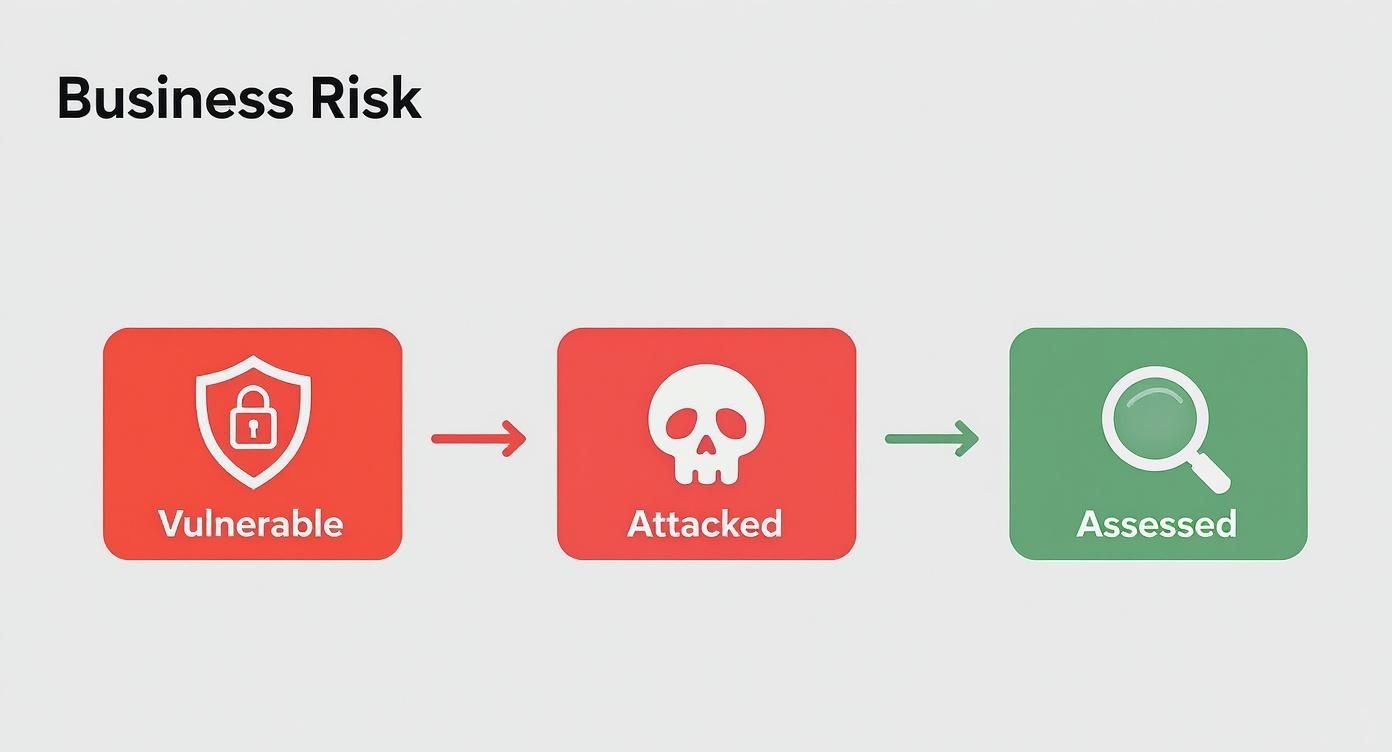
This visual really captures the journey from being vulnerable to becoming assessed and secure, showing just how transformative a proper risk assessment can be.

This whole process is about moving your business from a state of unknown risk to one of informed resilience, where you can actually spot and neutralize threats before they cause damage. Let's walk through each step so you know exactly what to expect.
Phase 1: Asset and Data Identification
First things first, we need to know what you’re trying to protect. You can’t secure what you don’t know you have. In this initial phase, we work side-by-side with your team to create a detailed inventory of your company's "crown jewels"—the absolute most critical assets that keep your business humming.
And this isn't just about servers and computers. We identify and classify everything of value to understand what’s really at stake.
- Data Assets: This is your customer databases, financial records, employee information, and any proprietary intellectual property that gives you an edge over the competition.
- Hardware Assets: We map out all your physical gear, including servers, laptops, workstations, and any mobile devices that connect to your network.
- Software Assets: This covers the whole gamut, from your core business applications and cloud services (like Microsoft 365) to the operating systems running your machines and the AI tools in use.
Creating this comprehensive map establishes the scope of the assessment and makes sure no critical piece of the puzzle is missed. It's the foundation for accurately figuring out how a security incident could impact your business.
Phase 2: Threat and Vulnerability Analysis
Once we have a handle on what we're protecting, the next step is to find the weak spots. This is where the deep-dive technical work really kicks in. Picture a professional security guard meticulously testing every lock, checking every window, and reviewing every single access point to your digital building.
Our security experts use a combination of automated scanning tools and good old-fashioned manual inspection to uncover vulnerabilities. This two-pronged approach gives us both broad coverage and in-depth analysis.
We're not just looking for the obvious flaws. This phase is about finding the subtle misconfigurations, outdated software, and process gaps that hackers are so good at exploiting. It’s a proactive hunt for potential entry points.
This analysis brings issues to the surface like:
- Unpatched Systems: Software that hasn't been updated is one of the most common ways attackers get in. Keeping systems current is a cornerstone of good security—you can learn more about how that works in our guide on what is patch management.
- Weak Configurations: This could be anything from default passwords that were never changed to misconfigured firewalls or cloud services that leave ports wide open.
- Access Control Gaps: We dig into who has access to what, ensuring employees only have the permissions they absolutely need to do their jobs and nothing more, across all platforms.
This meticulous search for flaws gives us the raw data we need for the final, and most critical, phase of the assessment.
Phase 3: Risk Analysis and Reporting
The final phase is all about translating those technical findings into a clear, actionable business plan. A long list of vulnerabilities is pretty useless without context. Here, we connect the dots, analyzing how likely it is for a specific threat to exploit a vulnerability and calculating the potential fallout for your business operations.
We then present our findings in a straightforward report, completely free of confusing jargon. It’s designed for everyone, from your leadership team to your IT staff. Most importantly, it will include a prioritized list of recommendations, zeroing in on the most critical risks first.
Instead of getting an overwhelming to-do list, you receive a strategic roadmap. This plan helps you allocate your time, budget, and resources where they'll have the biggest impact, ensuring you tackle the issues that pose the greatest danger to your business's future. This is how a cybersecurity risk assessment service transforms uncertainty into a confident path forward.
How to Choose the Right Security Partner
Picking the right team for your cybersecurity risk assessment services is one of the biggest security decisions you'll make for your business. It's not just about hiring someone to run a few scans and hand you a report. You're bringing in an advisor who will get an up-close look at your operations, your data, and every single one of your vulnerabilities.

For small and midsize businesses, this choice is even more critical. You need more than just a checklist; you need a real partner who understands your unique challenges, respects your budget, and is genuinely invested in seeing you become more secure for the long haul.
The Difference Between a Vendor and a Partner
It’s a simple but crucial distinction. A vendor sells you a one-time service. They'll do the assessment, give you a report, and then they're off to the next client. A true security partner, on the other hand, is in it for the long game—your success.
A partner takes the time to actually understand what you're trying to achieve as a business. They offer ongoing guidance to help you build a security-first culture that lasts. They translate all the technical jargon into plain English and stick around to help you put their recommendations into practice.
The right partner doesn’t just find problems—they give you the knowledge and the roadmap to fix them. Their goal is to make your business stronger and more self-sufficient, not to make you dependent on them.
As you start looking, having a clear set of criteria is key. It'll help you cut through the sales pitches and find a firm that's actually the right fit for you.
Key Questions to Ask Potential Providers
When you're meeting with potential partners, the questions you ask can tell you everything. A confident, capable provider will welcome your tough questions. Don't be shy—dig in.
Here are a few essential questions to get the conversation started:
- What’s your experience with businesses my size and in my industry? A firm that mostly works with giant corporations might not understand the budget and resource constraints of a typical SMB. Ask for specific examples or references from companies like yours.
- How do you handle industry-specific compliance and cloud security? If you're in a regulated field like healthcare (HIPAA) or you're part of the defense supply chain (CMMC), your partner needs to be an expert in those frameworks. Have them walk you through their process for finding and closing compliance gaps.
- Can I see a sample report? Ask for an example of a final deliverable. It should be easy to read, with a high-level summary for leadership and the nitty-gritty technical details for your IT team. A report that’s just a wall of confusing jargon is a huge red flag.
- How do you prioritize your findings? A good partner won’t just dump a massive list of problems on your desk. They should use a risk-based approach, telling you what to fix first based on what's most likely to be attacked and what would cause the most damage to your business.
- What kind of support do you offer after the assessment? This is the ultimate vendor vs. partner question. Do they offer help with remediation? Will they be available for ongoing advice to help you manage your security program?
The demand for cybersecurity risk assessment services is exploding as businesses everywhere face a tidal wave of digital threats. The global cybersecurity market, valued at USD 218.98 billion in 2025, is expected to soar to USD 562.77 billion by 2032. This growth is fueled by threats like ransomware, which jumped by nearly 49% in the first half of 2025 alone. You can explore the full cybersecurity market analysis to see the trends driving this need.
Evaluating Your Options: A Quick Checklist
To help you keep track of your conversations and compare providers apples-to-apples, we've put together a simple checklist. Use this to guide your evaluation process and make sure you're covering all your bases.
Comparing Risk Assessment Vendor Offerings
| Evaluation Criteria | What to Look For | Red Flags to Avoid |
|---|---|---|
| Industry & Size Experience | Case studies or references from SMBs in your specific industry (e.g., manufacturing, healthcare). | Vague answers or experience only with large enterprise clients. |
| Methodology | A clear, documented process that aligns with frameworks like NIST or CIS. | A "black box" approach where they can't explain their methods clearly. |
| Compliance & Tech Expertise | Proven experience with regulations (HIPAA, CMMC) and technologies like cloud solutions and AI. | A one-size-fits-all approach to compliance without specific knowledge. |
| Reporting & Deliverables | Sample reports with clear executive summaries and actionable, prioritized recommendations. | Jargon-filled reports that are hard to understand; lack of clear priorities. |
| Post-Assessment Support | Offers remediation guidance, re-testing, and ongoing advisory services. | The engagement ends the moment the report is delivered. |
| Tools & Technology | Use of modern, reputable tools, and can explain how they enhance the assessment. | Reliance on outdated or proprietary tools without clear justification. |
| Team & Certifications | Certified professionals (e.g., CISSP, CISA) with real-world experience. | Inexperienced staff or an inability to name who will be on the project. |
This table should give you a solid framework for making a confident, well-informed decision.
The Role of Modern Tools and AI
Technology, of course, plays a huge part in modern risk assessments. The best security partners are using advanced tools, including AI and machine learning, to run more efficient and thorough analyses. AI-powered platforms are fantastic at sifting through mountains of data to spot subtle patterns and anomalies that a human might overlook.
This helps them find sophisticated threats and give you a much deeper understanding of your security weak spots, especially within complex cloud environments. When you're talking to potential partners, ask them how they use modern tech to make their assessments better. It’s a good indicator of their commitment to giving you the best service possible.
Ultimately, choosing the right partner comes down to finding a team that blends deep technical skill with a real-world understanding of your business. They should feel like an extension of your own team, giving you the strategic guidance and hands-on support you need to protect what you’ve built.
Turning Your Assessment Report Into Action
Getting your cybersecurity risk assessment report back isn't the finish line—it's the starting pistol. This document is your roadmap, turning a bunch of technical findings into a clear, prioritized plan to beef up your business's defenses. For most SMBs, this is where the real work of building resilience begins.
A good report is built for a few different people. It needs a high-level executive summary for leadership that spells out the key risks in plain business terms. At the same time, it has to include detailed technical findings for your IT team or provider to actually execute on. The whole point is to bridge that gap between technical discovery and smart business decisions.
From Data To Decisions
The heart of the report is the risk matrix. Think of it as a strategic grid that maps out every vulnerability we found. It prioritizes everything by weighing two critical factors: the potential business impact if a vulnerability were exploited and the likelihood of that actually happening.
This simple but powerful tool cuts right through the noise. It shows you exactly where to focus your limited time and money. Instead of trying to patch every single hole at once, you can zero in on the high-impact, high-likelihood threats that pose a genuine danger to your operations.
For instance, an unpatched cloud server running your main accounting software is a way bigger priority than a minor software bug on a rarely-used computer. The matrix makes this distinction crystal clear, empowering you to make smart, cost-effective decisions.
Creating Your Remediation Plan
With your priorities laid out by the risk matrix, the next step is building a concrete remediation plan. This is your action-oriented playbook for systematically closing your security gaps, and it shouldn't be overwhelming. It should be broken down into manageable chunks.
For each high-priority risk, your plan needs to detail:
- The Specific Action: What exact steps do we need to take? This could be anything from applying a software patch to rewriting an internal security policy for cloud service usage.
- Assigned Responsibility: Who's in charge of getting this done? Naming a person is crucial for accountability.
- Timeline for Completion: When does this need to be fixed? Setting realistic deadlines keeps the momentum going.
- Required Resources: What do we need to implement the fix? This could mean budget, staff time, or new technology.
Let's say your assessment flags weaknesses in how you dispose of old hardware. A great next step would be to consult a secure hard drive shredding guide to create a solid policy. That's a perfect example of turning a finding into a specific, actionable task.
Your assessment report is a living document. It’s the foundation for an ongoing cycle of improvement—identify, prioritize, remediate, and then reassess. This continuous process is what truly builds a strong security posture over time.
The growing demand for cybersecurity risk assessment services shows a major shift in how businesses are thinking about digital threats. The market itself tells the story; valued at USD 245.6 billion in 2024, it's projected to climb to USD 639.2 billion by 2032. This incredible growth proves just how critical proactive assessments have become.
This action plan is what turns abstract risks into tangible security controls. For businesses ready to build a truly robust defense, exploring a full range of cybersecurity solutions for businesses is the logical next step in the journey toward resilience.
Got Questions About Risk Assessments? We've Got Answers.
When you're thinking about investing in cybersecurity risk assessment services, it’s only natural to have some practical questions. As experts who guide countless small and midsize businesses through this process, we’ve heard them all. Business owners want straight, simple answers, not a bunch of technical jargon.
So, let's cut to the chase. I want to tackle the big concerns that are always top of mind for any business leader trying to build a smart security strategy: cost, timing, and frequency. Let's dive in so you can move forward with a clear picture of what to expect.
What’s the Typical Cost for a Small Business?
This is almost always the first question I get, and the honest answer is: it depends. A cybersecurity risk assessment isn’t a one-size-fits-all product with a fixed price tag. The cost is tied directly to the size and complexity of your business.
Think of it like getting a home inspection. You wouldn't expect the inspection for a small condo to cost the same as one for a sprawling, multi-story house with intricate electrical and plumbing systems. The same logic applies here.
A few key factors will drive the price:
- Company Size: The number of employees, computers, and servers we need to look at directly shapes the scope. A 15-person office will naturally have a different price point than a 100-person manufacturing facility.
- Data Complexity: What kind of data do you handle? A business managing sensitive patient information under HIPAA needs a much more intense (and therefore, more expensive) assessment than a company that just holds basic customer contact info.
- IT Infrastructure: How complex is your tech setup? The number of physical locations, cloud services you use (like Microsoft 365 or AWS), and any custom software or AI tools you run will all influence the final cost.
For a small business with a pretty straightforward IT environment, a basic risk assessment might start in the low thousands. For a midsize company or one with specific compliance rules to follow, the investment will be higher, simply because a much deeper level of analysis is required. The key is to stop seeing it as a cost and start seeing it as an investment—one that can prevent a breach that could cost your business exponentially more.
How Long Does the Whole Process Take?
Just like cost, the timeline for a risk assessment scales with your organization’s complexity. A bigger, more intricate business environment just takes more time to review thoroughly. That said, a typical engagement for a small to midsize business follows a fairly predictable path.
From our first kickoff meeting to delivering the final report, you can generally expect the process to take somewhere between four to eight weeks. This schedule gives us enough time to be methodical and cover all the bases without rushing through critical steps.
Here’s a rough breakdown of how that time is spent:
- Discovery and Scoping (1-2 weeks): This is the get-to-know-you phase. We'll have meetings, send over questionnaires, and gather documentation to get a solid handle on your critical assets, processes, and business goals.
- Technical and Procedural Analysis (2-4 weeks): This is where the real deep-dive happens. Our team will be running scans, reviewing system and cloud configurations, interviewing key people on your team, and analyzing your existing policies.
- Analysis and Reporting (1-2 weeks): In the final stretch, we pull all our findings together. We'll correlate the data, prioritize risks based on their potential impact and likelihood, and then compile everything into a final, actionable report written in plain English.
Any professional provider worth their salt will give you a clear project plan with milestones, so you’ll always know exactly where we are in the process and what’s coming up next.
The most important part of the timeline is the collaboration. Your active participation during the discovery phase is crucial for ensuring the assessment is accurate and truly reflects your business's unique risk profile.
Risk Assessment vs. Penetration Test: What’s the Difference?
This is a really common point of confusion, but the distinction is critical. While both are important security tools, they serve completely different purposes. Think of a risk assessment as strategic and comprehensive, while a penetration test is tactical and highly focused.
Let's use an analogy. Imagine you're tasked with securing a physical building.
- A cybersecurity risk assessment is like hiring a security consultant for a full audit. They walk the entire property, check every single door and window, test the alarm systems, review security for cloud-connected devices, and interview your staff about security procedures. They deliver a report that tells you where your biggest security gaps are and a prioritized plan to fix them.
- A penetration test (or "pen test") is when you hire a team of ethical hackers and tell them, "Try to break in." Their goal is to actively exploit a specific vulnerability—like trying to pick the lock on a back door or find an unlocked window on the second floor—to see if they can get past your defenses. It tests one specific defense, not your entire security strategy.
A risk assessment answers the big-picture question, "What are our weaknesses, and which ones should we fix first?" A pen test answers a very specific question: "Can this particular vulnerability be exploited by an attacker right now?" For most SMBs, a risk assessment is the essential starting point because it gives you the broad, strategic roadmap you need to build a truly solid security foundation.
How Often Should My Business Get an Assessment?
Cybersecurity is never a "set it and forget it" task. The threat landscape, your own technology, and your business operations are all in a constant state of flux. Because of this, risk assessments need to be a regular, recurring part of your security program, not a one-time event you check off a list.
For most small and midsize businesses, conducting a full cybersecurity risk assessment annually is the widely accepted best practice. An annual review ensures that your security posture keeps pace with your business’s growth and the ever-changing tactics of cybercriminals.
However, there are times you should absolutely consider an assessment more frequently or on an ad-hoc basis. You should get one done anytime your business undergoes a significant change, such as:
- Major Technology Upgrades: Rolling out a new AI platform, a new ERP system, or making a big move to new cloud solutions introduces a whole new set of potential risks.
- Business Mergers or Acquisitions: When you're integrating new networks, systems, and employees, you need a fresh look at your combined security posture.
- Changes in Regulatory Requirements: If new data privacy laws or industry mandates come into play, an assessment is needed to make sure you're compliant.
By treating your risk assessment as a recurring part of your business strategy, you ensure your defenses remain strong, relevant, and perfectly aligned with your goals, year after year.
Ready to gain a clear understanding of your business's unique cyber risks? The team at Eagle Point Technology Solutions provides expert guidance to help you protect your operations and build a resilient security foundation. Contact us today to schedule your cybersecurity risk assessment.