Is your IT budget a source of frustration? For many small and medium-sized businesses (SMBs), technology often feels like a constant game of catch-up—fixing what's broken, reacting to daily fires, and just trying to keep the lights on. If this sounds familiar, you're not alone. This reactive approach, driven by a simple IT to-do list, is necessary for survival but rarely leads to sustainable growth.
This guide is designed to help you make the critical shift from a scattered task list to a strategic technology roadmap. A roadmap is a powerful tool because it connects every single IT decision you make directly back to your core business goals. It’s the bridge between where your technology is today and where your business needs to be tomorrow, turning your IT spending from a necessary evil into a competitive advantage.
Moving Beyond a Simple IT To-Do List
A to-do list is tactical; it's about fixing immediate problems. A technology roadmap is strategic; it's about building future success. It forces you to stop asking, "What's broken today?" and start asking, "How can technology help us grow, improve efficiency, and better serve our customers next year?"
This isn't just theory. For many businesses in Western Pennsylvania and Eastern Ohio, this shift is the key to unlocking real potential.
From Reactive Fixes to Proactive Growth
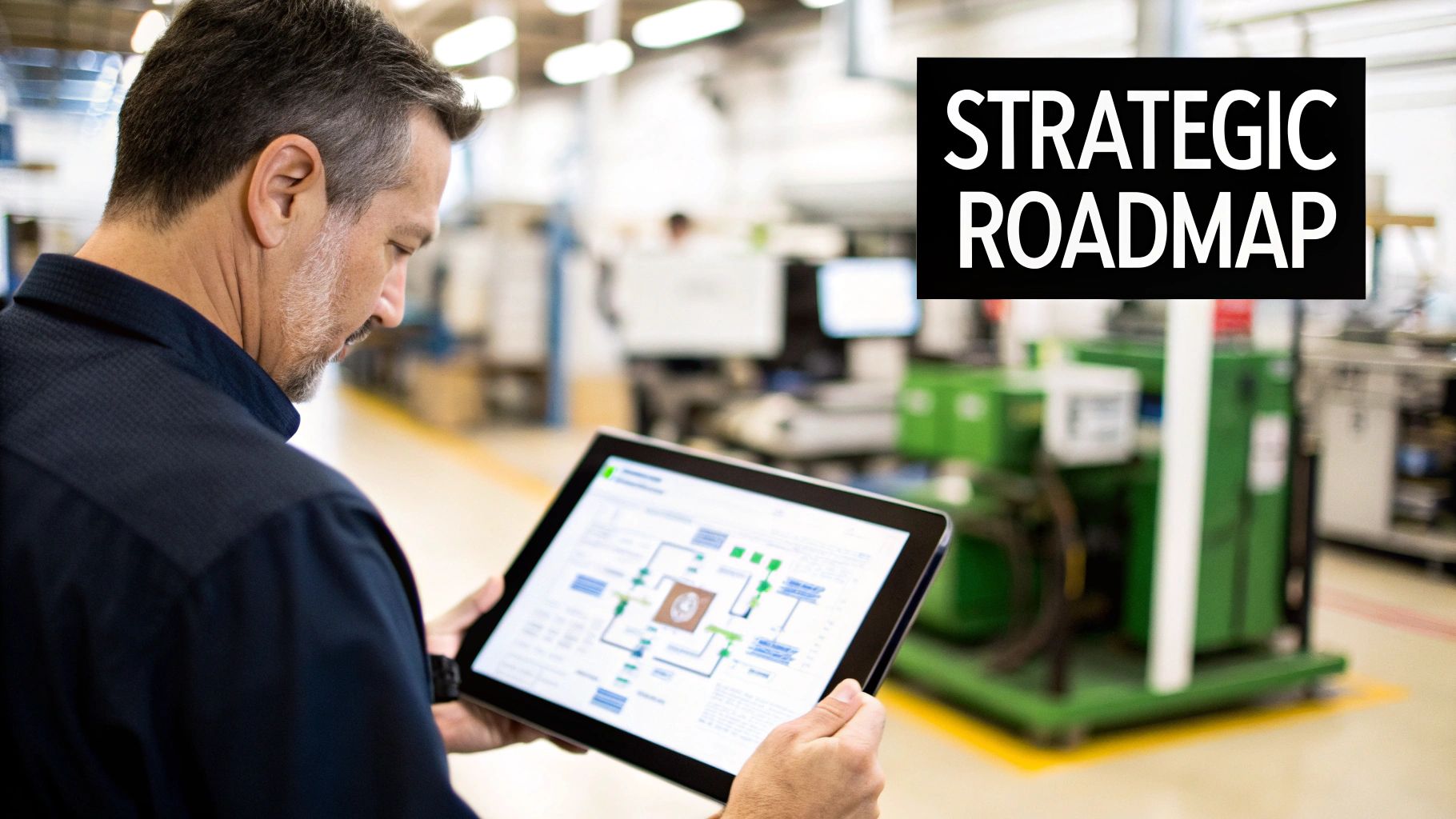
Let's consider a common scenario we see with local manufacturing firms. Many struggle with outdated systems: a server that crashes randomly, production software that doesn't sync with accounting, and growing concerns about cybersecurity. Their "IT plan" is simply a list of things to fix when they finally break. This approach creates constant disruption and missed opportunities.
By building a real technology roadmap, that chaos transforms into a clear path forward. Instead of just replacing the server when it dies, the roadmap might outline a phased migration to a secure cloud platform. This move not only solves the reliability issue but also gives the sales team secure remote access to critical data. Instead of manually crunching numbers, the company can budget for an ERP system that integrates production and finance, providing real-time insights into profitability.
A technology roadmap shifts the entire conversation from cutting costs to creating value. It’s the difference between patching holes in the boat and charting a course to a new destination.
The data backs this up. A Deloitte survey of US CEOs found that 81% reported a clear IT strategy roadmap boosted their customer retention by 25%. On the flip side, a BCG analysis revealed that only 35% of digital transformation projects succeed, with a lack of business alignment being the top reason for failure.
To help you see the difference clearly, here's a breakdown of a tactical to-do list versus a strategic roadmap.
Roadmap vs. To-Do List: Key Differences
| Attribute | IT To-Do List | Technology Roadmap |
|---|---|---|
| Focus | Tactical & Immediate | Strategic & Long-Term |
| Purpose | Fixes current problems | Achieves future business goals |
| Timeframe | Short-term (days/weeks) | Mid to long-term (1-3 years) |
| Driver | Technical issues & failures | Business objectives & growth plans |
| Outcome | System stability | Competitive advantage & efficiency |
Seeing them side-by-side makes it obvious. A to-do list keeps you afloat, but a roadmap helps you navigate toward your goals.
To truly get past fragmented IT tasks, a structured approach is essential. Adopting comprehensive frameworks, like those detailed in The Ultimate Framework for ISO 27001 Certification in Australia, can provide the discipline needed for strategic planning. This is how a simple IT budget transforms into a powerful engine for efficiency and a genuine competitive edge.
Establishing Your Starting Point with a Tech Assessment
You can't map out a trip to a new destination without knowing your exact starting point. The same is true for your business technology. Before you can plan new projects or strategic moves, you need a brutally honest picture of what your IT looks like today. This is where a thorough technology assessment comes in—it’s the foundation of any effective roadmap.
For many SMB owners, this sounds like a massive, overly technical headache. It doesn't have to be. At its core, an assessment is just about taking a clear-eyed look under the hood to see what’s working, what’s at risk, and what’s quietly holding your business back. It’s time to move past assumptions and get real data on the table.
Taking Inventory of Your IT Assets
First, you need a simple inventory. You have to know what you’ve got before you can decide what you need. This isn't just about counting computers; it’s about understanding the entire ecosystem your business relies on.
Your inventory should cover three main areas:
- Hardware: This includes servers, employee computers (desktops and laptops), networking gear (like switches, firewalls, and Wi-Fi access points), and any specialized equipment. Think about PLCs on a manufacturing floor or diagnostic tools in a healthcare clinic. Be sure to note the age and warranty status of critical equipment.
- Software: List all applications essential to your business, from your accounting software and CRM to industry-specific programs. Document operating systems and their versions—this is often where you find old, unsupported software that poses a significant security risk.
- Cloud Services & Subscriptions: Get a handle on all your subscriptions. Catalog every SaaS tool (like Microsoft 365 or Google Workspace), cloud storage accounts, and any other cloud infrastructure. You'll almost certainly uncover some "shadow IT"—services that employees signed up for on their own—which can create serious security gaps and compliance issues.
Looking Deeper Than Just a List
Once you have that list, the real work begins. The goal is to understand how these assets perform and what risks they introduce. This analysis helps you find hidden bottlenecks, security vulnerabilities, and outdated systems that are quietly draining your productivity and your budget.
A proper tech assessment isn't an audit meant to find fault. It's a discovery process designed to find opportunities. It helps you pinpoint exactly where a strategic technology investment can have the biggest positive impact on your operations.
To guide this analysis, ask practical, business-focused questions that get to the heart of your daily operations. A structured approach is key. To help you get started, we've put together a comprehensive guide you can use as a reference. Check out our IT infrastructure audit checklist to see the kinds of detailed questions that uncover truly meaningful insights.
Uncovering Operational Pain Points
Honestly, some of the most valuable information you'll gather will come from the people using the technology every day. Your assessment must include direct feedback from your team.
Start asking questions that get to the root of their frustrations:
- Which software causes the most complaints or support tickets?
- What manual, repetitive tasks are eating up your team's time? (e.g., re-entering data into multiple systems)
- If our main server crashed right now, what is our exact plan to get back online, and how long would it take?
- Where are the performance slowdowns? Does the network grind to a halt every afternoon?
The answers add a human layer to your data that is just as important as your hardware inventory. It connects a technical problem, like a slow server, to a real-world business problem, like wasted payroll hours and frustrated customers. This candid look at your current state is the essential foundation for building a technology roadmap that solves genuine problems.
Connecting Technology Directly to Business Objectives
You’ve finished your tech assessment and have a clear picture of what you’re working with. Now for the most important step in building a technology roadmap: linking all that tech to why it matters to your business.
This is where your roadmap transforms from a simple IT inventory into a strategic plan that genuinely drives growth. Technology should never exist in a bubble. Every investment, upgrade, and new piece of software must serve a clear business purpose. Without that direct link, you just have a technical wish list, not a plan that leadership can support. Nail this alignment, and you'll get buy-in from the start.

Translating Business Goals into IT Initiatives
The trick is to begin with the company's high-level objectives and work backward to identify the technology needed to hit those targets. What are the big-picture goals discussed in your leadership meetings? Are you trying to increase market share, improve operational efficiency, or enhance customer satisfaction?
Let’s walk through a real-world example of translating a business goal into a tangible IT project:
- Business Goal: "We need to improve customer response time by 20% over the next year."
- Resulting IT Initiatives: This single goal could justify several tech projects. It might mean implementing a new CRM to better track customer inquiries, upgrading communication tools to a unified platform like Microsoft Teams, or even deploying an AI-powered chatbot to handle initial questions instantly.
See the difference? You’re not just "buying a CRM." You're investing in a tool to make customers happier and more loyal. That’s a story everyone—from the CEO to the sales team—can understand and support.
Gathering Intelligence from the Front Lines
Some of the best ideas for your roadmap won't come from the server room; they'll come from talking to your team. Your department heads and front-line staff live with the daily frustrations and roadblocks of your current technology. Their input is invaluable.
Schedule quick, informal chats with key people across the business. Ask open-ended questions that get to the heart of their daily headaches:
- "What's the one task you do every day that feels like it takes way too long?"
- "If you could wave a magic wand and fix one tech problem, what would it be?"
- "Where do you see communication breaking down between departments?"
You might hear from a warehouse manager that spotty Wi-Fi is causing shipping delays. A sales rep might complain they can't access customer data on their phone. These aren't just complaints; they are bright, flashing signs pointing you toward high-impact IT projects.
When you ground your roadmap in the real-world experiences of your team, you're not just picking technology. You're solving genuine business problems, which is the surest way to guarantee your initiatives will be welcomed and actually used.
The data supports this. CIO Magazine found that organizations with clearly defined IT KPIs in their roadmaps are twice as likely to achieve their digital transformation goals. This is critical when you remember that a staggering 70% of digital projects fail because of unclear objectives. By tying every project back to a measurable business outcome, you set yourself up for success. You can find more insights on why an expert-driven IT strategy is so important at Veritis.com.
Building Cross-Departmental Support
This process of talking to stakeholders does more than just gather good ideas; it actively builds the support and buy-in you’ll need down the road.
When the finance team sees that a new accounting software was chosen because you listened to their frustrations about manual reporting, they become champions for the project. When sales understands the new CRM will solve their mobile access problem, they’ll be your biggest advocates.
This collaborative approach ensures your technology roadmap isn’t seen as "just another IT thing." It becomes a shared plan that everyone has a stake in—a living guide that moves the entire business forward.
Prioritizing Projects for Maximum Impact
You’ve done the hard work of discovery and aligned your tech needs with your business goals. The result? A healthy list of potential IT projects. This is where many SMBs get bogged down. With limited time, a finite budget, and a small team, you simply can't tackle everything at once. The next critical step is ruthless prioritization—figuring out what will deliver the biggest bang for your buck, right now.
This isn’t about picking the cheapest or easiest tasks first. It’s a strategic exercise to build momentum by solving your most pressing problems. A scattered approach leads to a graveyard of half-finished projects and wasted money. A focused plan, on the other hand, delivers consistent, measurable value.
Sorting Initiatives into Strategic Buckets
A great way to get your arms around this is to start by categorizing each project. This simple step helps you stop looking at an overwhelming backlog and start seeing a portfolio of opportunities with different timelines and purposes.
I recommend sorting projects into a few practical buckets:
- Quick Wins: These are your low-hanging fruit—low-cost, high-impact projects you can complete quickly. Think about implementing a new password manager to instantly boost security or automating a tedious manual report that eats up hours each week. These wins are fantastic for building morale and showing immediate progress to leadership.
- Strategic Imperatives: These are the big-ticket items—the foundational projects critical for long-term growth or security. Migrating to the cloud, overhauling your cybersecurity defenses, or implementing a new ERP system would fall into this category. They require more planning and investment but are essential for your future.
- Operational Enhancements: These projects are all about improving internal processes and making your team more efficient. A new CRM to prevent leads from falling through the cracks or an upgraded inventory management system for the warehouse are perfect examples. They directly address the daily pain points your team shared during discovery.
Categorizing your list this way transforms it from a messy to-do list into a balanced portfolio that addresses both today's fires and tomorrow's goals.
Using a Scoring Matrix to Remove Guesswork
Now that your projects are sorted, you need an objective way to rank them. Relying on gut feelings or whoever shouts the loudest in a meeting is a recipe for disaster. A simple scoring matrix is the perfect tool to remove emotion and force an honest evaluation based on critical business criteria.
A prioritization matrix transforms subjective debates into an objective, data-driven conversation. It ensures that the projects you tackle first are the ones that deliver the most value, mitigate the biggest risks, or solve the most significant operational headaches.
You can build this right in a spreadsheet. The goal is to score each project on a scale (e.g., 1 to 5) across several key factors. Once projects are identified and prioritized, strong project leadership is what turns that list into successful outcomes. Understanding the core IT project managers' responsibilities is crucial for ensuring these initiatives get across the finish line.
Here’s a quick look at how you can structure this.
Sample Initiative Prioritization Matrix
This simple table helps you score each potential initiative against what truly matters to your business, giving you a clear, data-backed ranking.
| Initiative | Business Impact (1-5) | Urgency/Risk (1-5) | Effort/Cost (1-5) | Total Score |
|---|---|---|---|---|
| Upgrade CRM Software | 4 | 3 | 3 | 10 |
| Implement MFA | 5 | 5 | 2 | 12 |
| Replace Aging Server | 5 | 4 | 5 | 14 |
| Automate Invoicing | 3 | 2 | 2 | 7 |
A quick note on this model: for "Effort/Cost," a high score like 5 is a negative (high effort, high cost). By adding up the scores, you can immediately see which projects bubble to the top. In this example, replacing the aging server is the #1 priority. Even though it's a huge effort, its business impact and the risk of failure are too critical to ignore.
This straightforward exercise gives you a clear, defensible justification for your decisions. It allows you to build a visual timeline, breaking down the top-scoring projects into manageable phases, quarter by quarter. This isn't about cramming everything into the next three months; it's about creating a focused, realistic plan that generates real momentum.
Defining Your Budget and Measuring Real Success
You've got a prioritized list of valuable tech projects. But without a realistic budget, a roadmap is just a wish list. This is the crucial moment where your strategic vision meets financial reality.
Estimating costs can feel like throwing darts in the dark, often leading to sticker shock that stalls even the best-laid plans. But by approaching budgeting methodically, you can build a financial plan that's both realistic and helps prove the value of every dollar spent.
This is about more than just getting a quote for a new server. You need to think in terms of Total Cost of Ownership (TCO). That includes everything: software licenses, labor for implementation, ongoing maintenance contracts, and even the time required to train your employees. Ignoring these "soft" costs is a common reason projects go over budget.
Building a Realistic IT Budget
Crafting a dependable budget means digging deeper than a quick Google search. Real-world costs for hardware, software, and professional services can vary wildly. Getting expert guidance at this stage is the best way to avoid surprises.
Here’s what your budgeting process should cover:
- Vendor Consultations: Don’t just get one quote for a major purchase—talk to multiple vendors. This does more than give you a price range; it often exposes you to different solutions and approaches you might not have considered.
- Labor Estimation: Account for the human hours. How long will it take your team—or an outside partner—to deploy, configure, and test the new technology? An experienced managed service provider can usually give you a much tighter estimate because they've done it dozens of times.
- Recurring Costs: Get a handle on every subscription and annual renewal fee. That new SaaS platform might seem like a bargain at its monthly price, but what does that look like when multiplied by 12 months and the number of employees who will use it?
Putting together a solid IT budget is a cornerstone of your bigger financial strategy. For a deeper dive into making your tech dollars work harder, check out our guide on IT cost optimization strategies.
Think of your technology budget less as an expense line and more as an investment portfolio. The goal is to allocate funds to the initiatives that promise the highest return, whether that’s boosting efficiency, reducing risk, or opening up new revenue opportunities.
Turning Your Roadmap into a Management Tool
With a budget locked in, the final piece is governance. A technology roadmap isn't a static document you create and file away. To be effective, it must be a living, breathing management tool that guides your decisions and shows your progress. This is what turns a plan into a real driver for your business.
This simple visual shows the continuous cycle of prioritizing and scheduling work.
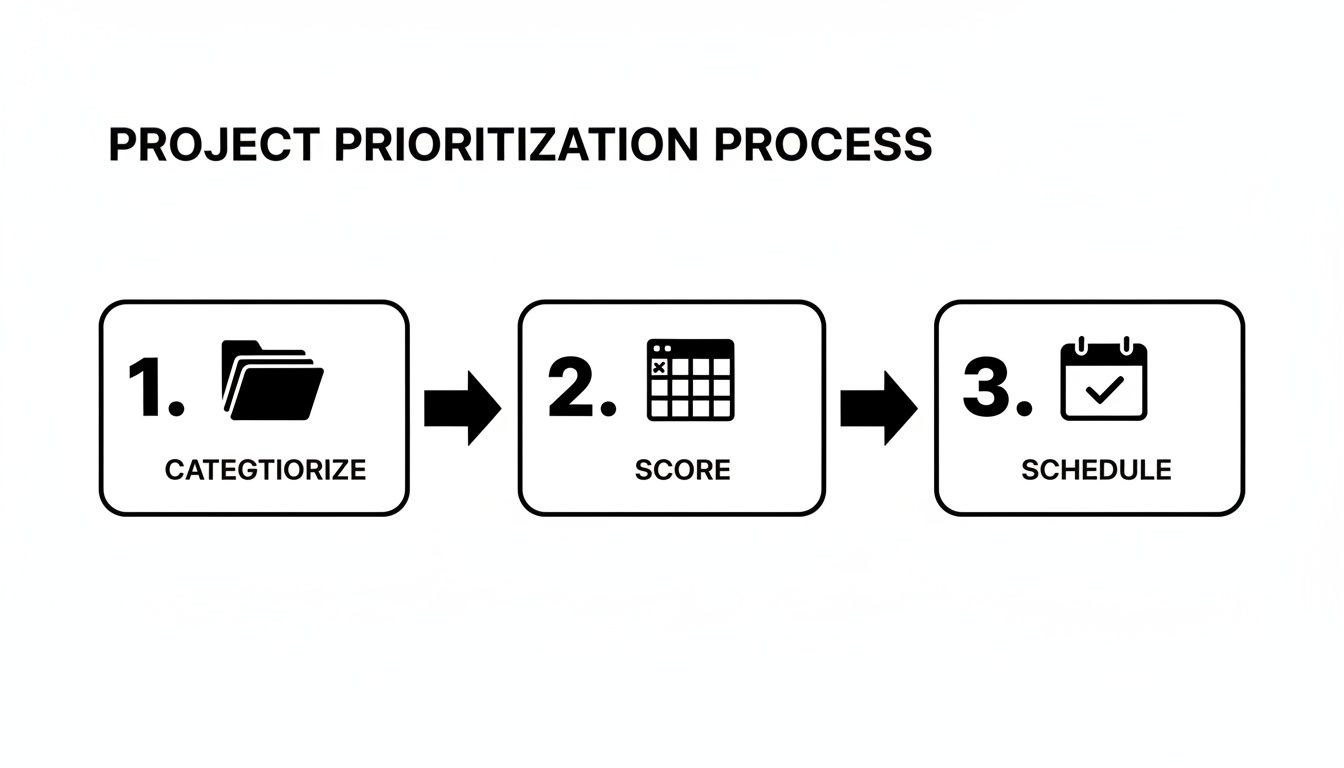
This process—categorize, score, schedule—creates a repeatable rhythm for managing your roadmap and making adjustments as things change.
To make this happen, you need a consistent review cadence. I strongly recommend a quarterly roadmap review with your key stakeholders. This meeting has two critical jobs: first, to check progress on current projects, and second, to adjust future priorities based on what the business needs now.
Measuring What Truly Matters with KPIs
Finally, to prove the ROI of your investments, you need to track the right Key Performance Indicators (KPIs). These metrics connect your tech projects directly to business outcomes, showing leadership exactly what they’re getting for their money.
Forget vague goals. Get specific and track measurable KPIs like these:
- Reduction in system downtime: Track the hours of unplanned outages before and after that server upgrade.
- Decrease in helpdesk tickets: Monitor how many support requests you get for that clunky old software you just replaced.
- Improved user adoption: How many employees are actively using the new CRM system 90 days after launch?
- Faster issue resolution time: Calculate the average time it takes your team to close critical security alerts.
Tracking KPIs like these gives you the hard data needed to justify your budget and demonstrate that a well-executed technology roadmap isn’t just an expense—it’s a powerful engine for growth.