For any small or midsize business in Western Pennsylvania or Eastern Ohio, every dollar and every hour is precious. I've seen it time and time again: the sales team is clamoring for a new CRM, operations needs a server upgrade, and your IT partner is pushing for critical cybersecurity improvements. It’s a constant juggling act.
Without a clear system, you end up spending your limited resources on projects that don't truly move the needle, leaving high-impact initiatives collecting dust. This chaotic "squeaky wheel gets the grease" method is a huge reason why so many IT projects fall short of expectations. When prioritization is just a matter of who shouts the loudest, the best idea rarely wins.

The Steep Price of Guesswork
Failing to prioritize IT projects properly isn't just inefficient—it's incredibly expensive, especially for SMBs with tight budgets. This lack of a structured approach is a major contributor to chronic under-delivery in the tech world.
Industry studies consistently show that only about 35% of projects are completed successfully. Think about that. The most common culprits are massive schedule delays and budget overruns. Some analyses find the average project blows its budget by nearly 75%, while the actual value delivered can fall short by about 39% of what was promised. You can dig into these sobering project performance statistics to see the full scope of the problem.
This guide is designed to give you a practical framework to stop guessing and start making decisions backed by data. By learning how to prioritize IT projects the right way, you can turn your backlog from a source of stress into a powerful roadmap for your business's growth.
Key Takeaway: A structured prioritization process isn't just about checking off IT tasks. It's about maximizing the return on every dollar you invest in technology and ensuring each project directly fuels your company's growth and security.
A Framework for Smart Decisions
Our goal here is to put a simple yet powerful system in place. This system helps you evaluate every potential project—from a cloud migration to an AI-powered automation tool—through the same critical lens, ensuring your decisions are based on objective value, not just gut feelings.
This framework is built on a few core principles that resonate with the challenges SMBs face:
- Business Alignment: Does this project solve a real business problem or help us hit a measurable goal?
- Objective Scoring: We need a consistent scoring system to remove bias and make fair, apples-to-apples comparisons.
- Resource Reality: A project is only viable if you actually have the budget, team, and time to see it through successfully.
- Strategic Sequencing: The order you tackle projects in matters, especially when one project depends on another.
Before we dive into the details, here’s a quick-start table to summarize the core pillars of this evaluation process. Think of it as your cheat sheet for every new IT request that comes your way.
Quick-Start Prioritization Framework
| Evaluation Pillar | Key Question to Ask | Example Metric |
|---|---|---|
| Business Benefit | How does this project help us make more money, save money, or improve customer satisfaction? | Projected ROI, Cost Savings, NPS Score Improvement |
| Project Risk | What could go wrong, and how likely is it to happen? (e.g., technical complexity, team experience) | Risk Score (1-5), Impact Analysis Rating |
| Total Cost | What is the full investment required, including software, hardware, labor, and training? | Total Cost of Ownership (TCO), Estimated Hours |
| Urgency/Timing | Why do we need to do this now? Is there a deadline or a market opportunity we'll miss? | Time-to-Market Impact, Seasonal Deadline |
| Compliance | Is this project required to meet a legal, regulatory, or industry standard (like HIPAA or CMMC)? | Pass/Fail, Compliance Mandate Date |
This table provides a high-level gut check. By asking these questions for every single project, you force a strategic conversation that moves beyond "this sounds like a good idea" to "this is a good idea that aligns with our goals and resources."
By embracing this approach, you'll create a clear, defensible plan that transforms your technology from a cost center into a true competitive advantage.
Aligning IT Initiatives with Your Business Goals
Before any project gets a green light, it has to answer one simple, non-negotiable question: “Why are we doing this?” As a trusted advisor to SMBs, I've seen too many businesses chase shiny new tech without a clear purpose. The most successful IT projects are never about technology for its own sake—they're direct answers to specific business needs.
Getting this right is the absolute foundation of prioritizing IT projects effectively. For a small or midsize business, this isn't just a best practice; it's a survival tactic. Without this critical alignment, you risk pouring your limited budget into projects that don't move the needle on what really matters: growing your company. Every single project that gets approved must have a clear, defensible link to your bottom line.
From Vague Ideas to Measurable Objectives
The first move is to get crystal clear on your high-level business goals for the next 12-18 months. And I'm not talking about IT goals here. These need to be company-wide objectives that everyone from sales to operations can understand and get behind.
For most SMBs I work with in industries like manufacturing, healthcare, and professional services, these objectives fall into a few key categories:
- Increase Revenue: This could mean anything from launching a new product line to expanding into a new market or even just improving the customer experience to boost retention.
- Improve Operational Efficiency: These goals are all about trimming the fat—automating repetitive tasks with AI, reducing waste, and ultimately lowering the cost of doing business.
- Reduce Business Risk: This is about protecting the castle. We're talking about shielding the company from cybersecurity threats like ransomware, avoiding hefty compliance penalties (HIPAA, CMMC), or preventing operational disruptions.
Once you’ve defined these big-picture objectives, the next step is to draw a straight line from any proposed IT project directly to one of those goals. This simple exercise forces a crucial conversation and ensures that both the tech folks and the business leaders are on the same page from day one.
Expert Tip: Don't just state a goal—make it measurable. Instead of a fuzzy target like "Improve sales," get specific with something like "Increase online sales by 15% in the next fiscal year." That level of clarity makes it infinitely easier to judge whether an IT project is truly supporting the objective.
Translating Business Goals into IT Projects
This is where the magic really happens. When you connect technology initiatives to tangible business outcomes, you transform your IT department from a cost center into a strategic partner. This translation is absolutely key to getting buy-in from leadership and proving the real value of your tech investments.
Let me give you a few real-world examples of what this looks like for typical SMBs here in Western Pennsylvania or Eastern Ohio:
Scenario 1: A Manufacturing Company
- Business Goal: Reduce production downtime by 20% to meet increasing customer demand.
- Potential IT Project: Implement a proactive server and network monitoring system.
- The Connection: This system isn't just about new hardware; it's a tool that can spot potential equipment failures and network clogs before they shut down the production line. It directly contributes to the uptime goal and protects revenue.
Scenario 2: A Healthcare Clinic
- Business Goal: Improve patient data security to maintain HIPAA compliance.
- Potential IT Project: Deploy Multi-Factor Authentication (MFA) and roll out a robust, encrypted data backup and recovery plan.
- The Connection: These cybersecurity measures directly tackle the compliance risk, protecting the clinic from massive fines and the kind of reputational damage that's hard to recover from.
Scenario 3: A Regional Retail Chain
- Business Goal: Increase online sales by 25% over the next year.
- Potential IT Project: Migrate the e-commerce platform to a more scalable and secure cloud-based solution.
- The Connection: A faster, more reliable website directly impacts the customer experience. It means fewer abandoned carts and the power to handle holiday traffic spikes, both of which are critical for hitting that ambitious sales target.
By framing every request this way, you shift the conversation away from technical jargon and toward business impact. The question is no longer, "Should we buy a new server?" Instead, it becomes, "Will this new server help us reduce downtime and ship more products?" This alignment ensures every dollar you spend on technology is a strategic investment in your company’s future.
How to Develop a Scoring System to Rank Projects Objectively
So you've confirmed a list of potential IT projects, and they all sound pretty good. Now for the hard part: how do you decide which one actually comes first? It's a classic dilemma for any business owner. Do you prioritize the cloud migration that could boost efficiency or the critical security upgrade that keeps the business safe?
Going with your gut or giving in to the loudest voice in the room is a recipe for wasting time and money.
What you need is a simple, objective scoring system. This isn't about building some complex algorithm; it's about creating a consistent framework to evaluate every project on a level playing field. Using proven decision-making frameworks helps remove the guesswork and emotion, allowing you to rank initiatives based on what truly matters to the business.
For most SMBs I work with, a straightforward scoring matrix is the perfect tool. You assign a numerical value to a few key criteria, which gives you a data-backed score to guide your decisions.
Defining Your Scoring Criteria
The real power of this approach comes from choosing the right criteria—the factors that reflect your business priorities. While you can customize these, most businesses find success focusing on four core areas.
We'll use a simple 1-to-5 scale for each, where 1 is a low score (low impact, low urgency) and 5 is a high score (high impact, high urgency).
-
Business Value: How much will this project help us grow or become more efficient?
- Score 1: Minimal impact on revenue or cost savings. A minor tweak.
- Score 3: Delivers a moderate efficiency boost for one department.
- Score 5: Directly enables a new revenue stream or creates significant, company-wide cost savings.
-
Risk Reduction: How well does this project protect the business from threats? This covers everything from cybersecurity vulnerabilities to regulatory compliance.
- Score 1: Addresses a minor, low-probability risk.
- Score 3: Mitigates a known operational vulnerability that’s causing headaches.
- Score 5: Closes a critical security gap, prevents a potential data breach, or is required for a major compliance standard like HIPAA or CMMC.
-
Urgency: How critical is the timing? Is there a hard deadline or a pressing external factor forcing your hand?
- Score 1: A "nice-to-have" idea with no real time sensitivity.
- Score 3: Responds to a growing market trend or a competitor's move.
- Score 5: Fixes a system on the verge of failure or is needed to meet a non-negotiable legal or contractual deadline.
-
Implementation Effort: What will it really take to get this done? This is your reality check, factoring in time, money, and people. A lower score here is better, as it means less strain on your resources.
- Score 1: Low cost, can be completed quickly with the existing team.
- Score 3: Requires a moderate budget and some help from an outside partner.
- Score 5: A large, complex project demanding significant investment, specialized skills, and a ton of time.
Expert Tip: Notice that "Effort" is a cost, not a benefit. When you calculate the final score, you'll add up the first three criteria and then subtract the effort score. This ensures that high-effort projects must deliver exceptionally high value to make the cut.
Putting the Scorecard into Practice
Let's walk through a couple of common scenarios I see with clients here in Eastern Ohio. Imagine you run a distribution company with a tight budget, trying to decide on your IT priorities for the next quarter.
Scenario A: Firewall Upgrade
Your current firewall is about to hit its "end-of-life," which means the manufacturer will stop releasing security updates, leaving you exposed.
- Business Value: 2 (Doesn't directly make money, but it prevents catastrophic loss.)
- Risk Reduction: 5 (Protects against ransomware and data breaches—a massive risk.)
- Urgency: 5 (End-of-life is a hard, non-negotiable deadline.)
- Effort: 2 (This is a standard, relatively quick project for an IT partner.)
- Total Score: (2 + 5 + 5) – 2 = 10
Scenario B: New CRM Software
The sales team is pushing for a new CRM system to better track leads and streamline their workflow.
- Business Value: 4 (Directly tied to generating leads and potential new revenue.)
- Risk Reduction: 1 (Doesn't really reduce any business risk.)
- Urgency: 3 (The current system is clunky, and it would be nice, but it’s not an emergency.)
- Effort: 4 (Requires significant software costs, data migration, and team training.)
- Total Score: (4 + 1 + 3) – 4 = 4
In this direct comparison, the firewall upgrade wins by a mile. Even though the CRM promises more direct business value, the immense risk and absolute urgency of the security project push it to the top. This simple process gives you a clear, defensible reason for your decision.
The conversation shifts from subjective opinions to objective analysis. You can use a scoring system just like this to identify your most critical needs and build consensus with your leadership team.
Sample IT Project Scoring Matrix
To make this even easier, here’s a basic template you can adapt for your own use. The idea is to sit down with your leadership team and fill this out for every potential project. It’s a fantastic way to spark strategic conversations and build consensus around your technology roadmap.
| Project Idea | Business Value (1-5) | Risk Reduction (1-5) | Urgency (1-5) | Effort (1-5) | Total Score |
|---|---|---|---|---|---|
| Firewall Upgrade | 2 | 5 | 5 | 2 | 10 |
| AI-Powered Inventory Tool | 5 | 2 | 4 | 5 | 6 |
| New CRM Software | 4 | 1 | 3 | 4 | 4 |
| Cloud-Based Phone System | 3 | 2 | 2 | 4 | 3 |
This simple chart makes it immediately clear where your resources should go first. It turns a complicated, often contentious decision into a straightforward business exercise.
Assessing Your True Capacity and Resources
A brilliant project, perfectly aligned with your business goals and scoring off the charts, is completely worthless if you don't have the people, time, and budget to actually pull it off. This is the reality check stage. Honestly, it's where most IT roadmaps for small and midsize businesses fall apart.
Skipping this step is the fastest way to turn an achievable plan into an impossible wish list. It's why a serious, structured look at your capacity isn't just a good idea—it's non-negotiable. It forces you to confront the #1 reason projects fail in an SMB environment: resource constraints. Before you greenlight a single thing, you need a clear-eyed view of what your team and your budget can truly handle.
Beyond the Budget Number
Figuring out your capacity goes way deeper than just glancing at the dollar figure in your IT budget. For most SMBs, your most valuable—and scarcest—resource is your people's time and expertise. A true capacity check means looking at three key areas.
- Human Resources: Who on your team actually has the skills for this project? More importantly, are they already swamped with other critical tasks or just keeping the lights on? Overloading your key people is a recipe for burnout and sloppy work.
- Time Allocation: How many focused hours per week can your team realistically dedicate to something new? You have to account for the daily grind of support tickets, system maintenance, and the inevitable "firefighting" that always pops up.
- Skill Gaps: Do you have the right expertise in-house? A cloud migration, for example, requires a totally different skillset than basic IT support. Spotting these gaps early means you can plan for external help from a partner like Eagle Point before it becomes a crisis.
This kind of realistic thinking prevents the productivity-killing nightmare of multitasking, where your team is spread so thin across so many initiatives that nothing ever gets done well.
The Real Cost of Ignoring Capacity
Failing to do this gut-check isn't just inefficient; it's a primary driver of project failure. Resource constraints are consistently cited as the leading operational reason IT projects get pushed to the back burner or fail outright.
In fact, resource planning has shot to the top of project management concerns for 2025, with 27% of professionals calling capacity planning their single biggest priority. When you consider that poor resource allocation contributes to major risks in as many as 70% of projects, it’s clear this isn't an optional step.
Expert Insight: Think of your IT project budget less like a bank account and more like a pool of available hours, skills, and vendor resources. Treating it as a simple number without considering the human capacity needed to spend it wisely is a critical mistake I see all the time.
A Practical Approach to Capacity Planning
You don't need complicated software to get a handle on your capacity. A simple, honest audit can give you the clarity you need to make smart calls.
- Map Current Workloads: Start by listing out all the ongoing responsibilities of your IT team or the key people involved. This means daily support, scheduled maintenance, and any projects already in motion.
- Estimate "Project" Hours: Looking at that list, how many hours are realistically available for new project work each week? Be conservative. For a lot of small teams, this might only be 5-10 hours per person.
- Factor in External Dependencies: Does this project depend on a key software vendor or a third-party contractor? Their availability and timelines are now part of your capacity plan. A delay on their end directly eats into your internal resources.
- Document and Optimize: While you're at it, look for ways to create more capacity. Adopting more efficient process documentation methods can free up a surprising amount of valuable time. Sometimes, streamlining an internal workflow is all it takes to make room for a new initiative.
Taking these steps helps you build a project list that's grounded in reality. It ensures that when a project finally gets the green light, it has the dedicated resources it actually needs to succeed. To help manage the financial side of this, check out our guide on IT cost optimization strategies—it can help you free up the budget needed for those high-priority initiatives.
Building and Communicating Your Strategic IT Roadmap
You've done the hard work of scoring your projects and checking your resources. The messy backlog is now a clean, ranked list. But here's the thing: a list isn't a plan. The final, critical step is turning that list into a visual, strategic IT roadmap—a clear story of how technology will push your business forward over the next 6, 12, or even 18 months.
This roadmap does so much more than just list what you're doing. It's your tool for communicating the why behind every single decision. For owners and department heads, it brings clarity and manages expectations. For your internal team, it provides focus and a sense of shared purpose. Everyone starts pulling in the same direction.
Sequencing for Success and Acknowledging Dependencies
Now, building a roadmap isn't just about plugging your highest-scoring projects into the next open calendar slot. You have to think like a general contractor building a house. You can't start framing the walls before you've poured the foundation. The exact same logic applies to your IT initiatives.
This is where you need to get serious about mapping out project dependencies—those situations where one project absolutely must be finished before another can even begin.
- Infrastructure First: You have to upgrade that aging server infrastructure before you can even think about deploying a new, resource-hungry ERP system.
- Security Always: Launching a new cloud app for customer data is a non-starter until you’ve rolled out Multi-Factor Authentication (MFA) across the entire company.
- Data Readiness: That cool, AI-powered sales forecasting tool? It's completely useless until the project to clean up and centralize your CRM data is wrapped up.
I’ve seen it happen time and again: ignoring these dependencies is one of the fastest ways to blow your budget and miss deadlines. Taking the time to map them out ensures your roadmap is ambitious but, more importantly, realistic and logically sound.
The Role of a Virtual CIO in Roadmap Governance
For a lot of small and midsize business owners, this whole strategic planning process can feel like a second job. You're busy running the day-to-day operations; you don't have the bandwidth to become a full-time IT strategist. This is precisely where a virtual CIO (vCIO) becomes a game-changing partner.
A vCIO from a managed service provider like Eagle Point doesn't just help you draft the initial roadmap—they help you live with it and manage it. Business is never static. A new competitor pops up, a sudden market opportunity arises, or a new cybersecurity threat completely changes your risk profile overnight.
A great IT roadmap is a living document, not something you carve in stone. It needs to be reviewed quarterly to make sure it still lines up with your business reality. A vCIO drives these reviews, helping you pivot your plan without killing your momentum.
They make sure the roadmap stays a dynamic guide, making smart adjustments along the way and keeping every stakeholder on the same page. This transforms your IT plan from a simple document into a powerful tool for navigating change.
From Technical Plan to a Compelling Business Story
At the end of the day, your IT roadmap is a communication tool. It needs to be simple, visual, and easy for non-technical leaders to grasp instantly. Resist the urge to get bogged down in technical jargon and specs. Instead, focus on tying every single project back to the business outcomes you identified at the very beginning of this process.
This process flow really highlights how capacity planning—knowing your true workload, skills, and budget constraints—is a vital input for any realistic roadmap.
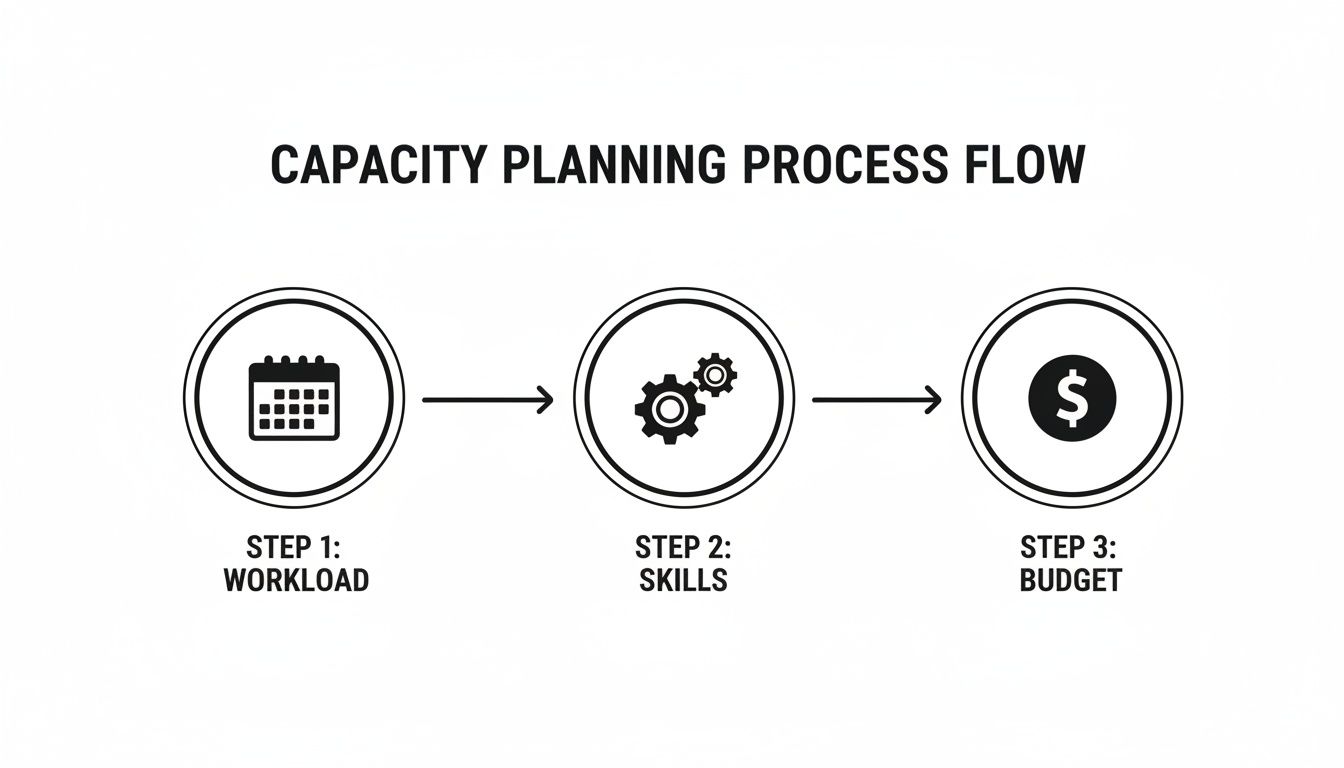
This visual drives home the point that a winning plan is built on a realistic foundation of what your team and budget can actually handle. When you present your plan this way, you’re not just asking for money. You’re showing exactly how a series of smart technology investments will deliver real results, cut down on risk, and give you a genuine competitive edge.
Why Foundational Cybersecurity Projects Often Jump the Line
In any planning meeting, it’s the flashy, revenue-generating projects that grab all the attention. But you’ll notice that a good IT partner will always push for foundational cybersecurity and compliance projects, even when they don’t have a clear ROI. There’s a simple reason for this: these aren’t just IT tasks; they’re essential to keeping your business alive and kicking.
Think of it this way: launching a big new marketing campaign is exciting, but it’s completely worthless if a ransomware attack locks up your entire customer database the next week. A single security breach or compliance failure can instantly wipe out every other goal you’ve set. This is exactly why reducing risk often has to come first.
The Concept of Table Stakes Investments
Certain projects are what we call "table stakes"—the absolute minimum you need just to stay in the game. You wouldn’t run a manufacturing plant without insurance, and in today's world, you can't run a business without solid digital protections.
- Multi-Factor Authentication (MFA): This isn't about adding an annoying extra step for your team. It’s about slamming the door on the vast majority of hackers trying to get into your accounts.
- Robust Data Backup: This project won't make you a single dollar in new revenue. What it will do is ensure your entire business can get back on its feet after a server dies or a cyberattack hits.
- System Patching: Keeping software up-to-date feels like a chore, but it's one of the most effective ways to close security holes before attackers find them. Our guide on what patch management is breaks down why this simple process is so vital.
These foundational projects are your business's digital immune system. They work quietly in the background, preventing disasters that could cost you far more than the initial investment.
Aligning with Modern Leadership Priorities
This "foundation-first" approach isn't just an IT-centric view; it's a core priority for business leaders everywhere. When you look at leadership surveys for 2025, cybersecurity and risk management are the top functional priorities for CIOs, with over 80% planning major investments in these areas.
Considering that IT projects are notorious for going over budget, putting your limited funds toward projects that tackle existential risk is simply the smartest way to spend every dollar. You can dig into the data yourself and see how this thinking shapes modern IT strategy by checking out these top priorities for CIOs in 2025.
Got Questions About IT Project Prioritization? We’ve Got Answers.
Even with a great framework in place, putting it into practice is where the real questions pop up. Over the years, I’ve seen small and midsize business leaders run into the same few hurdles when they start getting serious about how they prioritize IT projects. Let's tackle some of the most common ones I hear.
How Often Should We Revisit Our IT Priorities?
For most of the businesses we work with, a quarterly review hits the mark perfectly. This rhythm is quick enough to let you pivot when a new market opportunity (or threat) appears, but it’s also stable enough to give approved projects the runway they need to gain real momentum without constant stops and starts. Think of it as a regular pulse check to make sure your roadmap still reflects reality.
Beyond that, you should plan for a full, top-to-bottom roadmap refresh once a year, usually when you’re digging into your annual budget planning. Of course, all bets are off if something big happens—like an acquisition or a sudden competitor move. In that case, you pull everyone together for an immediate review, no questions asked.
What's the Single Biggest Mistake Companies Make in IT Prioritization?
Easy. It's letting the "squeaky wheel" get the grease. This is what happens when projects get the green light based on which department head complains the loudest, not on which initiative actually delivers the most business value. It’s a recipe for a chaotic, reactive IT environment where you’re constantly putting out fires instead of building for the future.
The best defense against the squeaky wheel is a scoring system like the one we've outlined. It takes the emotion and politics out of the equation and forces a data-driven conversation. Every project gets judged on its own merits—not on who’s yelling for it.
How Does a vCIO Fit into This Process?
A virtual CIO (vCIO) is essentially the quarterback for this whole prioritization game. They act as the strategic advisor who bridges the gap between what your leadership team wants to achieve and what the technical teams need to build. A good vCIO translates high-level business goals into a clear, actionable technology plan.
More than that, a vCIO is the one who facilitates those tough conversations, helps you build a scoring framework that makes sense for your business, and gives you an expert, unbiased opinion on what's realistic from a resource standpoint. They bring experienced, objective guidance to the table, making sure your tech investments are always locked onto your long-term strategy.
Trying to align your technology investments with your business goals can feel overwhelming, but you don't have to figure it out alone. Eagle Point Technology Solutions provides expert vCIO services to help small and medium-sized businesses in Western Pennsylvania and Eastern Ohio build a strategic roadmap that drives real business results. Schedule a consultation today to learn how we can align your technology with your goals.