For a small or medium-sized business in Western Pennsylvania or Eastern Ohio, the question isn't if a cyber incident will happen, but when. The difference between a minor disruption and a catastrophic event often comes down to one thing: a solid plan. A generic, off-the-shelf template won't cut it when you're facing a real threat like a ransomware attack or a data breach. You need a structured, actionable incident response (IR) plan tailored to the specific risks and resources of your business.
But where do you start? For business owners and IT managers juggling daily operations, limited budgets, and a small team, the sheer volume of cybersecurity frameworks can feel overwhelming. This article is designed to cut through the noise. We’ll demystify the process by breaking down eight proven incident response plan examples, from the comprehensive NIST framework to the tactical SANS six-phase model.
Instead of just describing these plans, we'll provide a strategic breakdown of what makes each one effective for an SMB. You'll find specific tactics, scannable checklists, and actionable takeaways you can apply directly to your organization. To see how a focused plan works in practice for one of the most common threats, explore dedicated data breach incident response strategies.
Our goal is to move you from theory to action. We'll analyze each model's strengths and weaknesses and, most importantly, provide tactical guidance on how you can adapt these expert-backed strategies to protect your manufacturing plant, professional services firm, or healthcare practice. Let's build a response plan that truly works for your business.
1. NIST Cybersecurity Framework Incident Response Plan
The National Institute of Standards and Technology (NIST) Cybersecurity Framework is less of a simple template and more of a comprehensive, risk-based approach to managing cybersecurity. It's considered the gold standard for creating a robust and resilient security posture, making it an essential model for any serious collection of incident response plan examples. For SMBs in sectors like manufacturing or healthcare, adopting this framework demonstrates a commitment to security that aligns with industry best practices and regulatory requirements like HIPAA.
The framework is built on five core functions: Identify, Protect, Detect, Respond, and Recover. While all are crucial, the Respond and Recover functions form the heart of an incident response plan. The Respond function contains the specific actions to take once a cybersecurity event is detected, including analysis, containment, and eradication.
Why It's a Top-Tier Framework
Unlike a basic checklist, the NIST framework encourages your organization to build a mature, cyclical process. It’s not just about reacting to a single event; it's about continuously improving your ability to handle future threats. This approach is highly respected and often a requirement for businesses working with government agencies or in regulated industries.
For example, a healthcare provider using the NIST framework would not only have a plan to contain a data breach but would also have pre-established processes to identify which patient records were compromised (Identify), how to restore systems from secure backups (Recover), and what security controls failed (Protect).
Actionable Steps for SMBs
Adapting the NIST framework doesn’t have to be overwhelming, even with a small IT team. Here’s how to start:
-
Begin with a Risk Assessment: Identify your most critical assets—from customer data to manufacturing equipment—and understand the potential threats to them. This helps you focus your efforts where they matter most.
-
Build Your Team: Formally assign incident response roles. Even in a small company, designate a lead, a communications person, and a technical expert.
-
Leverage Your MSP: An MSP like Eagle Point can be instrumental in implementing the NIST framework. We can help conduct the initial risk assessment, manage the technical aspects of containment and eradication, and ensure your recovery processes are sound.
-
Practice with Tabletop Exercises: Regularly walk through potential scenarios, like a ransomware attack, to test your plan and identify gaps before a real incident occurs.
2. SANS Incident Handler's Handbook (Six-Phase Model)
The SANS Institute's incident response methodology provides a highly structured, six-phase model that is a cornerstone for technical incident handlers. This framework is one of the most respected incident response plan examples because it offers a clear, sequential path from preparation to post-incident analysis. For SMBs, particularly those in manufacturing or professional services that handle sensitive client data or intellectual property, this model provides the detailed, tactical process needed to manage complex cyber events effectively.

The handbook is built on six distinct phases: Preparation, Identification, Containment, Eradication, Recovery, and Lessons Learned. This cyclical process emphasizes that a successful response begins long before an incident occurs (Preparation) and ends with institutional knowledge that strengthens defenses against future attacks (Lessons Learned). The model’s strength lies in its meticulous, step-by-step guidance for technical teams.
Why It's a Top-Tier Framework
Unlike more high-level strategic frameworks, the SANS model is designed for the technical responders in the trenches. It provides a tactical playbook that ensures no critical step is missed, which is vital for preserving evidence and minimizing damage. This detailed approach is why it's widely adopted by security professionals and organizations requiring a high degree of forensic rigor.
For instance, a manufacturing company hit with ransomware would use the SANS model to first confirm the attack's scope (Identification), then isolate affected machinery to prevent further spread (Containment), and finally remove the malware from all systems (Eradication). The Lessons Learned phase would then inform how they could better segment their network to protect critical production equipment in the future.
Actionable Steps for SMBs
Implementing the SANS model is achievable for an SMB when approached methodically:
-
Focus on Preparation: This is the most crucial phase for any business, regardless of size. Ensure you have the right tools (like endpoint detection and response), secure and tested backups, and a clear communication plan in place before an incident ever happens.
-
Assign Clear Roles: Define who is responsible for each phase. An IT manager might lead Containment, while a company leader handles communication. Documenting these roles is key.
-
Leverage Your MSP: An MSP like Eagle Point can operationalize the SANS framework for you. We manage the technical heavy lifting of Containment, Eradication, and Recovery, ensuring forensic integrity while your team focuses on business continuity.
-
Document Everything: The SANS model emphasizes documentation. Keep a detailed log of every action taken, every system affected, and every decision made. This is invaluable for analysis and potential legal action.
3. MITRE ATT&CK Framework-Based Incident Response
The MITRE ATT&CK framework isn't a traditional plan; it's a globally accessible knowledge base of adversary tactics and techniques based on real-world observations. It provides a common language for cybersecurity professionals to describe how attackers operate. For SMBs, using this framework means shifting from a reactive "what happened?" mindset to a proactive "how did they do it, and how can we stop it next time?" approach.
The framework is a massive, categorized library of everything an attacker might do, from gaining initial access to stealing data. An incident response plan built on ATT&CK maps detected malicious activity to these known techniques. This provides invaluable context, helping your team understand the attacker's goals and anticipate their next moves.

Why It's a Top-Tier Framework
An ATT&CK-based approach transforms your incident response from a generic process into a highly targeted, threat-informed defense. It allows you to prioritize actions based on the specific tactics being used against you. Instead of just blocking a malicious IP address, you can identify the technique (e.g., T1078 – Valid Accounts) and strengthen controls around that entire category of threat behavior.
For example, if an incident is mapped to the "Phishing" technique (T1566), your plan wouldn't just involve blocking the sender. It would also trigger actions to check for related activities, like credential theft (T1003), because you understand the attacker's likely playbook. This level of detail makes it one of the most effective incident response plan examples for proactively improving security.
Actionable Steps for SMBs
Integrating MITRE ATT&CK doesn't require an enterprise-sized security team. Here’s how to get started:
-
Map Existing Controls: Identify which ATT&CK techniques your current security tools (like firewalls and antivirus) already cover. This will quickly reveal your biggest visibility and protection gaps.
-
Prioritize Common Threats: You don't need to cover the entire framework at once. Focus on the top 10-20 techniques most commonly used against businesses in your industry, such as phishing and ransomware.
-
Enhance Your Endpoint Security: Many modern security tools are built with ATT&CK in mind. A robust endpoint security management strategy can provide the visibility needed to detect specific adversary behaviors on user devices and servers.
-
Use It for Threat Hunting: Your MSP can leverage the ATT&CK framework to proactively hunt for signs of compromise in your network, searching for specific techniques instead of just waiting for an alert.
4. ISO/IEC 27035 Information Security Incident Management
The ISO/IEC 27035 standard is an international benchmark for developing and implementing a formal information security incident management program. Unlike a simple checklist, it provides a comprehensive, structured approach that integrates seamlessly with other ISO standards, particularly ISO/IEC 27001 for information security management. This makes it an ideal framework for organizations requiring international certification or those operating in regulated sectors.
The standard outlines a continuous improvement cycle consisting of five key phases: Plan and Prepare; Detect and Report; Assess and Decide; Respond; and Learn Lessons. This model emphasizes not only reacting to incidents but also proactively improving processes based on past events, ensuring your organization becomes more resilient against evolving cyber threats.
Why It's a Top-Tier Framework
Adopting ISO/IEC 27035 elevates an incident response plan from a reactive document to a strategic, certifiable management process. It signals a mature security posture to partners, clients, and regulators, which can be a competitive advantage. Its alignment with ISO 27001 creates a unified security ecosystem where incident management is a core component of overall risk management, not a siloed function.
For instance, a professional services firm using ISO 27035 would have meticulously documented procedures for every phase. When a potential data breach is detected, the plan dictates exactly how to assess its severity, who to notify based on predefined criteria, what technical steps to take for containment, and, critically, how to conduct a post-incident review to prevent recurrence. This structured approach is essential for demonstrating due diligence.
Actionable Steps for SMBs
Integrating this international standard is a significant but achievable goal for SMBs aiming for a higher level of security maturity. Here’s how to get started:
-
Align with ISO 27001: If you already have or are pursuing ISO 27001 certification, integrating 27035 is a natural next step. The frameworks are designed to complement each other.
-
Document Everything: ISO standards demand rigorous documentation. Clearly define all roles, responsibilities, procedures, and communication plans. This documentation is vital for both internal consistency and external audits.
-
Establish Formal Processes: Define clear escalation paths and communication channels. Who makes the decision to disconnect a server? Who is authorized to speak with regulatory bodies? These questions must have documented answers.
-
Partner with Your MSP: An MSP like Eagle Point can guide you through the complexities of ISO implementation. We help SMBs develop the necessary documentation, manage the technical response, and conduct the internal reviews required to meet and maintain ISO standards.
5. CIS Controls Incident Response Framework
The Center for Internet Security (CIS) Controls offer a prioritized, actionable set of cyber defense best practices. Unlike broader, more theoretical frameworks, the CIS Controls are highly prescriptive, providing a clear roadmap for organizations to improve their security. For SMBs, this framework is particularly valuable because it cuts through the noise and focuses on the most critical and effective security actions, acknowledging that you can't do everything at once.
The controls are organized into Implementation Groups (IGs) based on an organization's size and resources, making it an accessible starting point. IG1, for example, represents basic "cyber hygiene" and is the minimum standard all businesses should meet. The incident response components are embedded within Control 17: Incident Response Management, which outlines the need to establish and maintain a formal incident response plan.
Why It's a Top-Tier Framework
The CIS Controls are respected because they are data-driven and focus on what works, prioritizing defenses that stop the most common attacks. This practical, "start here" approach is perfect for SMBs that may lack the resources or in-house expertise to tackle a more complex framework like NIST from day one. It provides a direct, measurable path to improving security.
For instance, a small manufacturing company can use the CIS Controls to build its incident response plan from the ground up. By starting with IG1, they would first focus on essential steps like creating an incident response team, defining communication protocols, and establishing procedures for reporting incidents. This builds a solid foundation before moving on to more advanced measures.
Actionable Steps for SMBs
Implementing the CIS Controls is a straightforward process when approached methodically:
-
Start with IG1: Focus on the "basic cyber hygiene" controls. This is the foundation of your security program and addresses the most prevalent threats SMBs face.
-
Establish Incident Response Management (Control 17): Formally create your incident response plan. Define roles, responsibilities, and the specific steps for detection, containment, eradication, and recovery.
-
Leverage Your MSP: An MSP like Eagle Point can help you assess your current alignment with the CIS Controls. We can identify gaps and implement the necessary technical controls to strengthen your defenses and streamline your response capabilities.
-
Regularly Benchmark: Use the CIS Controls as a recurring checklist. Regularly review your environment against the framework to measure progress and identify new areas for improvement.
6. ITIL Incident Management Process
The Information Technology Infrastructure Library (ITIL) is a globally recognized framework for IT service management (ITSM). While its scope is much broader than just cybersecurity, its Incident Management process provides a structured, repeatable model that is invaluable for creating effective incident response plan examples. For SMBs, particularly those with mature IT operations or those working with an MSP, adopting ITIL principles brings order and predictability to the chaos of a security event.
ITIL defines an "incident" as any unplanned interruption to an IT service. The framework's goal is to restore normal service operation as quickly as possible and minimize the impact on business operations. This process involves steps like Incident Logging, Categorization, Prioritization, Diagnosis, Escalation, Resolution, and Closure.
Why It's a Top-Tier Framework
Unlike a purely cybersecurity-focused plan, ITIL integrates incident response into the larger context of business service delivery. This ensures that security incidents are not just treated as technical problems but as business disruptions that require a coordinated, prioritized response. This approach is highly effective for maintaining operational continuity and meeting Service Level Agreements (SLAs).
For example, a distribution company using ITIL would log a malware outbreak on a warehouse computer as a high-priority incident. The incident would be categorized (malware) and prioritized based on its business impact (shipping stoppage). The response would follow a predefined workflow, escalating to senior technicians or a cybersecurity partner if the initial response fails, ensuring the fastest possible return to normal operations.
Actionable Steps for SMBs
Integrating ITIL's structured process doesn't require a full-blown certification. Here’s how to apply its principles:
-
Define and Categorize Incidents: Create a clear system for classifying IT incidents. Differentiate between a single user’s phishing email and a widespread ransomware attack, and assign categories and priorities accordingly.
-
Establish SLAs: Define clear timelines for acknowledgment and resolution based on incident priority. A critical system outage should have a much shorter response time than a minor software glitch.
-
Leverage Your MSP: An MSP like Eagle Point often builds its service delivery on ITIL principles. We use ITSM tools to log, track, and resolve incidents according to predefined SLAs, ensuring your security events are managed efficiently and transparently.
-
Integrate with Your Helpdesk: Use a ticketing system to manage the incident lifecycle. This creates a single source of truth for all incidents, from initial report to final resolution and post-incident review.
7. Microsoft Security Incident Response Plan Template
For the millions of SMBs that run on Microsoft technologies, this template is more than just an example; it's a native guide to securing your digital environment. Microsoft provides detailed incident response guidance specifically designed for organizations using Windows, Azure, and Microsoft 365. This makes it one of the most practical incident response plan examples for businesses already invested in the Microsoft ecosystem.
The plan is structured around Microsoft's own security products, integrating detection, response, and recovery processes. It provides specific procedures for handling incidents within Microsoft Sentinel (a cloud-native security information and event management tool), investigating alerts from Microsoft Defender, and analyzing security logs from Microsoft 365. This direct alignment ensures that the response actions are relevant and optimized for the tools you already use.
Why It's a Top-Tier Framework
This framework's strength lies in its tight integration with the Microsoft security stack. Instead of a generic plan that needs heavy adaptation, it gives you a head start by leveraging the built-in capabilities of tools like Azure and Microsoft 365. It's designed to help you get maximum value from your existing technology investments.
For example, a distribution company using Microsoft 365 can use this template to pre-configure automated responses. When a phishing attack is detected, the plan can trigger an automated playbook in Microsoft Sentinel to block the sender's IP address, quarantine malicious emails across all user inboxes, and alert the IT team—all before a technician even logs in.
Actionable Steps for SMBs
Integrating Microsoft's framework is a straightforward process for companies within its ecosystem:
-
Activate and Configure Microsoft Sentinel: If you have the licensing, deploy Sentinel to centralize log data from Microsoft 365, Azure AD, and Defender. Use the built-in incident response templates to get started quickly.
-
Define Automated Responses: Use Sentinel's SOAR (Security Orchestration, Automated Response) capabilities to create playbooks for common incidents like phishing, malware detection, and suspicious logins.
-
Integrate Security and IT Operations: Ensure your response plan includes processes for both security actions (like isolating a device) and operational tasks. A key part of this is keeping systems updated; learn more about a solid patch management strategy here.
-
Leverage Your MSP: An MSP like Eagle Point can configure, manage, and monitor your Microsoft security tools. We can implement these templates, customize automation to your specific needs, and manage the incident response process on your behalf, providing 24/7 expert oversight.
8. PCI DSS Incident Response Requirements
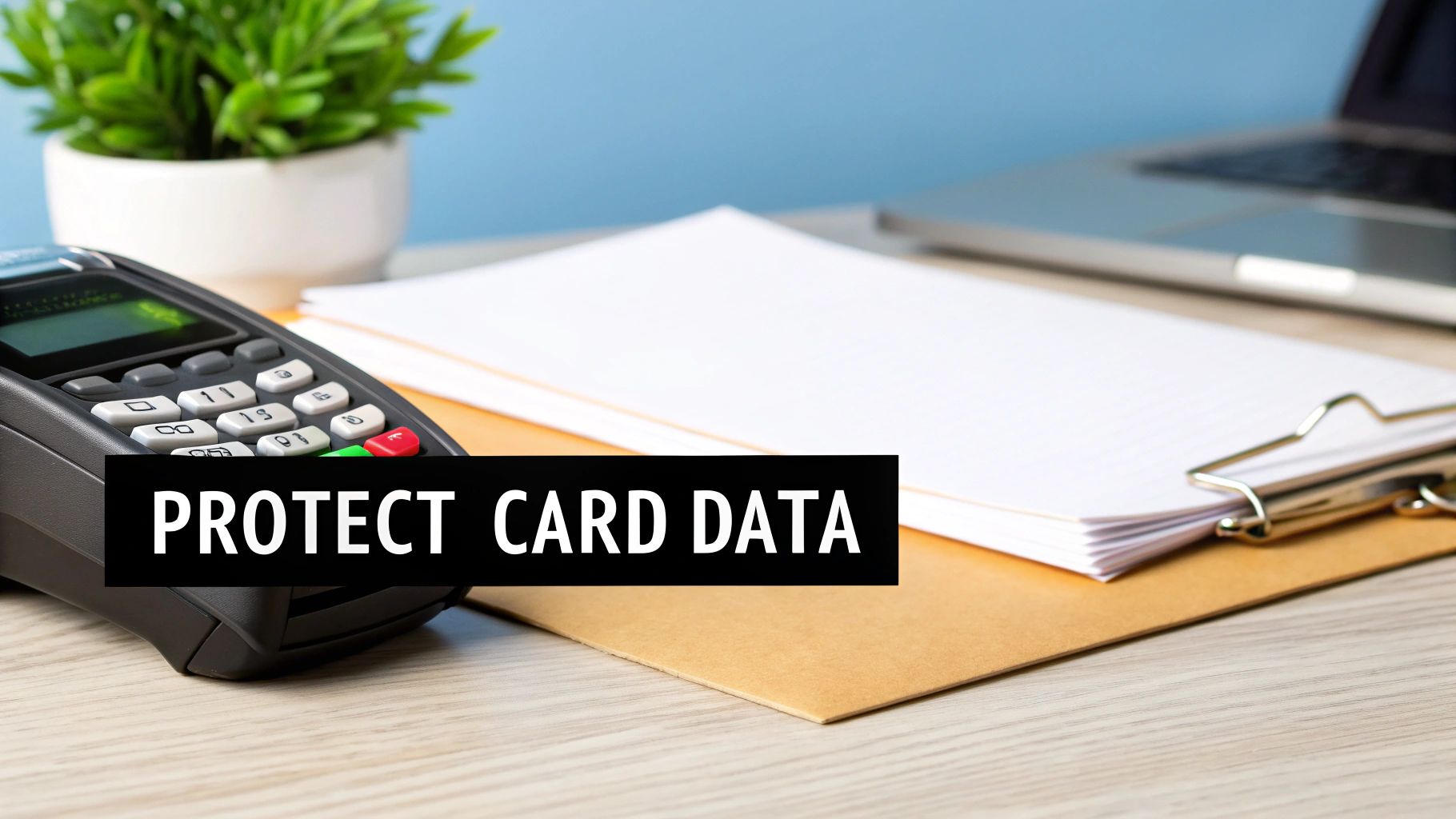
For any business that accepts, processes, stores, or transmits credit card information, the Payment Card Industry Data Security Standard (PCI DSS) is not just a best practice; it's a mandatory requirement. Its incident response guidelines are highly specific and designed to protect cardholder data, making them one of the most critical incident response plan examples for retail, healthcare, and e-commerce businesses. A failure to comply can result in severe fines, loss of card processing privileges, and significant reputational damage.
The PCI DSS framework requires organizations to have a dedicated plan ready to be activated the moment a potential breach of cardholder data is suspected. This plan must cover immediate containment, investigation, and notification procedures involving payment card brands and acquiring banks. It is a prescriptive, compliance-driven approach that leaves little room for ambiguity.
Why It's a Top-Tier Framework
Unlike more general frameworks, the PCI DSS plan is laser-focused on a single, high-value asset: cardholder data. Its prescriptive nature ensures that even SMBs without extensive security teams have a clear, step-by-step guide to follow. This framework is essential because it is directly tied to your ability to do business and is enforced by financial institutions like Visa, Mastercard, and American Express.
For instance, a local retail store that experiences a point-of-sale malware incident must follow PCI DSS requirements precisely. This includes immediately isolating affected systems, preserving forensic evidence, and notifying their payment processor and card brands according to strict timelines. Their response isn't just about fixing the technical issue; it's about maintaining compliance and trust.
Actionable Steps for SMBs
Integrating PCI DSS requirements into your incident response plan is a non-negotiable for any merchant. Here’s how to ensure compliance:
-
Designate a PCI-Specific Team: Create an incident response team with members who understand PCI DSS requirements, including legal, IT, and management representatives.
-
Document Everything: Maintain meticulous logs of all actions taken during an incident. This documentation is crucial for forensic investigations and compliance audits.
-
Isolate Your Cardholder Data Environment (CDE): Proper network segmentation is key. By limiting where card data lives, you can limit the scope of a potential breach, making containment faster and reducing compliance risks. A properly configured firewall is a foundational element for this strategy.
-
Train Your Staff Annually: Conduct regular training sessions focused on PCI DSS incident response, ensuring employees know how to identify and report a potential card data compromise immediately.
Comparison of 8 Incident Response Frameworks
| Framework / Model | Implementation complexity | Resource requirements | Expected outcomes | Ideal use cases | Key advantages |
|---|---|---|---|---|---|
| NIST Cybersecurity Framework Incident Response Plan | Moderate–High — comprehensive and customizable | Moderate–High — training, tools, governance | Risk-based, end-to-end incident lifecycle management and continuous improvement | Organizations seeking standardized, flexible cybersecurity programs and regulatory alignment | Widely recognized, flexible, integrates technical and organizational processes |
| SANS Incident Handler's Handbook (Six-Phase Model) | High — detailed, sequential technical process | High — forensic capability, skilled analysts, training | Forensic-grade evidence preservation and technically rigorous incident handling | IR teams, security consultancies, law enforcement, complex incident investigations | Deep technical guidance, clear phases, strong forensic focus |
| MITRE ATT&CK Framework-Based Incident Response | Moderate–High — mapping TTPs and integrating telemetry | Moderate — threat intelligence, tooling, analyst training | Threat-centric prioritization and improved detection/contextualization of adversary behavior | SOCs, threat hunting, detection engineering, red/blue exercises | Context on attacker techniques, prioritization, detection tuning |
| ISO/IEC 27035 Information Security Incident Management | High — formalized processes aligned with ISO standards | High — documentation, audits, certification effort | Auditable, standardized incident management aligned with ISMS and compliance | Organizations pursuing ISO certification or international standardization | International recognition, auditability, clear roles and escalation |
| CIS Controls Incident Response Framework | Low–Moderate — prioritized, prescriptive controls | Low–Moderate — focused controls, benchmarking tools | Rapid, prioritized improvement in defensive posture and incident readiness | Resource-constrained organizations, SMBs, baseline security programs | Prioritized, easy to communicate and scale, free resources available |
| ITIL Incident Management Process | Moderate–High — process and cultural changes across ITSM | Moderate — ITSM tools, SLAs, staff training | Faster resolution, IT-business alignment and SLA-driven incident handling | Enterprises with mature IT operations, service providers, MSPs | Aligns security incidents with IT operations and business impact |
| Microsoft Security Incident Response Plan Template | Low–Moderate — vendor-specific templates and playbooks | Low–Moderate — Microsoft tools (Sentinel, Defender), product knowledge | Tailored incident playbooks for Microsoft/Azure environments and faster deployment | Organizations heavily invested in Microsoft cloud and productivity platforms | Prebuilt playbooks, deep integration with Microsoft security tools, free support |
| PCI DSS Incident Response Requirements | Moderate–High — compliance-driven mandatory procedures | High — forensic investigation, reporting, audits, remediation costs | Compliance with payment card incident rules and mandated reporting and preservation | Merchants, payment processors, organizations handling cardholder data | Clear regulatory requirements, protects cardholder data, mandatory for payment environments |
From Examples to Execution: Your Next Steps in Incident Response
Navigating the landscape of incident response plan examples can feel like assembling a complex puzzle. We've explored a variety of established models, from the comprehensive NIST framework to the tactical SANS model and even vendor-specific guides from Microsoft. The goal was not to present a single "best" option, but to showcase the diverse tools available for building a resilient defense. The most critical insight is that these frameworks are not rigid mandates; they are powerful, adaptable blueprints.
The true value of these incident response plan examples lies not in adopting one wholesale, but in understanding their core principles to construct a plan that fits your unique operational reality. For a small manufacturing firm in Western Pennsylvania, a plan rooted in the prioritized, practical CIS Controls might be the most effective starting point. A healthcare provider in Eastern Ohio, however, must layer in the rigorous documentation requirements found in frameworks like NIST to meet HIPAA compliance.
Synthesizing a Practical SMB Strategy
The most effective approach for a small or midsize business is often a hybrid one. Think of it as building a custom toolkit rather than buying a pre-packaged one.
-
Foundation: Use the CIS Controls as your structural base. Its prioritized approach is budget-friendly and aligns perfectly with the resource constraints most SMBs face.
-
Tactical Playbooks: Integrate the detailed, six-phase process from the SANS Institute for your high-risk scenarios like ransomware. This gives your technical team a clear, step-by-step guide when the pressure is on.
-
Governance and Communication: Borrow principles from NIST for your overarching governance structure. This framework excels at defining roles, responsibilities, and communication strategies, ensuring everyone from leadership to the IT desk knows their part.
This "mix and match" strategy allows you to create a robust, customized plan that is both technically sound and organizationally practical, avoiding the enterprise-level complexity that can paralyze smaller teams.
The Litmus Test: From Document to Drill
An untested incident response plan is merely a document of good intentions. The single most important takeaway from analyzing these incident response plan examples is the absolute necessity of regular testing.
Tabletop exercises are non-negotiable. These simulated scenarios allow your team to walk through a potential crisis, identify gaps in your plan, clarify roles, and build the muscle memory needed for a real event. Does your communication plan work in practice? Are contact lists up to date? Do team members understand their specific duties? Drills answer these questions in a low-stakes environment, allowing you to fix weaknesses before a real attacker exploits them. A plan that lives only on paper is guaranteed to fail when it matters most.
Ultimately, mastering these concepts transforms incident response from a reactive scramble into a structured, strategic advantage. It minimizes downtime, protects your reputation, reduces financial impact, and builds trust with your customers. It's not just about surviving a cyberattack; it's about emerging stronger, more resilient, and better prepared for the future.
Feeling overwhelmed by the process of building, testing, and managing a comprehensive incident response plan? You don’t have to do it alone. Partnering with Eagle Point Technology Solutions provides your business with the specialized cybersecurity expertise to craft and execute a plan tailored to your specific risks. We transform theory into a decisive, protective advantage. Contact us today for a complimentary cybersecurity assessment to identify gaps and build a plan that truly protects your business.