Let's be honest, for most small and midsize businesses in Western Pennsylvania and Eastern Ohio, IT is a constant headache. You’re focused on running your company, and the last thing you want to deal with is a server crashing during a production run or a laptop giving up the ghost before a major client presentation. When technology breaks, you call for help, pay a hefty bill, and cross your fingers it doesn’t happen again soon.
That old way of doing things is called the "break-fix" model. It’s purely reactive, a bit like calling the fire department after the building is already in flames. It’s stressful, unpredictable, and often more expensive than you think.
A Managed Service Provider, or MSP, completely flips that script.

Shifting from Reactive Fixes to Proactive Strategy
So, what does a managed service provider do that’s so different? Instead of waiting for things to break, an MSP acts as your dedicated, outsourced IT department, working constantly behind the scenes to keep your technology running smoothly. It's a partnership built on a proactive, subscription-based model designed to prevent problems before they can ever disrupt your business.
Think of it this way: a break-fix technician is like a mechanic you only call when your car has already broken down on the side of the road. An MSP is the dedicated pit crew that's constantly tuning your engine, checking your tires, and making sure you never break down in the first place.
The Core Mission of an MSP: Your Trusted Advisor
An MSP doesn't just fix computers. We take full ownership of your entire technology environment, from cybersecurity and cloud services to network performance and strategic planning. The goal isn't just to keep the lights on; it's to ensure your technology is a reliable, secure asset that actively helps you achieve your business goals.
This strategic shift turns IT from a chaotic, unpredictable expense into a stable, manageable investment. Here’s a peek at what that looks like in practice:
- Continuous Monitoring: We keep a vigilant eye on your network, servers, and computers 24/7, spotting potential issues like a failing hard drive or unusual network traffic long before they cause a crisis.
- Preventative Maintenance: We're constantly in the background, updating software, applying critical security patches, and fine-tuning your systems to keep them healthy and secure.
- Strategic Guidance: We sit down with you to talk about the future. As your trusted advisor, we provide expert advice on IT budgeting, planning for growth, and choosing the right technology—like AI or cloud solutions—to give you a competitive edge.
To put it into perspective, here's a quick look at how the two models stack up.
MSP vs Traditional IT Support at a Glance
This table breaks down the fundamental differences between partnering with a proactive MSP and relying on the old reactive, break-fix model.
| Feature | Managed Service Provider (MSP) | Traditional Break-Fix IT |
|---|---|---|
| Approach | Proactive: Focuses on prevention and continuous optimization. | Reactive: Addresses problems only after they occur. |
| Cost Structure | Predictable: Fixed monthly fee for a comprehensive suite of services. | Unpredictable: Billed hourly for labor and parts per incident. |
| Business Impact | Reduces Downtime: Minimizes disruptions and maximizes productivity. | Causes Downtime: Business stops while you wait for a fix. |
| Goal Alignment | Our success is tied to your uptime and stability. | Profits increase when your technology breaks. |
| Strategy | Includes long-term IT planning and strategic guidance. | Focuses solely on immediate technical repairs. |
As you can see, the difference is night and day. An MSP's success is directly tied to your success—if your systems are down, we're not doing our job.
Ultimately, an MSP's job is to deliver peace of mind. We handle the ever-growing complexity of modern IT so you can stop worrying about technology and get back to what you do best: running your business.
Proactive IT Management: The Foundation of MSP Services
At its heart, what a managed service provider really does is flip your company’s relationship with technology on its head. It’s a shift from reactive to proactive. Instead of waiting for a critical server to crash during a busy production run or a key sales presentation, an MSP works tirelessly in the background to stop those failures from ever happening in the first place.
This proactive approach is built on a foundation of several core services that all work together. The goal? To create a stable, secure, and reliable IT environment that just works.
It's a model that’s quickly becoming the standard for modern businesses. The global managed services market is expected to rocket from USD 297.20 billion to USD 878.71 billion by 2032, and North America is leading the charge. This isn't just a trend; it's a fundamental shift as SMBs realize the immense value of having true IT experts in their corner.
24/7 Proactive Monitoring and Maintenance
Imagine having a dedicated team of engineers watching over your entire network—every server, every computer—around the clock. That’s the core of proactive monitoring. We don’t sit around waiting for a panicked call that a server is down. Our systems are designed to alert us to the early warning signs, like unusual processor activity or a hard drive showing signs of failure, long before it ever becomes a crisis.
This constant vigilance allows us to perform preventative maintenance, much like a scheduled oil change for your car. This isn't fluff; it's the daily grind that keeps things running smoothly.
- System Health Checks: We're constantly reviewing logs and performance data to spot potential bottlenecks or hardware issues before they slow you down.
- Automated Updates: Security patches and software updates are deployed seamlessly to shield you from the latest vulnerabilities. This is a critical defense, and you can learn more about its importance in our guide on what is patch management.
- Resource Management: We keep an eye on server capacity and network traffic to make sure your systems can handle your business demands without a hiccup.
To make all this happen, MSPs rely on sophisticated tools. For instance, we use specialized RMM platforms like Atera that give us the visibility and control needed to manage complex IT environments efficiently, from remote monitoring to automating routine tasks.
Responsive Helpdesk Support
Even with the best proactive care, tech problems will pop up. A printer will refuse to connect, a crucial application will crash, or an employee will accidentally delete a file they desperately need. When these moments strike, your team needs support that is fast, effective, and approachable.
A good MSP provides a professional helpdesk that becomes your single point of contact for every IT need. This isn’t a generic call center; it’s a team of skilled technicians who get to know your business and your specific technology. They can resolve most issues remotely, getting your employees back to work with as little disruption as possible.
Real-World Scenario: A Western Pennsylvania manufacturing company we work with relies on a specific server to run its production line software. Our monitoring system detected that the server's main storage drive was showing early signs of failure. Before it could crash and halt production—costing them thousands in downtime—our team cloned the drive and replaced the hardware during off-hours. The result was zero operational downtime. A crisis was completely averted, all thanks to proactive monitoring.
Network and Server Management
Think of your network and servers as the central nervous system of your business. They store your data, run your applications, and connect your team to everything they need. Managing this infrastructure is a complex job that requires specialized expertise to keep it both stable and secure.
An MSP handles all of it, including:
- Configuring and managing routers, switches, and firewalls.
- Ensuring servers are always optimized for peak performance and reliability.
- Managing user accounts and access permissions to keep sensitive data protected.
This is the behind-the-scenes work that keeps your digital infrastructure humming along, so your team can access files, send emails, and use business-critical applications without a second thought.
Backup and Disaster Recovery
Here's a question every business owner should ask: What would happen if a fire, flood, or a devastating ransomware attack wiped out your servers? For many businesses without a solid plan, it would be a catastrophic, company-ending event. That's why a core service every MSP provides is a robust Backup and Disaster Recovery (BDR) strategy.
And let's be clear, this is so much more than just copying files to an external hard drive. A modern BDR solution involves:
- Automated Backups: We take regular, automated snapshots of your entire system—servers, data, applications, the whole nine yards.
- Offsite and Cloud Storage: Encrypted copies of your backups are stored in multiple secure locations, protecting them from any local disaster.
- Recovery Planning: We create and, more importantly, test a detailed plan to restore your operations quickly if a major outage ever occurs.
A strong BDR plan is your ultimate safety net. It provides invaluable peace of mind, ensuring that no matter what happens, your critical business data is safe and recoverable.
Building a Modern Cybersecurity Defense
Beyond just keeping the lights on, what does a managed service provider do to shield your business from the non-stop barrage of digital threats? We build a fortress. In today's world, cybersecurity isn't an optional extra; it’s a core requirement for survival, especially for small and midsize businesses who are, unfortunately, preferred targets for cybercriminals.
A real defense isn't about installing a single piece of antivirus software and crossing your fingers. It’s about creating a layered security strategy designed for the specific risks your business faces—whether you're a professional services firm in Western Pennsylvania handling sensitive client data or a healthcare provider in Eastern Ohio responsible for protecting patient information.
Beyond Basic Antivirus
Let's be blunt: traditional antivirus software is no match for today’s sophisticated attacks. Cybercriminals have leveled up, and our defenses must do the same. A skilled MSP goes much deeper, implementing a layered approach that protects your business from every conceivable angle.
This means deploying advanced tools that work in concert to spot, block, and shut down threats before they can do any real damage. The goal is simple: make it as difficult as possible for an attacker to find a way into your network.
Here’s a look at the essential layers an MSP puts in place:
- Next-Generation Firewalls: Think of this as a highly intelligent security guard for your network. It doesn't just block known bad guys; it inspects all traffic coming in and out for suspicious behavior, stopping attacks before they ever reach your servers.
- Advanced Email Filtering: Since most cyberattacks start with a malicious email, this layer is non-negotiable. It scans incoming messages for phishing links, malware-packed attachments, and business email compromise scams, neutralizing threats before they even land in an employee's inbox.
- Endpoint Detection and Response (EDR): This is like having a security camera and an alarm system on every single computer and server. EDR constantly monitors for signs of an active attack and can automatically quarantine an infected device to stop a threat from spreading across your entire network.
This proactive approach is at the heart of modern IT management, where security is woven into every service.
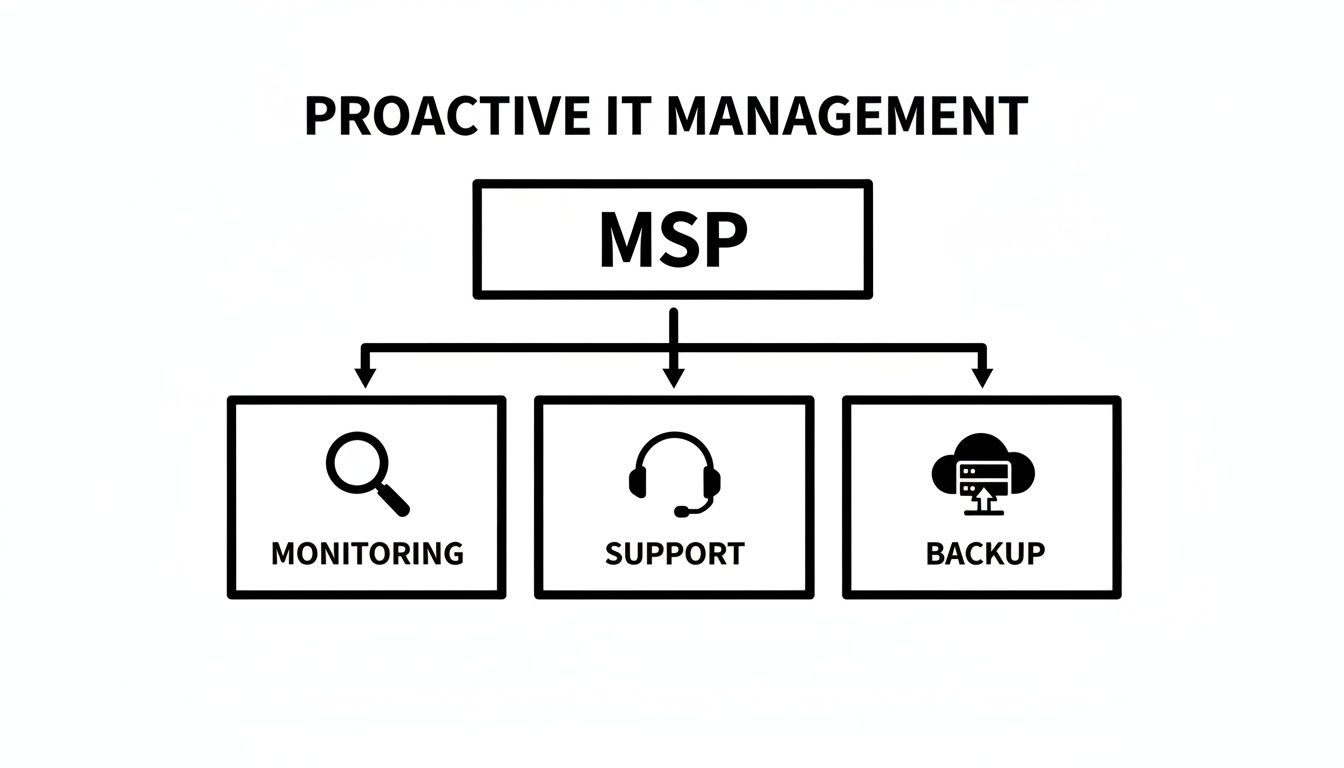
As you can see, a true MSP integrates monitoring, support, and backups into one cohesive strategy, with cybersecurity threaded through every single component.
The Human Element and Compliance
Technology, however, is only one piece of the puzzle. Your employees are your first line of defense, but they can also be your biggest weakness if they aren't trained to recognize threats. That’s why a comprehensive MSP security service includes ongoing employee security awareness training.
This practical training teaches your team how to spot phishing emails, use strong passwords, and avoid common scams, turning them from a potential risk into a powerful security asset.
For many businesses, cybersecurity is also a matter of compliance. Industries like healthcare (HIPAA) and manufacturing (CMMC) operate under strict data protection regulations. A good MSP helps you navigate these complex rules, implementing the right controls and documentation to ensure you meet your obligations and steer clear of crippling fines. This is a crucial function, as a single breach can have devastating legal and financial consequences.
Your Strategic Security Partner
The demand for robust cybersecurity has exploded, which is why partnering with an MSP has become essential for secure, scalable IT. Industry data shows that mid-sized enterprises are a major driver of this trend, accounting for 61% of new contracts focused on security. This is part of a broader market boom, with global IT managed services revenue growing 13% year-over-year to US$595 billion, delivered by around 341,000 partners worldwide. By 2033, the market is projected to blow past $1 trillion, proving the critical role MSPs play in helping businesses grow without the overhead. You can discover additional insights on MSP statistics from Infrascale to see the full picture.
Ultimately, an MSP acts as your dedicated security team, providing the expertise, tools, and vigilance that are impossible for most SMBs to build in-house. It’s about more than just technology; it’s about providing peace of mind so you can focus on your business with confidence.
Gaining Strategic Guidance with a Virtual CIO
Beyond fixing the day-to-day tech hiccups and building a strong cybersecurity defense, a true managed service provider should elevate the conversation. It's about moving from technical fixes to business strategy. Many small and midsize businesses are masters of their craft but don't have the high-level technology leadership needed to map out the future. This is where a virtual Chief Information Officer, or vCIO, becomes a total game-changer.
Instead of taking on the massive expense of a full-time, six-figure executive, you get access to a seasoned technology strategist who acts as a part of your leadership team. A vCIO isn’t worried about a single broken computer; they’re focused on the big picture. Where is your business headed, and how can technology—like AI and cloud services—help you get there faster and more efficiently?
Your Technology Financial Advisor
Think of a vCIO as a financial advisor, but for your technology. A financial planner helps you make smart investments to grow your wealth. In the same way, a vCIO helps you make smart technology investments that deliver the best possible return for your business. Their entire job is to align every dollar you spend on IT with your core business goals.
This strategic relationship completely changes the dynamic. We stop being just a vendor who fixes things and become a genuine partner invested in your long-term success. The focus shifts from reactive problem-solving to proactive planning and growth.
What a vCIO Delivers to Your Business
A vCIO from an MSP like Eagle Point Technology Solutions brings critical functions to the table that are often out of reach for SMBs. This is a huge reason why mid-sized enterprises are driving 61% of new managed services contracts—they’re prioritizing this strategic layer right alongside their core IT support. This is all part of a massive market shift, with the global managed services market expected to jump from USD 297.20 billion to USD 878.71 billion by 2032. You can discover more about this managed services growth from Fortune Business Insights.
So, what does a vCIO actually do?
- Technology Roadmaps: We sit down with you to create a clear, multi-year plan. This roadmap outlines necessary upgrades, new projects, and strategic initiatives—like a cloud migration or AI integration—ensuring your technology evolves with your business, not just in reaction to it.
- IT Budgeting and Forecasting: Say goodbye to surprise capital expenses. A vCIO helps you build a predictable, proactive IT budget you can actually plan around. This turns a volatile cost center into a stable, strategic investment.
- Vendor Management: We take on the headache of dealing with all your different tech vendors—internet, software, hardware, you name it. We'll handle the negotiations and support calls to make sure you're getting the best service and value.
- Business Process Improvement: We look at how you work and find opportunities where technology can make a real difference. This could be anything from AI-powered automation to a new cloud application that boosts productivity across your team.
For a distribution company in Eastern Ohio, this might mean planning a network infrastructure upgrade to support a new warehouse management system. For a retail business in Western Pennsylvania, it could involve creating a strategy to integrate AI-powered analytics to better understand customer behavior.
Ultimately, a vCIO ensures your IT isn't just a line item on your expense report but a powerful engine for growth. By providing this high-level guidance, we help you make informed decisions that give you a real competitive edge in your market. To see how this works in practice, you can learn more about our approach to expert IT leadership.
Navigating MSP Pricing and Proving the ROI
Let's talk about the bottom line. As a business owner in Western Pennsylvania or Eastern Ohio, you have to watch every dollar. So when you hear about managed IT services, the first question is always, "What's it going to cost me?"
But that's not quite the right question. The real conversation should be about the shift from viewing IT as a chaotic, unpredictable expense to seeing it as a strategic investment. With an MSP, you're not just buying tech support; you're buying stability, security, and a predictable budget. Gone are the days of surprise, sky-high bills from a break-fix technician when a server crashes. Instead, you get a fixed, manageable monthly fee you can actually plan for.
Common MSP Pricing Models Explained
While every provider is a bit different, most MSP pricing boils down to a few core models. The key is finding one that truly fits your business—your team size, the technology you rely on, and how you operate day-to-day.
- Per-User Pricing: This is probably the most popular and straightforward model out there. You pay a simple flat fee each month for every employee. It’s incredibly easy to scale up or down as you hire or as team members move on. This works great for businesses where people use multiple devices, like a laptop at the office, a desktop at home, and a company smartphone.
- Per-Device Pricing: Here, you pay a flat fee for each piece of hardware being managed—think servers, workstations, printers, and network gear. This can be a smart, cost-effective choice for environments with more devices than people, like a manufacturing facility with shared computer stations on the shop floor.
- Tiered Plans: Many MSPs, including us, offer packages that bundle different levels of service, often labeled something like Bronze, Silver, and Gold. A basic tier might cover essential monitoring and maintenance, while a premium tier could add on strategic vCIO services, advanced cybersecurity, and priority support. This lets you pick the exact level of coverage that aligns with your budget and your needs.
Shifting from Cost to Investment
The monthly fee isn't the whole story. The real value is found when you calculate the return on that investment, especially when you stack it up against the alternatives. Frankly, partnering with an MSP is almost always more cost-effective than trying to do it all yourself.
An often-overlooked fact is that a critical skills gap costs individual companies an average of $800,000 annually in lost productivity and opportunities. An MSP instantly closes that gap. You get an entire team of certified experts—cybersecurity specialists, network engineers, cloud architects—for a fraction of what it would cost to hire even one senior IT professional.
This investment delivers tangible returns you can see and feel. For a deep dive into managing these expenses effectively, check out our guide on IT cost optimization strategies.
To truly grasp the value, let's compare what it looks like to partner with an MSP versus hiring an in-house IT specialist.
MSP vs In-House IT Cost-Benefit Analysis for SMBs
| Factor | Managed Service Provider | In-House IT Staff |
|---|---|---|
| Annual Salary & Benefits | Included in monthly fee (typically $1,500 – $5,000/mo total) | $75,000 – $120,000+ per employee (salary, benefits, taxes) |
| Access to Expertise | Full team of specialists (security, cloud, network) | Limited to the knowledge of 1-2 individuals |
| Training & Certification | MSP covers all ongoing training costs | You pay for certifications, conferences, and training |
| Tools & Software | Enterprise-grade tools included in the fee | $10,000 – $30,000+ annually for necessary software licenses |
| Coverage & Availability | 24/7/365 monitoring and support | Limited to work hours; vacations and sick days mean no coverage |
| Scalability | Easily scales up or down with your business needs | Hiring/firing is slow and expensive |
| Total Annual Cost (Est.) | $18,000 – $60,000 | $100,000 – $160,000+ |
The table makes it clear: the total cost of ownership for in-house IT far exceeds the predictable fee of an MSP, all while providing a narrower range of expertise.
Ultimately, the most significant ROI comes from stopping expensive disasters before they ever happen. Think about it:
- Reduced Downtime: Our proactive management spots and fixes issues that could otherwise bring your operations to a grinding halt. Just a few hours of downtime can cost a small business thousands in lost sales and wages.
- Enhanced Security: A single ransomware attack can be an extinction-level event for a small business. The cost of a solid MSP partnership is a rounding error compared to the financial ruin and reputational damage of a data breach.
- Predictable Spending: That fixed monthly fee does more than prevent surprise repair bills. It empowers you to plan your finances accurately, so you can invest in growing your business instead of constantly putting out fires.
By preventing just one major security incident or system outage a year, an MSP partnership pays for itself, often many times over. It’s a direct investment in your company’s stability, security, and future growth.
How to Choose the Right MSP for Your Business
Picking a managed service provider isn't like hiring a plumber. It’s about bringing a long-term partner into the fold, someone who will get to know the ins and outs of your business operations. Making the right choice is absolutely critical, especially for SMBs here in Western Pennsylvania and Eastern Ohio, where a provider who understands the local business pulse can make all the difference.
To make a solid decision, you need to look past the sales pitch and ask the tough questions. It’s less about what an MSP does on paper and more about how they deliver those services in a way that actually helps your business grow. Think of it like a final-round interview for a key leadership position on your team.

Key Questions to Ask Any Potential MSP
To properly vet potential partners, you need to come prepared. Arm yourself with questions that get to the heart of their service, their expertise, and how they treat their clients. If you get vague, canned answers, that’s a major red flag. You want a partner who gives clear, confident responses they can back up.
Here’s a practical checklist to guide your conversations:
- What are your guaranteed response times? Ask to see their Service Level Agreements (SLAs). How fast will they jump on a critical server-down issue versus a low-priority ticket for a password reset? Getting this straight upfront saves a ton of frustration down the road.
- What technical certifications does your team hold? You're looking for proof of expertise from major players like Microsoft or Cisco. This isn't just a piece of paper; it shows they're committed to ongoing training and actually know their stuff.
- Can you provide client testimonials or case studies? The best proof of a job well done is a history of success. Ask for references from businesses in your industry or of a similar size. A good MSP will be proud to share them.
- How do you approach cybersecurity? A quality provider should be able to walk you through their multi-layered security strategy, from firewalls and endpoint protection to employee awareness training. If their answer is just, "we install antivirus," that’s not nearly enough in today's world.
- Do you have experience with our industry-specific software or compliance needs? If you're in healthcare dealing with HIPAA or a manufacturing firm with specialized software, you need a partner who already speaks your language and understands your unique regulatory headaches.
Evaluating Technical and Cultural Fit
Beyond the checklist, trust your gut on the cultural fit. Do they talk to you like a partner, or are they drowning you in technical jargon you don't understand? A true partner takes the time to explain complex issues in plain English.
Also, take a look at their technology stack. For businesses running on Amazon Web Services, for example, it's crucial to understand the specialized role of an AWS managed service provider to make sure they can properly secure and optimize your cloud setup. It proves they have deep, specialized knowledge that matches your specific infrastructure.
The goal is to find a partner who feels like an extension of your own team—someone who is genuinely invested in your success, proactively offers strategic advice, and is always looking out for your best interests.
Choosing the right MSP is a foundational decision that will impact your productivity, security, and growth for years. Take your time, do your homework, and pick a partner who will empower your business to succeed.
Frequently Asked Questions About Managed IT Services
Even with a good grasp of the core services, it's completely normal for business owners to have some lingering questions. Handing over the keys to your IT is a big decision, and you deserve total clarity before making a move. Here are some quick, straight-to-the-point answers to the concerns we hear most often from SMBs across Western Pennsylvania and Eastern Ohio.
Will I Lose Control of My IT if I Hire an MSP?
Not in the slightest. A good MSP is a strategic partner, not a dictator. You’re always in the driver's seat when it comes to your business strategy and goals; we just handle the technical heavy lifting to get you there and provide expert advice along the way.
Think of us as your in-house IT department, ready to execute your vision and keep you in the loop. We worry about the "how," but you always, always direct the "what" and the "why."
Is an MSP Affordable for a Small Business?
Yes, and honestly, it’s often a smarter financial move than the alternatives. Once you add up the true costs of hiring, training, and retaining just one skilled IT professional—not to mention the catastrophic expense of unexpected downtime or a security breach—an MSP's predictable monthly fee almost always comes out on top.
You get access to an entire team of specialists for what’s typically a fraction of the cost of a single senior-level hire. It's an investment in stability that pays for itself by stopping expensive problems before they ever start.
How Difficult Is It to Switch to an MSP?
When you work with a professional MSP, the process is designed to be smooth and cause minimal disruption. It all starts with a deep dive into your current IT setup and, more importantly, where you want your business to go.
The entire switch is carefully managed so your day-to-day operations aren't interrupted. A great provider will map out a custom migration plan, deploy any new tools discreetly, and transition responsibilities seamlessly. You'll get clear communication at every single stage, so you're never left wondering what's happening.
Do I Still Need an MSP if My Business Is Very Small?
Absolutely. In fact, the smallest businesses often see the biggest benefits. Without an MSP, who handles IT? Usually, it's the owner or another team member who gets pulled away from the work that actually generates revenue.
An MSP gives you the kind of enterprise-level security and support that would normally be out of reach. This levels the playing field, protecting your small but mighty business from the same threats that target large corporations. It frees you up to focus entirely on growth, knowing your tech backbone is solid and secure.
Partnering with the right MSP can turn your technology from a constant headache into your greatest asset for growth. If you’re ready to see what a proactive, strategic IT partnership can do for your business, the team at Eagle Point Technology Solutions is here to help.
Schedule a free, no-obligation consultation today to talk about the unique challenges and goals you have for your business.