As a business owner in Western Pennsylvania or Eastern Ohio, you're constantly juggling growth, operations, and the bottom line. You know technology is critical, but are you making the right decisions? Are you spending too much on IT, or worse, not enough in the right places? Are you truly protected from a ransomware attack that could shut you down?
These are big, strategic questions that go far beyond day-to-day IT support. Answering them requires executive-level expertise, but the six-figure salary of a full-time Chief Information Officer (CIO) is out of reach for most small and medium-sized businesses (SMBs).
So, what is a virtual CIO? Think of a vCIO not as your everyday IT support person, but as a strategic partner who sits at your leadership table. They’re an outsourced executive who provides top-tier technology guidance on a part-time, affordable basis, making sure every dollar you spend on tech directly fuels your company's growth, security, and profitability.
Your Guide to Strategic IT Leadership
For most SMB owners, the thought of hiring a full-time Chief Information Officer feels like a non-starter. The salary, benefits, and overhead just aren't in the budget. And yet, the need for that level of strategic thinking has never been more intense.
You're wrestling with big questions that go way beyond simple IT fixes. How do we build a tech budget that actually makes sense for a manufacturing plant or a professional services firm? Are we really protected from a ransomware attack? Can our current cloud setup handle the growth we’re aiming for next year?
This is precisely where a virtual CIO steps in. A vCIO becomes a key part of your leadership team, connecting your technology decisions directly to your business goals. They offer the forward-thinking guidance you need to tackle today's challenges while getting ready for tomorrow's opportunities.

Bridging the Gap Between Daily IT and Future Growth
Many businesses already have someone—an in-house person or a managed service provider—handling the immediate needs. They fix computer glitches, manage servers, and answer helpdesk tickets. That work is absolutely essential, but it’s reactive. A vCIO, on the other hand, is completely proactive and focused on the future.
A vCIO's job isn't to fix a broken printer. It's to build a technology roadmap that prevents you from buying the wrong printer—or server, or software—in the first place. Their entire focus is on maximizing value and minimizing risk for the long haul.
This kind of service is quickly becoming a game-changer for ambitious SMBs. The global vCIO market is currently valued at $13.9 billion and is projected to skyrocket to $36.4 billion by 2033. This boom is driven by businesses just like yours, looking to align their technology with big-picture goals without the hefty price tag of an in-house CIO.
At a Glance: In-House CIO vs. Virtual CIO
It can be tough to visualize the difference, so here’s a quick breakdown of how a traditional CIO stacks up against a vCIO.
| Attribute | Full-Time In-House CIO | Virtual CIO (vCIO) Service |
|---|---|---|
| Cost | Six-figure salary plus benefits, bonus, and overhead. A major investment. | A predictable monthly fee, offering a fraction of the cost of a full-time executive. |
| Engagement | Full-time, 40+ hours per week. Deeply embedded in daily operations. | Part-time and flexible. Engages for strategic meetings, planning, and oversight. |
| Focus | Blends daily management with long-term strategy. Can get pulled into operational fires. | Purely strategic. Focused on planning, budgeting, security, and long-term business alignment. |
| Expertise | Expertise is limited to one individual's background and experience. | Access to a team of experts with diverse knowledge across cybersecurity, cloud, and AI. |
The takeaway is simple: a vCIO gives you the strategic brainpower you need, precisely when you need it, without the full-time financial commitment.
What Does a vCIO Actually Do For You?
Partnering with a vCIO brings several key advantages to the table, especially for SMBs with limited resources:
- Strategic Technology Planning: They'll work with you to develop a multi-year IT roadmap that’s perfectly aligned with where you want to take your company.
- Budgeting and Cost Control: Your IT spending will stop being a reactive, unpredictable expense and become a strategic, value-driven investment.
- Cybersecurity and Compliance Oversight: A vCIO ensures your business is protected against threats and meets any industry-specific regulations you face, like HIPAA or CMMC.
- Vendor Management: They take the lead on negotiating with software and hardware vendors, making sure you get the best solutions at the best possible price.
By bringing in this kind of expert IT leadership, you get access to C-suite expertise that fits your budget and your needs. It’s a powerful asset for any business in our region that’s ready to grow smarter.
What a Virtual CIO Actually Does for Your Business
So, what does a vCIO really do all day? It's a fair question. Let's get past the formal definition and talk about the real-world impact they can have on a business with 50 employees.
A vCIO isn’t some consultant who just hands you a report and vanishes. They become an active part of your leadership team, focused on one thing: turning your technology from a confusing, reactive expense into a powerful tool that actively drives your company forward.
This means they aren't bogged down in day-to-day helpdesk tickets or troubleshooting printer jams. Instead, they’re zeroed in on high-level direction. They’re the ones tackling the big questions that keep business owners up at night, like, "Are we spending the right amount on IT?" or "Is our tech actually ready for the growth we're planning over the next three years?"
Strategic Technology Roadmapping
One of the most valuable things a vCIO brings to the table is a multi-year technology roadmap. And no, this isn't just a shopping list of new servers and software. It’s a detailed plan that ties every single technology decision directly back to your specific business goals.
Let's say a manufacturing firm here in Western Pennsylvania wants to expand its production line in two years. A vCIO gets ahead of that, ensuring the network infrastructure, data storage, and operational software can handle the increased load before it becomes a bottleneck. This kind of forward thinking prevents crippling downtime and costly operational headaches down the line.
This is the key difference between a vCIO and standard IT support. While your day-to-day IT team keeps the lights on, the vCIO is designing the blueprint for the entire building. To get a better sense of how these roles complement each other, check out our guide on what a managed service provider does.
IT Budgeting and Financial Oversight
For many small and midsize businesses, the IT budget is a constant source of frustration—a messy mix of surprise repairs and unpredictable costs. A vCIO steps in to tame that beast, turning your IT spending into a predictable, manageable investment with a clear return.
How do they pull this off?
- They analyze current spending: First, they dig in to find waste, redundant software subscriptions, and overpriced services that are draining your budget.
- They create predictable budgets: Next, they develop annual and quarterly budgets that align perfectly with the technology roadmap, eliminating nasty surprises.
- They demonstrate ROI: Every major IT expense is tied back to a tangible business benefit, whether it's boosting productivity or slashing security risks.
A vCIO’s goal is to break the cycle of "break-fix" spending. They shift the financial focus from just repairing what’s broken to strategically investing in technology that prevents things from breaking in the first place. It’s about creating stability and efficiency.
Vendor Management and Negotiation
Let's be honest—dealing with tech vendors can be a massive time-sink for any business owner. A vCIO takes that entire burden off your plate, acting as your expert negotiator and single point of contact for all things tech.
They'll handle negotiating contracts for new software, internet service providers, and hardware purchases, making sure you get the best possible terms and value. Expert guidance on complex projects, like a CIO's Guide to SharePoint Migration Planning, is part of their strategic value. By managing all those vendor relationships, a vCIO frees up your leadership team to focus on running the business, confident that your tech partnerships are in good hands.
Cybersecurity and Compliance Governance
Finally, your vCIO is your high-level guardian for cybersecurity and compliance. They do more than just install antivirus software; they build and oversee your entire security strategy from the ground up.
This means conducting deep-dive risk assessments to find vulnerabilities you didn't even know you had. From there, they implement policies and controls to protect your business from the relentless barrage of threats like ransomware and phishing attacks.
For businesses in regulated industries like healthcare (HIPAA) or manufacturing (CMMC), this strategic oversight is absolutely essential. A vCIO ensures your company meets all necessary compliance requirements, protecting you from crippling fines and the reputational damage that follows a breach. They turn technology from a potential liability into a secure foundation for growth.
The Clear Financial Case for a Virtual CIO
For any business owner in Western Pennsylvania or Eastern Ohio, decisions always circle back to the bottom line. You have to know that every dollar you invest is pulling its weight. It's easy to look at technology as just another column in the expense ledger, but a virtual CIO flips that script. They turn IT into a strategic investment with a clear, compelling return.
The most immediate financial win is obvious: you get executive-level strategy without the executive-level salary. A full-time CIO comes with a hefty six-figure price tag, benefits, and overhead. In contrast, vCIOs operate on flexible, fractional models that give you the brainpower you need, right when you need it, for a fraction of the cost.
But the real value of a vCIO goes so much deeper than just salary savings. Their impact is felt directly on your profitability through proactive cost control and sharp risk mitigation.

Beyond Salary Savings: Tangible Financial Wins
A vCIO’s core job is to align your technology spending with your actual business goals. This process naturally roots out inefficiency and waste, translating into financial victories that can save your company thousands—if not tens of thousands—every single year.
So, where does this money come from? It’s not magic. It’s strategy.
- Preventing Overspending: They conduct thorough audits of your software licenses, cloud services, and vendor contracts to cut redundant or unnecessary costs. For instance, they might discover you're paying for 50 premium software licenses when only 30 employees are actively using them. That's an immediate saving.
- Boosting Team Productivity: A good vCIO makes sure your team has the right tools to work efficiently. By swapping out slow, clunky systems for a modern, streamlined tech stack, they cut downtime and frustration. This lets your people focus on what they do best: generating revenue.
- Smarter Vendor Negotiations: Armed with deep industry knowledge, a vCIO can negotiate much better rates and terms on everything from your internet service to new hardware. They know the market, they know the vendors, and they know how to get you the maximum value for every dollar.
By zeroing in on these areas, a vCIO transforms your IT budget from a reactive expense account into a predictable, optimized investment. You can dive deeper into this process by exploring our complete guide to IT cost optimization strategies.
Mitigating Six-Figure Risks
While saving money is great, avoiding catastrophic costs is even better. This is where a vCIO becomes absolutely vital, acting as a shield against financial disasters that can cripple a small or mid-sized business.
One of the biggest risks out there is non-compliance. For a healthcare provider in our region, a single HIPAA violation can trigger fines that easily climb into the six-figure range. A vCIO implements and oversees the controls needed to meet these strict regulatory standards, effectively serving as an insurance policy against those crippling penalties.
The same logic applies to cybersecurity. The cost of just one ransomware attack—factoring in downtime, data recovery, and reputational damage—can be absolutely devastating. A vCIO’s strategic security planning drastically reduces this risk, saving you from a potentially business-ending financial hit.
Think of it this way: a vCIO doesn’t just help you spend less; they prevent you from losing more. Their strategic oversight is a direct investment in your company's financial stability and long-term resilience.
To really grasp the financial upside, it helps to look at benchmarks for hourly IT consulting rates. When you compare those numbers to a fractional, strategic service, it’s clear how much value you get versus ad-hoc support or a full-time executive salary. The financial case is undeniable: a virtual CIO isn't just another IT expense; they are a powerful driver of your financial health.
How a vCIO Champions Security and Modernization
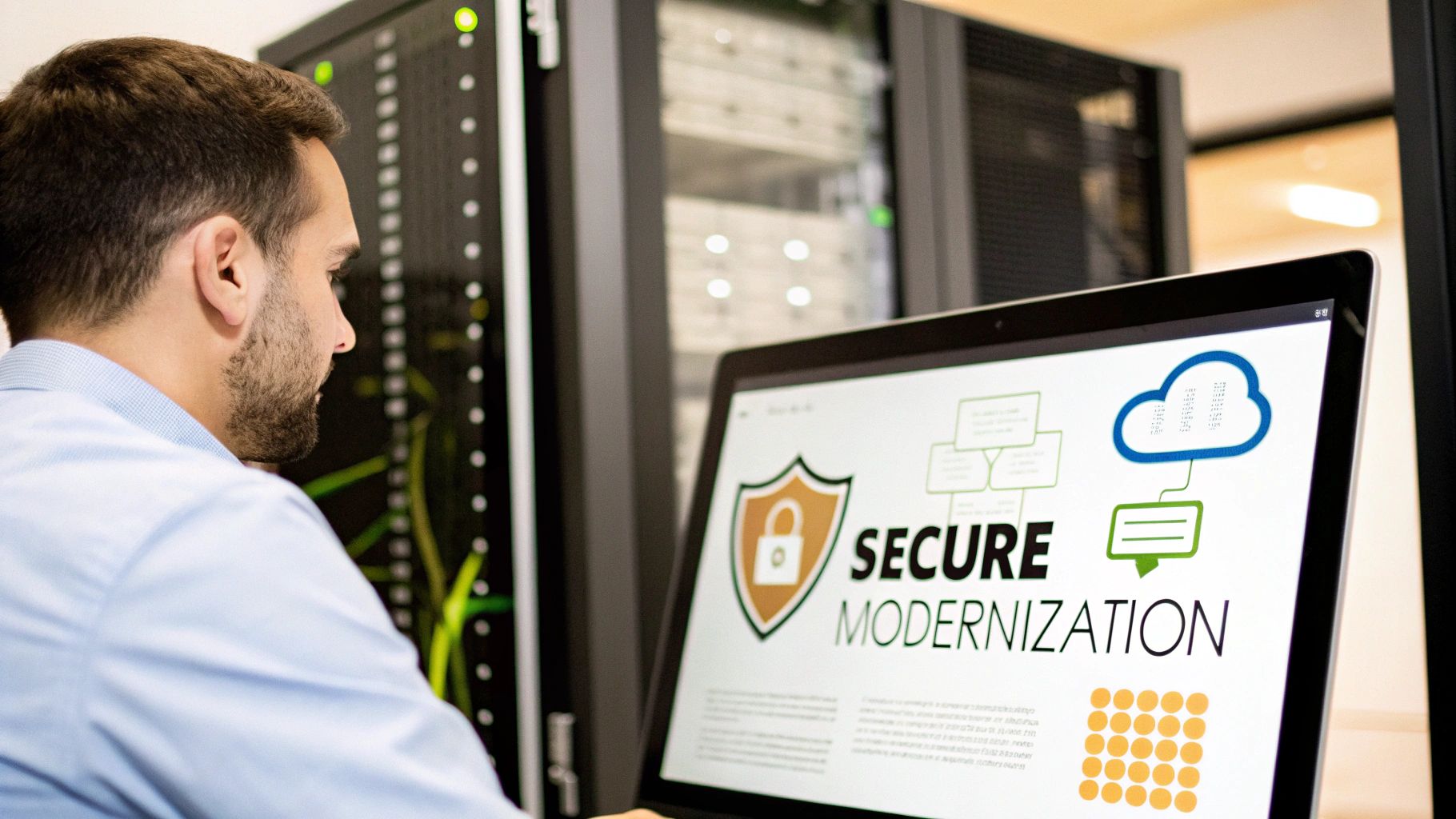
In today's market, technology isn't just about keeping the lights on; it’s about creating a real competitive edge. For many SMBs, the idea of "modernization" can feel overwhelming—a massive project with a confusing price tag. This is where a vCIO steps in, acting as your guide to turn abstract concepts like digital transformation into practical, impactful projects.
They don't just push the latest trendy software. A vCIO starts by getting to the root of your specific business challenges. They translate your goals—like improving production efficiency for a manufacturing company or enhancing customer service for a retailer—into a concrete technology plan. This could mean leading a seamless cloud migration to Microsoft 365 or implementing practical AI-powered automation tools that free up your staff from repetitive tasks.
Elevating Your Cybersecurity Posture
Beyond operational upgrades, a vCIO’s most critical role is championing your cybersecurity. For too many businesses, security is a patchwork quilt of antivirus software and a firewall. A vCIO elevates this from a simple checklist to a comprehensive, forward-thinking strategy designed to protect your entire organization from threats like ransomware and business email compromise.
This strategic oversight is all about building layers of defense. A vCIO doesn't just react to threats; they work to prevent them from happening in the first place.
A vCIO shifts your security mindset from "Are we protected today?" to "Are we resilient enough for tomorrow?" They build a security program that adapts to new threats and supports your company’s growth without exposing you to unnecessary risk.
This involves several key activities that go far beyond basic IT support:
- Comprehensive Risk Assessments: They conduct deep-dive analyses to identify vulnerabilities hiding in your network, processes, and even employee habits.
- Practical Security Policies: A vCIO develops clear, easy-to-follow security policies that your team can actually use, covering everything from password management to data handling.
- Layered Defense Strategy: They make sure you have a robust security stack, including advanced threat detection, email filtering, and a solid backup and disaster recovery plan.
This high-level governance ensures your business isn't just defended against today's threats but is prepared to handle the challenges just over the horizon.
Guiding Your Business into the Future with AI
Modernization also means preparing for what's next, and for many businesses, that means AI. While artificial intelligence might sound like something reserved for huge corporations, a vCIO makes it accessible and practical for SMBs. They help you cut through the hype to find real-world applications that can actually make a difference, such as using AI-powered tools for data analysis, customer service automation, or streamlining operations.
With full AI implementation soaring 282% year-over-year among businesses, a vCIO is critical in orchestrating this shift for companies your size. They focus on initiatives that enhance employee skills—by as much as 43%—and mitigate the risks of falling behind the competition. You can explore the latest research on how CIOs are leading this charge and learn more about key trends shaping the future of business AI.
A Strategic Partnership for Growth
Ultimately, a vCIO acts as the bridge between your current operations and your future ambitions. They take the complex worlds of cybersecurity, cloud services, and AI and make them manageable, strategic, and directly tied to your bottom line.
Their job is to ensure that every technology decision is a smart business decision. By championing a strong security posture and guiding you through meaningful modernization projects, a vCIO doesn't just protect your business—they position it to win.
Warning Signs: Is It Time for a Virtual CIO?
Many business owners I talk to in Western Pennsylvania and Eastern Ohio feel the friction. They know technology is holding them back, but they can’t quite put a finger on why. You sense things could be more efficient, more secure, and better planned, but the path forward feels foggy. This is a classic growing pain for companies where technology has morphed from a simple tool into a complex, mission-critical engine.
Recognizing you need strategic help is the first step. If you find yourself nodding along with the scenarios below, it’s a strong signal that the reactive, day-to-day firefighting approach to IT just isn’t cutting it anymore. These aren't just minor annoyances; they're symptoms of a strategic gap a vCIO is perfectly suited to fill.
Your Annual IT Budget Is a Guessing Game
Does your IT budget feel less like a strategic plan and more like a slush fund for emergencies and surprise software renewals? If you're constantly ambushed by large, unplanned bills for failed servers or mandatory software upgrades, you’re operating without a technology roadmap.
A vCIO flips this reactive spending cycle on its head, building a predictable, forward-looking budget. They connect every dollar to a clear business goal, making sure you’re investing in tech that fuels growth, not just patching what’s broken. This turns your IT budget from a frustrating expense into a powerful planning tool.
The goal is to stop asking, "What did we spend on IT last year?" and start confidently stating, "Here is what our technology will achieve for us next year." This shift from hindsight to foresight is a core function of a vCIO.
You Worry Constantly About a Cyberattack
You read the headlines. You know that threats like ransomware and data breaches are a real danger, especially for businesses right here in our region. But if your defense plan is basically an antivirus subscription and crossed fingers, you’re leaving your business dangerously exposed. That nagging sense of unease about security means no one is truly steering the ship.
A virtual CIO takes ownership of your cybersecurity posture. They don’t just install software; they build a comprehensive security program. This includes:
- Risk Assessments: Proactively finding your specific weak spots before an attacker does.
- Security Policies: Creating simple, clear rules for your team to follow that actually reduce risk.
- Incident Response Planning: Building a concrete playbook for what to do if an attack happens, which drastically minimizes damage and downtime.
This proactive governance transforms vague anxiety into a well-managed and measurable risk.
Your Team Complains About Outdated Systems
Are you hearing a constant drumbeat of complaints about slow computers, clunky software, or processes that just don’t make sense? These aren't just minor grumbles. They’re direct indicators of lost productivity that’s eating into your bottom line. When your technology frustrates your team instead of empowering them, it’s a dead giveaway that your IT strategy is misaligned with your business operations.
A vCIO digs into your entire tech stack from the perspective of business efficiency. They pinpoint the bottlenecks and craft a sensible modernization plan that gives your team the right tools for the job. This focus on user experience and workflow optimization ensures your technology investments lead to a more productive, and frankly, happier team. Your systems should be a competitive advantage, not a source of daily frustration.
Feeling like some of this hits a little too close to home? That's completely normal for a growing business. The key is recognizing these symptoms for what they are: signs that you've outgrown your current approach to IT. This checklist can help you clarify if the challenges you're facing point toward a need for strategic vCIO guidance.
Checklist: Is It Time for a Virtual CIO?
| Symptom or Business Challenge | Why This Indicates a Need for a vCIO |
|---|---|
| IT costs are unpredictable and often reactive. | You lack a technology roadmap and budget aligned with business goals. A vCIO creates predictable, strategic IT investments. |
| You have no clear cybersecurity strategy or plan. | You're vulnerable to attacks. A vCIO implements a comprehensive security program to manage risk effectively. |
| Technology feels more like a hindrance than a help. | Your systems are inefficient, causing productivity loss. A vCIO aligns your tech stack with business processes to boost efficiency. |
| You’re not sure if you’re compliant with industry regulations (HIPAA, etc.). | You're exposed to legal and financial penalties. A vCIO manages compliance and ensures you meet all necessary standards. |
| You don't have a plan for what to do if your systems go down. | A disaster could cripple your operations. A vCIO develops robust business continuity and disaster recovery plans. |
| Major technology decisions are made without expert input. | You risk making expensive mistakes. A vCIO provides the executive-level expertise needed for sound technology decisions. |
If you checked off several items on this list, it's not a cause for panic—it's an opportunity. It means your business is reaching a level of maturity where strategic technology leadership has become essential for the next stage of growth.