IT governance is the strategic rulebook for your company's technology. Think of it as the formal system of rules, policies, and processes that ensures every tech decision—from picking new cloud software to beefing up cybersecurity—directly supports your business goals and helps keep risk in check.
Too many small and midsize business leaders still see IT as just a cost center—a bunch of computers and software you need to keep the lights on. That view misses the big picture entirely. In reality, your technology is a powerful asset that can drive growth, create incredible efficiencies, and build a real competitive advantage. The million-dollar question is, how do you steer that asset in the right direction?
This is exactly where IT governance comes into play. It provides a structured framework for making decisions, making sure your technology investments in areas like cloud services and AI deliver real, measurable value instead of turning into expensive distractions. It’s not about adding layers of red tape; it’s about making smart, deliberate choices with your eyes wide open.
Without a governance plan, IT decisions often happen in a vacuum. One department might grab a cool new cloud app without thinking about its security flaws, or the company might invest in new servers that don't actually line up with its long-term goals. These disconnected moves lead to wasted money, glaring security holes, and a ton of missed opportunities.
IT governance is what bridges the gap between your big-picture business strategy and your day-to-day tech operations. It helps you nail down the answers to critical questions like:
This structured approach has become a huge priority for businesses trying to manage risk and align technology with clear objectives. A recent industry analysis revealed that over 62-65% of data leaders globally now prioritize governance even above flashy tech like AI. It’s a major shift toward building a solid foundation first, and it’s fueled by the growing complexity of cybersecurity regulations and the massive costs that come with governance failures. You can dive deeper into the numbers by exploring more data transformation challenge statistics.
To get a real handle on IT governance, it helps to break it down into four essential pillars. Each one tackles a different—but connected—part of managing your technology, ensuring you have a balanced and effective game plan.
Let's look at what these pillars are and what they mean for a typical small or midsize business.
These components work together to form a complete system. Get them right, and you can turn your IT from a reactive support team into a proactive driver of business success. By focusing on these four areas, even a small company can build a powerful governance structure that supports lasting growth and resilience.
VIDEO
Once you're on board with why IT governance is so important, the next question is always how . This is where governance frameworks come into play. But don't let the word "framework" intimidate you—these aren't rigid, complicated rulebooks meant to tie your business in knots.
Think of them more like blueprints or toolkits, packed with proven best practices from thousands of other companies.
For a small or midsize business, the goal isn't to swallow an entire framework whole overnight. It’s about picking and choosing the specific parts that solve your most urgent problems, whether that’s tightening up your cybersecurity, managing your cloud solutions, or just making sure your tech investments are actually paying off.
The trick is to find a practical, right-sized approach that fits your company's culture, budget, and industry without bogging you down with unnecessary red tape.
Popular Frameworks Decoded for SMBs
While there are dozens of frameworks out there, a few have become the gold standard. In fact, the adoption of recognized frameworks like COBIT, ITIL, and ISO/IEC 38500 has skyrocketed. COBIT , for example, is used by over 70% of Fortune 500 companies to connect IT to business goals. Meanwhile, ITIL is the go-to for more than 60% of large enterprises looking to get their cloud and IT service delivery in order. You can dig into more insights about IT governance frameworks on Zluri.com .
So, what do these acronyms actually mean for your business? Let's break it down simply.
COBIT (Control Objectives for Information and Related Technologies): Think of this as the ultimate alignment tool. It helps you draw a straight line from your cloud software and helpdesk tickets all the way back to your big-picture business goals. It’s all about answering the question, "Is our technology truly helping us win?"
ITIL (Information Technology Infrastructure Library): If your goal is to deliver better, more reliable IT services, ITIL is your guide. It provides a clear roadmap for managing everything from your cloud services to fixing things when they break (incident management ).
ISO/IEC 38500: This one operates at the 30,000-foot view. It’s less about the day-to-day operations and more about the board's and leadership's role in overseeing technology. It lays out principles to ensure senior leaders are directing, evaluating, and monitoring IT effectively and responsibly, especially in high-risk areas like AI and cybersecurity.
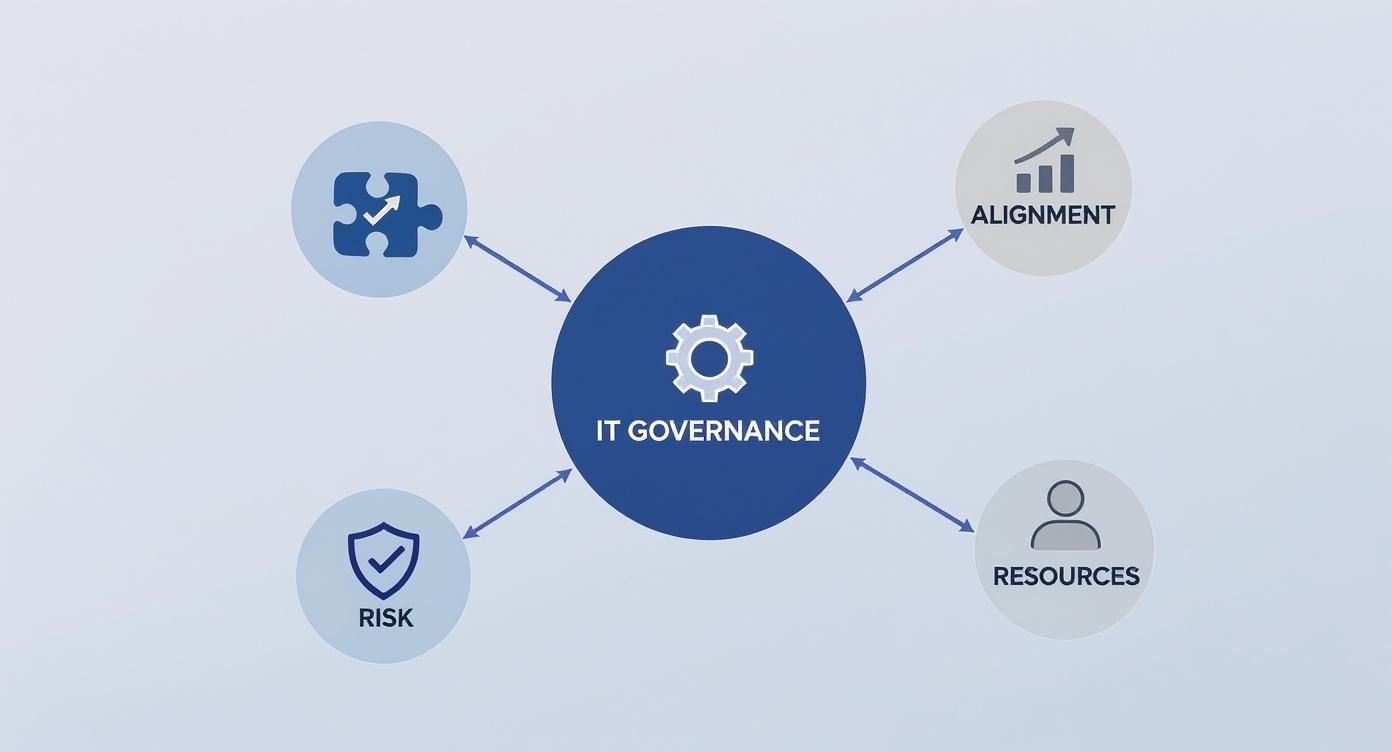
This visual map really helps show how IT governance connects technology to core business functions like delivering value, managing risk, and allocating resources.
As you can see, good governance isn't just one thing. It's a balanced system where all the pieces work in harmony to drive the organization's mission forward.
Comparing Popular IT Governance Frameworks
To make the choice clearer, it helps to see these frameworks side-by-side. Each has a distinct focus and is better suited for different business needs. The table below breaks down the essentials to help you see which one—or which parts of one—might be the best fit for your company.
Framework
Primary Focus
Best For SMBs Who…
Key Benefit
COBIT Aligning IT strategy with overall business objectives.
Need to demonstrate the value of their IT investments and ensure tech decisions support growth.
Provides a clear link between IT activities and business outcomes, improving ROI.
ITIL Standardizing IT service delivery and management processes.
Want to improve the efficiency and reliability of their IT support, including cloud service management.
Creates consistent, predictable, and high-quality IT service delivery for employees and customers.
ISO/IEC 38500 High-level principles for board and executive oversight of IT.
Are formalizing their leadership structure and need to define accountability for major tech risks and decisions.
Establishes clear responsibility at the top, ensuring IT is a strategic asset, not just a cost center.
Ultimately, the goal isn't just to pick a framework from a list. It's about understanding what each offers and borrowing the components that will make the biggest impact on your business right now.
Creating A Hybrid Approach That Works
Here’s the secret: you don’t have to pick just one. For most small and midsize businesses, the most effective strategy is a hybrid one. You can borrow pieces from each framework to build a custom solution that fits like a glove.
This is where having a partner like a Managed Service Provider (MSP) or a virtual CIO (vCIO) is a game-changer. They have the experience to help you select the right controls and processes for your specific situation without overcomplicating things.
For a growing business, the best IT governance framework is the one you can actually implement and sustain. Start small, focus on high-impact areas like cybersecurity and cloud management, and build from there.
So, what does this "mix-and-match" approach look like in the real world?
You might use COBIT principles to define your high-level technology goals and how you'll measure success.
Then, you could implement a few ITIL processes to improve your helpdesk response times and streamline how you manage cloud software updates.
Finally, you might adopt ISO/IEC 38500 concepts to clarify the board's oversight role for major cybersecurity risks and big-ticket AI investments.
This lets you build a practical governance structure that gives you control and direction without killing the agility that makes your business great. It ensures your plan is tailored to you, not the other way around.
Defining Roles And Responsibilities In Your Governance Plan
An IT governance framework is the blueprint, but a plan without people is just a document collecting dust on a shelf. To bring it to life, you need absolute clarity on who is responsible for what. This crucial step transforms abstract policies into concrete actions and, most importantly, establishes accountability.
For small and midsize businesses, this can feel like a major hurdle. You probably don't have a sprawling internal IT department with dozens of specialized roles. The good news? You don't need one. Modern IT governance for SMBs is all about smart delegation and leaning on the right external expertise.
A successful plan hinges on defining clear roles and responsibilities , ensuring every critical function has a clear owner. It’s the only way to prevent tasks from falling through the cracks and create a culture where everyone knows their part in protecting and growing the business.
Clarifying Key Governance Roles
Even in a small organization, several key roles are essential for a functional governance structure. These aren't necessarily full-time positions but rather "hats" that different people wear. The trick is to formally assign these responsibilities so there’s never any confusion.
Executive Leadership (The Board/Owners): This group sits at the top of the pyramid. They set the overall business direction that IT must support and are ultimately on the hook for managing technology-related risks, from cybersecurity threats to ethical AI use. They approve major IT investments and sign off on critical policies.
IT Steering Committee (or Key Stakeholders): In an SMB, this might just be a small group of department heads or senior managers. Their job is to review IT performance, prioritize projects based on what the business actually needs, and make sure the IT strategy stays aligned with company goals.
Data Owners: These are typically the department managers responsible for the data their teams create and use—think the sales manager for customer data in a cloud CRM. They are in charge of classifying data sensitivity and approving who gets access.
This structure creates a clear chain of command for technology decisions, moving them from high-level strategy all the way down to on-the-ground implementation.
The Modern SMB Governance Team: vCIO and MSP
For most businesses in Western Pennsylvania and Eastern Ohio, filling these roles internally just isn't realistic. This is where strategic partnerships become a total game-changer, giving you access to enterprise-level expertise without the enterprise-level payroll.
A Virtual Chief Information Officer (vCIO) steps in to handle the high-level strategy. Think of them as your part-time technology executive.
A vCIO provides the strategic oversight needed to align your technology with your business objectives, guiding everything from cybersecurity planning and cloud strategy to developing a long-term IT roadmap.
While the vCIO sets the direction, a Managed Service Provider (MSP) handles the execution. They are your hands-on IT department, responsible for the daily management, maintenance, and security of your technology infrastructure.
This partnership model creates a powerful and cost-effective governance structure. The vCIO and MSP work hand-in-hand, providing both the "what" and the "how" of your IT plan. It’s a brilliant approach that lets you build a robust system of checks and balances. Businesses looking for this kind of strategic direction can explore how to get expert IT leadership to fill this critical gap.
Here’s a simple breakdown of how these roles work together:
Role
Primary Responsibility
Key Governance Function
Business Leadership Sets business goals and risk tolerance.
Direct & Approve: Provides the "why" behind IT decisions.
Virtual CIO (vCIO) Develops the IT strategy, roadmap, and budget.
Plan & Organize: Translates business goals into a tech plan.
Managed Service Provider (MSP) Implements, manages, and secures IT systems.
Build & Run: Executes the plan and handles daily operations.
Internal Team/Data Owners Uses technology and manages departmental data.
Use & Monitor: Ensures policies are followed in daily workflows.
This collaborative model ensures accountability at every level. Your leadership sets the vision, your vCIO creates the strategic plan, your MSP executes it flawlessly, and your team uses the technology securely and productively. It’s a complete system designed for the realities of today’s SMBs.
Connecting IT Governance To Stronger Cybersecurity
Think of your cybersecurity tools as soldiers on the front lines. IT governance is the command center that gives them their orders, sets the rules of engagement, and makes sure they’re all working together toward a common goal. Without that strategic direction, your security efforts are just a bunch of disconnected, reactive tactics, leaving massive gaps for attackers to waltz right through.
This is where your security strategy truly comes to life. Governance elevates your approach from just buying security products to building a tough, proactive defense. It mandates the critical practices that stop attacks before they even start, like regular risk assessments, strict access controls, and having a clear plan for when things go wrong.
How Governance Builds A Layered Defense
A well-defined governance structure creates layers of protection that keep your business, your data, and your reputation safe. It’s the "how" behind a strong security posture, establishing clear policies and processes that clamp down on risk across your entire organization.
And let's be clear: this connection is more critical than ever. As cyber threats get more sophisticated, cybersecurity has become a non-negotiable part of IT governance. The average global cost of a data breach just hit a staggering $4.88 million . Despite this, a shocking 95% of cybersecurity incidents still boil down to simple human error, which screams for better governance and training.
A strong governance plan tackles this human element head-on by weaving security into your company culture and daily workflows. Here’s how that plays out in the real world:
Access Control Policies: Governance dictates who can touch sensitive data and when. It goes way beyond just handing out passwords and enforces the principle of "least privilege"—meaning employees only get access to the information they absolutely need to do their jobs. Nothing more.
Risk Management: A good governance framework demands regular, formal risk assessments. This process forces you to identify your biggest vulnerabilities—whether it’s in your cloud apps, on-site servers, or employee habits—and fix the most dangerous problems first.
Incident Response Planning: When an attack happens, chaos is your worst enemy. Governance ensures you have a documented, practiced incident response plan. This plan lays out the exact steps to take, who to call, and how to communicate, allowing for a swift, organized response that minimizes the damage.
From Policy To Protection: Real-World Scenarios
Without governance, simple, everyday business activities can open up huge security holes. With it, those same activities become secure and build your resilience.
A strong IT governance framework acts as your organization's security conscience, consistently asking, "Is this the most secure and responsible way to use our technology to achieve our goals?"
Let’s look at a quick comparison:
Scenario
Without Governance (High Risk)
With Governance (Low Risk)
Onboarding a New Employee A new hire gets broad network access on day one with a simple, easy-to-guess password. Training is informal and happens "whenever someone has time."
A formal process grants access only to necessary systems based on their specific role. Multi-factor authentication is mandatory, and they complete cybersecurity training before they even touch a critical system.
Adopting New Cloud Software A department head finds a cool new app and signs up without telling IT. Turns out, it has known security flaws and doesn’t comply with data privacy laws.
All new software must go through a documented vetting process. The vCIO or MSP assesses its security, compliance, and how it integrates with existing systems before it gets the green light.
These examples show that governance isn't some abstract theory; it's a set of practical controls that directly impacts your security every single day. For the best protection, these plans are often built around established security standards. You can get a better handle on this by understanding key cybersecurity frameworks and seeing how they fit into the big picture.
Ultimately, IT governance provides the structure you need to manage technology risks like a pro. By pairing that strategic oversight with the right technical tools, businesses can build a security program that actually works. You can learn more about what goes into this defense by exploring different cybersecurity solutions for businesses .
Implementing Your IT Governance Roadmap
Knowing what IT governance is and why it matters is one thing, but actually putting it into practice? That’s where many small and midsize business owners get intimidated. The good news is that you don’t just flip a switch one day and “have” IT governance. It’s a practical, step-by-step journey of building controls that actually fit your business.
The goal here isn't to create a rigid set of rules that kills your ability to be agile. Instead, you're building a living roadmap that aligns your technology with your business goals. By breaking it down into manageable stages, you can create a structure that helps you grow while protecting you from needless risk.
Stage 1: Secure Leadership Buy-In and Define Goals
Before you even think about writing a policy, your leadership team needs to be fully on board. This is a business initiative, not just some "IT project." The folks in the C-suite need to understand its value, from slashing cybersecurity risks to finally getting a real return on your tech investments.
Once you have that commitment, you need to get crystal clear on what you want to achieve. Are you mostly worried about meeting specific industry compliance rules? Is the main goal to get a handle on chaotic cloud spending? Or are you trying to build a secure foundation to safely explore new tools like AI?
Defining these top-level business objectives is the most critical first step. They become the "north star" for your entire plan, making sure every decision from here on out has a clear purpose.
Stage 2: Assess Your Current Technology Landscape
You can't draw a map to your destination without knowing where you're starting from. This stage is all about a thorough, honest look at your current IT environment—your hardware, software, security setup, and any processes you already have in place. For most SMBs, this is where bringing in an outside expert provides a ton of value.
An experienced Managed Service Provider (MSP) can run a detailed technology assessment to pinpoint your strengths and—more importantly—your biggest weaknesses. This kind of audit almost always uncovers ugly truths like:
Unsupported Software: Critical applications that are no longer getting security updates, leaving massive holes for attackers.Shadow IT: Unauthorized cloud services that employees are using without approval, leading to data leaks and compliance nightmares.Inconsistent Security Controls: Some laptops might have up-to-date protection while others are completely exposed.Zero Documentation: No clear record of how your network is configured, who has access to what, or how to recover from a disaster.
A professional IT assessment gives you an objective, data-driven baseline. It moves you from guessing about your risks to knowing exactly where to focus your efforts for the biggest and fastest impact.
Stage 3: Form a Governance Committee and Select Framework Elements
With your goals set and your current situation mapped out, it’s time to build the team and pick your tools. Your governance committee doesn't need to be huge. For a typical SMB, it might just be the business owner, a key manager from operations or finance, and your vCIO or MSP partner. This small group will steer the ship.
Next, this committee will look at the frameworks we talked about earlier (like COBIT or ITIL) and pick and choose the specific controls that address your top priorities. You're not adopting an entire framework wholesale; you're cherry-picking the parts that make sense for you right now . You might start with a few ITIL processes for managing new software requests and a couple of COBIT principles for risk management. To learn more about how an MSP can help execute these chosen processes, consider exploring the benefits of managed IT services .
Stage 4: Develop and Communicate Essential Policies
Now it's time to put pen to paper. The committee's job is to develop a handful of core policies that address your most pressing needs. The key is to start small and focus on clarity. Don't try to write a 100-page manual on day one.
Begin with the absolute essentials:
Acceptable Use Policy (AUP): Simple, clear rules for employees on how they can use company tech, from cloud services to generative AI tools.Data Classification and Handling Policy: Defines what information is sensitive and lays out the rules for how to store, share, and protect it.Incident Response Plan: A straightforward, step-by-step guide on what to do when—not if—a security breach or system failure happens.
Once these policies are drafted, communication is everything. They have to be shared with every single employee, and you need to provide training to make sure people actually understand their responsibilities. This is how you start building a security-first culture.
Stage 5: Monitor, Measure, and Adapt
IT governance is not a "set it and forget it" project. Technology changes, your business goals shift, and new threats pop up all the time. Your governance plan has to evolve, too. The final stage is all about creating a sustainable cycle of monitoring, measuring, and adapting.
Your governance committee should meet regularly—maybe once a quarter—to review how things are going. Are people following the policies? Have new cybersecurity or cloud risks emerged? Is your tech still aligned with your business strategy? This continuous improvement loop is what ensures your governance framework remains a valuable asset that helps your business thrive, securely and efficiently.
Common Questions About IT Governance
After digging into the frameworks and implementation steps, most small and midsize business owners still have some very practical, bottom-line questions. It's one thing to talk about principles and another to see how it all plays out in a real business. Let's tackle some of the most common questions we hear from leaders across Western Pennsylvania and Eastern Ohio.
My goal here is to give you clear, direct answers—no jargon, no fluff. I want to help you see how a solid governance plan can become one of your best business assets, not just another layer of complexity.
Is IT Governance Only For Large Corporations?
This is probably the biggest myth out there, and the short answer is a hard no. In fact, you could argue that governance is even more critical for a small or midsize business. For a growing company, a single major data breach or a failed IT project can be a catastrophic, company-ending event. Good governance is your insurance policy against that kind of disaster.
For an SMB, governance isn't about creating endless red tape. It’s about putting smart, essential controls in place to bring stability and predictability to your technology. It means having a formal process for approving new cloud software, knowing exactly who has access to sensitive client data, and having a documented, tested plan for when a cyber incident hits.
The core principles of risk management and strategic alignment don't change with company size. The only thing that changes is the scale of implementation. For an SMB, governance is about being deliberate, not bureaucratic.
Ultimately, a right-sized governance plan actually helps you grow faster and more nimbly. It provides the guardrails that let you take calculated risks with confidence, knowing your foundation is solid.
How Does IT Governance Help With Cloud And AI?
Think of governance as the essential foundation for using modern tools like cloud computing and artificial intelligence safely and effectively. Without it, you’re just flying blind and hoping for the best.
For cloud solutions , governance sets the rules of the road. It establishes clear policies for things like:
Cost Management: Prevents "cloud sprawl," where different departments spin up services without any oversight, leading to those shocking monthly bills.Security Configuration: Makes it crystal clear who is responsible for securing your cloud environment—a common point of failure known as the shared responsibility model.Data Handling: Defines what types of data can go into which cloud services, making sure your sensitive information stays protected where it belongs.
When it comes to artificial intelligence , governance is even more vital. AI is only as good as the data it’s trained on. A strong governance framework ensures the data you feed into AI models is secure, accurate, and handled ethically. It gives you the oversight needed to prevent major problems like data bias, privacy violations, or compliance nightmares. This structure is what makes your AI initiatives far more likely to produce valuable and trustworthy results.
What Is The First Step We Should Take?
Getting started doesn't have to be a massive, overwhelming project. The single most effective first step is to get a professional technology and risk assessment. This is usually done with an experienced partner, like a vCIO or a Managed Service Provider who has seen it all before.
An assessment gives you an objective, 360-degree view of where you stand today. It uncovers hidden vulnerabilities, flags compliance gaps, and pinpoints areas where your tech isn't pulling its weight for your business goals. It hands you a clear, prioritized list of what needs to be fixed first.
From there, the next logical step is to start documenting your most critical policies. Don't try to boil the ocean. Start with the basics that give you the most protection for the least amount of effort. These usually include:
An Acceptable Use Policy (AUP) for all employees.
A simple Data Backup and Recovery Plan .
A basic Incident Response Plan .
This approach lets you build a strong foundation quickly. You tackle your biggest risks first and create some real momentum for continuous improvement down the road.
How Much Does Implementing IT Governance Cost?
It’s really important to reframe this question. IT governance is an investment in stability and resilience, not a typical business expense. For most SMBs, the cost isn't tied up in expensive new software. It's mainly about the time of your key people and the fee for an expert partner who can provide strategic guidance and hands-on help.
The real question you should be asking is: what is the cost of not having governance? Just think about the financial fallout from:
A data breach that leads to regulatory fines and destroys your reputation.
A ransomware attack that grinds your operations to a halt for days or even weeks.
A major cloud or AI project that goes off the rails due to poor planning and a lack of clear goals.
When you look at it that way, the potential cost of a governance failure is almost always magnitudes higher than the proactive cost of implementing a solid framework. Investing in a structured way to manage your technology is one of the smartest financial decisions a modern business can make.
A robust IT governance plan is your roadmap to secure and strategic growth. At Eagle Point Technology Solutions , we provide the vCIO and managed IT services that businesses in Western Pennsylvania and Eastern Ohio rely on to build and maintain effective governance. Let us help you align your technology with your business goals.
Contact us today to schedule your technology assessment
Article created using Outrank