

Is your business network trying to tell you something? It’s a scenario we see all the time. One minute, your team is flying through their tasks; the next, everything grinds to a halt. Critical apps are lagging, video calls get choppy, and pulling a file from the server feels like wading through digital quicksand. Work stops, but the reason why is a total mystery.
For many small and medium-sized businesses (SMBs) across Western Pennsylvania and Eastern Ohio, this is when the frantic, reactive "break-fix" call happens. You’re stuck trying to describe a vague problem while your operations, customer service, and bottom line all take a hit. But what if these slowdowns aren't so random? What if they're warning signs your network has been sending all along?
What Is Network Monitoring, Really?
At its core, what is network monitoring is the ongoing practice of watching over your company’s entire IT network to keep it performing at its best, catch problems early, and spot security threats before they can disrupt your business. Think of it as the central nervous system for your technology—it takes in a constant stream of signals and translates them into clear, actionable information to keep everything running smoothly.
Instead of just waiting for something to break, this proactive approach involves keeping a constant, watchful eye on your entire digital infrastructure. It’s the tool that finally lets you understand what your network is trying to tell you, helping you get ahead of problems long before they impact your team.
The global network monitoring market is expected to grow significantly, from around $4 billion in 2025 to over $8.24 billion by 2032. This explosive growth sends a clear message: proactive IT management isn't a luxury for large corporations anymore—it's essential for the survival and growth of SMBs. For a solid overview of the basics, you can check out this great guide on What Is Network Monitoring.
By translating technical data into business intelligence, network monitoring provides the foresight needed to maintain stability and security. It moves you from a state of recurring IT emergencies to one of strategic control and business resilience.
In this guide, we’ll pull back the curtain on this essential practice. We'll show you how it serves as the foundation of modern IT, shifting you away from the costly pain of downtime and toward optimized, secure performance. Our goal is to give you the peace of mind to focus on what you do best—running your business.
How Proactive Monitoring Transforms Business Operations
It's one thing to understand the technical definition of network monitoring, but it's another thing entirely to see how it fundamentally changes your business. This isn't just another IT tool; it's a strategic asset that transforms how you handle day-to-day operations, security, and future growth. For small and midsize businesses, making the switch from reactive firefighting to proactive management is a massive competitive advantage.
Getting out of the "break-fix" cycle does more than just save you the headache of an unexpected IT meltdown—it directly protects your bottom line. By keeping a constant eye on the health of your network, you can spot the tiny, almost invisible signs of trouble long before they blow up into a full-scale outage that brings your business to a grinding halt.
Drastically Minimize Expensive Downtime
Every single minute your network is down, you're losing money. Orders stop coming in, employees can't access critical files, and customer service hits a wall. Proactive monitoring is your early warning system, flagging issues like a server component that's about to fail or a network switch that's starting to overheat.
Think about it in local terms. For a manufacturing plant in Western Pennsylvania, this could mean catching a network bottleneck that’s threatening to shut down the entire production line. For a professional services firm in Eastern Ohio, it could be identifying a storage server that's almost full, preventing a crash that would make critical client files inaccessible. Fixing these problems before they cause an outage translates directly into saved revenue and sustained productivity.
Strengthen Your Cybersecurity Posture
Your network is the superhighway for all your company’s data, which makes it a prime target for cybercriminals. Network monitoring is one of your best security tools, acting as a digital watchdog that never sleeps. It starts by learning what "normal" looks like on your network, so any deviation from that baseline sticks out like a sore thumb.
By analyzing traffic patterns, monitoring can flag suspicious activity that often signals a breach in progress. This could be a workstation suddenly communicating with a known malicious server or an unusual spike in data being sent out of your network at 3 AM.
This constant vigilance gives you the visibility you need to shut down attacks before real damage is done. It’s not just about keeping things running fast; it’s about protecting your sensitive company and client data from threats like ransomware and business email compromise.
From Reactive Problems to Proactive Solutions
For many SMBs, the shift to proactive monitoring feels like a complete operational overhaul. It changes the entire dynamic from putting out fires to preventing them from ever starting. Here’s a look at how that transformation plays out in the real world.
| Common SMB Challenge | The Old 'Break-Fix' Response | The Proactive Monitoring Solution |
|---|---|---|
| "The internet is slow again!" | Wait for employee complaints, then spend hours trying to find the source of the bottleneck. | Receive an alert that bandwidth usage is spiking, identify the cause (e.g., a large unauthorized download), and resolve it in minutes. |
| A critical server crashes. | Scramble to get the server back online, resulting in hours of downtime and lost revenue. | Get a notification that a server's memory usage is critically high, allowing for a reboot or resource upgrade during off-hours. |
| Suspicious activity is discovered after a breach. | Begin a costly and disruptive forensic investigation after sensitive data has already been stolen. | Flag an unusual data transfer to an external IP at 2 AM, block the connection, and investigate the potential threat immediately. |
| Budgeting for IT upgrades is a guessing game. | Wait until hardware fails or performance becomes unbearable, forcing an emergency, unbudgeted purchase. | Use historical performance data to forecast when network upgrades are needed and build them into the annual budget. |
This table highlights the core benefit: you regain control. Instead of your technology dictating your workday with emergencies, you’re in the driver’s seat, making informed decisions that keep the business moving forward.
Optimize Performance for Critical Applications
Is your team constantly complaining about sluggish applications or video calls that freeze and stutter? Network monitoring helps you get to the root cause of these performance hogs. It answers the crucial questions: Is the problem with the application itself, the server it's running on, or the network connection in between?
This level of detail allows you to fine-tune your infrastructure with precision. You can make sure your most important business systems—whether it’s your ERP, CRM, or cloud software—always have the bandwidth and resources they need to run smoothly. The result? Your team can work efficiently without being held back by frustrating tech delays. To really get the most out of this, it's vital to follow established network monitoring best practices.
Enable Data-Driven Strategic Planning
Guesswork has no place in a solid IT strategy. If you want to make smart decisions about where to invest in technology, you need real data to back them up. Network monitoring gives you a treasure trove of historical and real-time information on your system’s performance, usage trends, and capacity limits.
This data becomes the bedrock of strategic IT planning, a key function that a Virtual CIO (vCIO) provides. For example, monitoring reports might show that your network is consistently hitting 90% of its bandwidth capacity during business hours. Armed with that hard data, you can confidently justify an investment in upgrading your infrastructure before it starts to choke off growth. This forward-thinking approach ensures your technology is always an asset that supports your business goals, not a liability holding them back. To see how we build this foundation, check out our approach to managed servers and network infrastructure.
Understanding What Your Network Is Actually Saying
To really grasp why network monitoring is so important, it helps to understand what’s happening "under the hood." Think of your network as the highway system connecting all your business locations. All your critical data—emails, files, video calls—are the cars and trucks zipping back and forth.
Network monitoring tools are like traffic cameras, speed sensors, and highway patrol all rolled into one. They give you a live, complete picture of what's moving, where it's headed, and how smoothly everything is flowing. This isn't about getting bogged down in technical jargon. It’s about turning all those digital signals into simple, practical insights that help you run your business better. Without that visibility, you're driving blind, only finding out about a problem when a massive pile-up brings everything to a screeching halt.
The Four Pillars of Network Visibility
When we talk about network monitoring at Eagle Point, we focus on four critical areas. Each one provides a different piece of the puzzle, and when you put them all together, you get a clear, comprehensive picture of your network's health and security.
- Device Availability: This is the most fundamental check. Is your main server actually online? Is the office router responding? Think of it as a daily roll call for your IT gear, making sure every critical piece is present and accounted for.
- Performance Metrics: This tells you how well everything is running. It’s not just about being online; it's about being fast and efficient. This is where we spot slowdowns and bottlenecks before your team even starts complaining about them.
- Traffic Analysis: Who or what is hogging all the bandwidth? This analysis is like looking at the highway and identifying which trucks are taking up three lanes. We can see which applications, devices, or users are consuming the most resources.
- Security Logging: This acts as your digital detective, keeping a detailed log of everything that happens on your network. It helps us spot suspicious patterns that could signal a security threat, like someone trying to access a server they have no business touching.
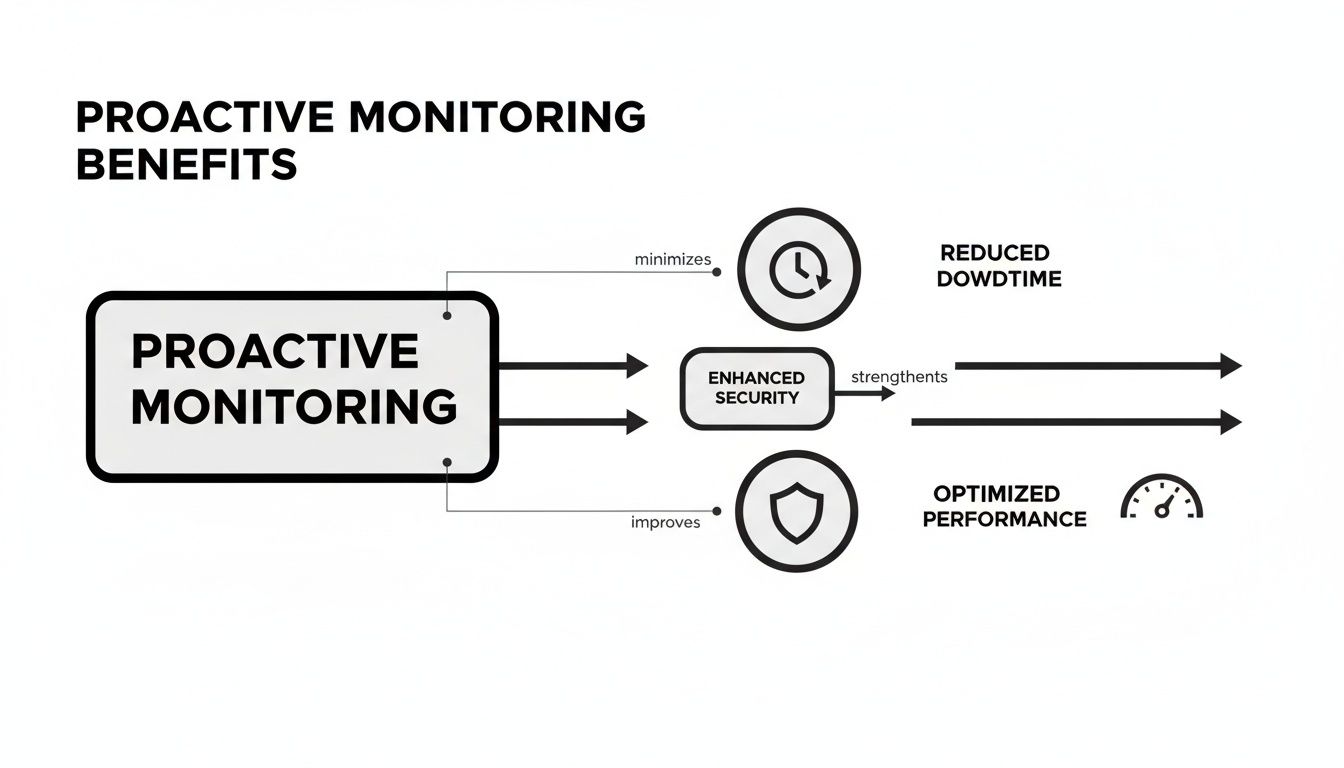
This approach ensures that monitoring isn't just about collecting data; it's about supporting core business goals like reducing downtime, strengthening security, and boosting performance.
Demystifying Performance: A Simple Analogy
Performance metrics can sound intimidating, but a simple analogy makes it all click. Let’s imagine you’re sending a critical package from your office to a client.
Latency: This is the total time it takes for that package to travel from your desk to your client’s doorstep. On your network, high latency means data is taking way too long to make the trip, causing those frustrating delays everyone hates.
Packet Loss: What happens if some of your packages just vanish along the way? That’s packet loss. When parts of your data disappear in transit, the system has to resend them, which can slow everything down to a crawl.
Jitter: Now, imagine you send 100 packages, but they all arrive out of order and at completely random times. That maddening inconsistency is jitter. For things like video calls or VoIP phone systems, high jitter leads to that choppy, garbled audio that makes conversations impossible.
Keeping a close eye on these three metrics is absolutely essential for delivering a smooth, reliable experience for your team and customers. The practice has come a long way since the early days of Simple Network Management Protocol (SNMP) in the 1990s. Today, the network monitoring market is projected to grow from USD 3.12 billion in 2025 to USD 5.02 billion by 2030.
For SMBs in Eastern Ohio and Western PA, this growth is fantastic news. It means powerful monitoring tools, which currently make up 56% of the market, are more accessible than ever, allowing even small businesses to achieve the kind of oversight that was once reserved for large corporations. You can explore more insights on the network monitoring market on mordorintelligence.com.
How Is the Data Collected?
So, how do we actually gather all this information? It comes down to two primary methods.
- Agent-Based Monitoring: This involves installing a small, lightweight piece of software—an "agent"—on each device you want to watch, like a server or key workstation. The agent sits right on the device, giving us incredibly deep and detailed insights straight from the source.
- Agentless Monitoring: This method uses a central monitoring station to reach out and "ask" other devices on the network for their status and performance data. It's often quicker to set up across a wide range of devices but might not provide the same granular detail as an agent.
A seasoned MSP like Eagle Point Technology Solutions almost always uses a hybrid strategy. We’ll strategically place agents on your most critical systems while using agentless methods to keep an eye on the broader network. This balanced approach gives you the comprehensive visibility you need without adding unnecessary complexity.
Your First Line of Defense Against Cyber Threats

It’s easy to think of network monitoring as just a tool for boosting performance, but that's a dangerous mistake. For today's SMBs, it’s one of the most important parts of a solid cybersecurity plan. Think of it as a digital alarm system for your business, constantly watching for the subtle signs of a threat before it explodes into a full-blown crisis.
This constant vigilance is your first line of defense. By getting a clear picture of what "normal" traffic looks like on your network, anything out of the ordinary immediately sticks out.
Detecting Threats Before They Strike
Cyberattacks rarely start with a bang. They’re usually quiet, creeping in with subtle actions that are easy to miss. A smart monitoring system is trained to pick up on these faint whispers of an attack, giving you a chance to shut it down before any real damage is done.
Here are a few common threats we see in Western Pennsylvania and Eastern Ohio that good monitoring can expose early on:
- Ransomware: Before it locks up your files, ransomware often starts by quietly scanning your internal network, looking for valuable data. A monitoring tool flags that kind of unusual reconnaissance as a massive red flag.
- Unauthorized Data Exfiltration: Attackers want your data. Imagine a workstation suddenly sending huge files to an unknown server in another country at 3 AM. Monitoring would instantly alert your IT team to that highly suspicious activity.
- Phishing and Malware Infections: When an employee accidentally clicks a malicious link, the infected computer will often try to "phone home" to a command server. Network monitoring can spot and block that communication, containing the threat before it spreads.
Proactive threat detection isn't about luck; it's about visibility. By monitoring your network traffic, you gain the power to spot an intruder's digital footprints and act immediately, often neutralizing the threat before they even know you're onto them.
The need for this kind of visibility is growing every day. With cyber attacks on the rise, real-time traffic analysis is no longer a "nice-to-have." Industry reports show that this proactive approach can stop a significant percentage of threats from succeeding. This urgency is reflected in the market's explosive growth, which is set to expand from USD 2.88 billion in 2024 to USD 6.60 billion by 2032. You can read more about the growth of the network monitoring market on globenewswire.com.
Meeting Compliance and Proving Due Diligence
For businesses in regulated fields like healthcare (HIPAA) or defense manufacturing (CMMC), network monitoring isn't just a good idea—it's often a strict requirement. These regulations demand that you have systems in place to actively protect sensitive information.
Network monitoring gives you exactly what you need to meet these rules. It creates detailed logs and audit trails of all network activity, which are absolutely priceless for security investigations and compliance audits.
These logs are your proof that you’re doing your part to protect data. They can show who accessed what, when they did it, and from where. This level of detail is crucial for proving due diligence and avoiding the massive fines that come with non-compliance. At the end of the day, network monitoring isn't just another operational expense. It's a powerful investment in your company's security that protects your reputation, your data, and your bottom line.
Choosing Your Approach: DIY vs. Managed Services
When it comes to network monitoring, small and midsize businesses eventually hit a fork in the road. Do you try to build and manage a system in-house, or do you partner with a dedicated expert like a Managed Service Provider (MSP)? For most SMBs juggling limited resources and big ambitions, this decision is a game-changer.
The Do-It-Yourself (DIY) path might seem tempting at first. If you have a highly skilled, dedicated IT team, piecing together a monitoring solution is technically possible. But this approach is loaded with significant hurdles that are easy to underestimate. Successfully managing a network monitoring system isn't a side project for your already-swamped IT person. It requires a deep and specific skill set that many smaller teams just don't have on deck.
The Realities of In-House Network Monitoring
Taking on network monitoring all on your own means signing up for several substantial challenges that can quickly bleed your budget and burn out your team. It’s so much more than just installing some software; you’re effectively building and sustaining a complex, mission-critical system from scratch.
First, you have to navigate the crowded and confusing world of monitoring tools. The most effective platforms come with steep licensing fees that can be a major shock to an SMB's budget. Beyond the software sticker price, you'll likely need to invest in dedicated hardware to run the system, adding another layer of upfront cost before you've even started. But the financial hit is only the beginning. The real challenge, more often than not, is the human one.
An effective network monitoring system demands 24/7 attention. A critical alert at 2 AM on a Sunday needs the same immediate response as one at 2 PM on a Tuesday. For a small internal IT team, providing this round-the-clock coverage is often completely unsustainable and a fast track to burnout.
On top of that, managing the system requires specialized expertise. Your team needs to know how to configure the tools, interpret complex data streams, and—most importantly—tell the difference between a minor hiccup and the first warning sign of a major security breach. This constant need for vigilance and expertise turns what seems like a one-time project into a massive, ongoing operational burden.
The Strategic Advantage of a Managed Service Partnership
For the vast majority of SMBs, partnering with an MSP is a far more practical and cost-effective approach. Instead of trying to build an entire monitoring operation from the ground up, you get to plug into one that's already built, optimized, and staffed by seasoned pros.
This model immediately solves the biggest DIY headaches. You get access to enterprise-grade monitoring technology without the crippling upfront investment. Even better, you get a dedicated team of professionals whose entire job is to watch over your network, 24/7/365. This frees your internal team to focus on strategic projects that actually drive your business forward, rather than getting bogged down in the endless cycle of network alerts.
A partnership also provides a predictable, manageable monthly cost. Instead of facing surprise hardware failures or unexpected software renewal fees, your IT monitoring budget becomes a simple, consistent operational expense. If you're curious about the nuts and bolts, you can learn more about what a managed service provider does in our detailed guide.
Network Monitoring Implementation: DIY vs. Managed Service
Making the right call really comes down to a clear-eyed look at your company's resources, expertise, and priorities. To help you weigh the factors that matter most to your business, here’s a head-to-head comparison.
| Factor | DIY (In-House) | Managed Service (MSP) |
|---|---|---|
| Upfront Costs | High investment in software licenses and dedicated hardware. | Low to zero. Costs are bundled into a predictable monthly fee. |
| Required Expertise | Demands deep, specialized knowledge of monitoring tools and network security. | Immediate access to a team of certified experts and engineers. |
| Staffing & Coverage | Requires a 24/7 on-call schedule, which is often impractical for small teams. | Provides round-the-clock monitoring and alert response automatically. |
| Tool Management | Your team is responsible for all updates, patches, and configurations. | The MSP handles all maintenance and ensures tools are always up-to-date. |
| Focus | Internal IT team gets pulled into reactive alert management. | Your team can focus on core business initiatives and strategic growth. |
For businesses here in Western Pennsylvania and Eastern Ohio, the choice often boils down to a simple question: Do you want your team managing IT tools, or do you want them using technology to drive your business forward? By outsourcing the complex and demanding task of network monitoring, you're not just buying a service—you're making a strategic investment in focus, efficiency, and peace of mind.
It’s Time for Peace of Mind with Proactive IT Management
We’ve covered a lot of ground in this guide, from boosting performance to locking down your cybersecurity. But for any small or midsize business leader, it all boils down to one question: "How do I make this happen for my company without derailing my budget or burning out my team?"
The answer isn't about buying another piece of software. It’s about making a fundamental shift from a reactive, break-fix IT model to a proactive one built on continuous, expert oversight.
At Eagle Point Technology Solutions, our approach is straightforward. We combine top-tier monitoring tools with the seasoned expertise of our technical team to deliver a solution that works for real-world businesses in Western Pennsylvania and Eastern Ohio. Our goal isn't just to fix problems faster; our primary mission is to prevent them from ever happening in the first place.
Your Strategic Technology Partner
We're not just another outsourced IT helpdesk. Think of us as your trusted advisor and virtual CIO (vCIO). We take the time to really get to know your business and what you’re trying to achieve. This allows us to make sure your technology stops being a cost center and starts acting like the strategic asset it should be—one that actively fuels your growth.
The real value of managed network monitoring is turning a flood of raw data into decisive, strategic action. It’s about having a partner who not only spots a potential issue but instantly understands what it means for your specific operations and gets it resolved before you even knew there was a problem.
This proactive style of IT management delivers the kind of stability and security you need to get back to what you do best—running and growing your business. It’s the peace of mind that comes from knowing a dedicated team of experts is always watching over your network, ready to step in at a moment's notice.
If you’re ready to trade frustrating IT emergencies for a more predictable, secure, and strategic technology future, we're here to help. Schedule a no-obligation consultation with our team to see exactly how proactive management can make a difference for your business.
Your Network Monitoring Questions, Answered
Working with business owners across Western Pennsylvania and Eastern Ohio, we’ve heard just about every question there is when it comes to IT. Network monitoring, in particular, often brings up some great points. Let's get you some straight answers to the questions we hear most often.
How Quickly Can Network Monitoring Be Set Up?
This really comes down to whether you go it alone or bring in a partner. If you try the DIY route, you could be looking at weeks, maybe even months, of researching tools, buying equipment, and wrestling with configurations.
When you partner with an MSP like Eagle Point Technology Solutions, that timeline shrinks dramatically. We can typically get our monitoring tools deployed and start gathering baseline data within just a few days. That means you get a clear view of what’s happening on your network almost right away.
Is Network Monitoring Expensive for a Small Business?
It’s easy to assume anything with "enterprise-grade" capabilities comes with a hefty price tag, but the managed services model changes the game for small and midsize businesses. Instead of a huge upfront investment in software and hardware, you get a predictable monthly fee. This bundles all the technology, the expertise, and the 24/7 watchfulness into a single, manageable cost.
I always tell clients to flip the question around: "What’s the cost of not monitoring?" When you think about the price of downtime, a security breach, or lost productivity, proactive monitoring starts looking like one of the best investments you can make. It pays for itself by stopping those disasters before they happen.
What Kind of Team Do I Need to Manage It?
Here’s the thing: effective network monitoring isn’t a side project for your one IT person. It demands a dedicated team with the right skills to make sense of the alerts, troubleshoot tricky problems, and be on-call around the clock. A single alert at 3 AM could be the first sign of a major security incident that can’t wait until morning.
This is exactly why so many SMBs turn to an MSP. You instantly plug into our entire team of certified engineers and security analysts who are always keeping an eye on your network. Your people can stay focused on their real jobs, and we’ll handle the rest.
How Does Monitoring Impact My Network's Performance?
That's a sharp question. Business leaders are right to worry if the very act of watching the network could slow it down. The good news is that modern monitoring tools are designed from the ground up to be incredibly lightweight and efficient.
Whether we use agent-based or agentless methods, they sip tiny amounts of system resources. These tools are built to run silently in the background so they won't interfere with your day-to-day operations or create new bottlenecks. In fact, the performance boost you get from us finding and fixing underlying issues will completely overshadow the tiny footprint of the monitoring tools themselves. A faster, more reliable system is the whole point.
Ready to stop reacting to IT problems and start preventing them? Eagle Point Technology Solutions provides the expert oversight and proactive management you need to ensure your network is a secure, reliable asset for your business. Let's build a more resilient technology foundation together.