Let’s cut through the jargon. What exactly is a vulnerability assessment?
Think of it as a professional, top-to-bottom inspection of your company’s digital footprint. It’s a proactive search for security weaknesses in your network, your software, and especially your cloud services—before a cybercriminal gets a chance to find them first. The whole point is to map out these flaws and create a clear, prioritized to-do list for fixing them.
What Is a Vulnerability Assessment in Plain English

Imagine your business is a house. You've got locks on the doors and windows to keep it safe. A vulnerability assessment is like hiring a professional security inspector to come in and methodically check every single entry point.
They aren't trying to break in. They're simply cataloging every potential weakness they find—a sticky window latch, a lock that’s easy to pick, or a garage code that’s just too simple.
At the end of the inspection, you get a detailed report: "The back door lock is flimsy, the second-floor window doesn't latch correctly, and the garage door is a weak point." Now you have a clear, actionable list of what to fix to make your house truly secure.
In the digital world, that "house" is your entire IT infrastructure. We're talking servers, employee laptops, the Wi-Fi network, and all your cloud accounts. A vulnerability assessment is that essential, proactive health checkup for your technology.
The Core Purpose and Goals
The main goal is simple: find and classify security flaws before they turn into full-blown security breaches. It’s all about shifting from a reactive, "fix-it-when-it-breaks" mentality to a proactive, defensive one. This is a cornerstone of modern cybersecurity, and it’s why our introduction to cybersecurity for small businesses stresses the importance of getting ahead of threats.
So, what are we trying to accomplish with an assessment? The table below breaks down the primary goals and what they mean for your business.
Core Goals of a Vulnerability Assessment
| Objective | Description for Your Business |
|---|---|
| Identify Known Weaknesses | We're looking for the low-hanging fruit for attackers: unpatched software, misconfigured cloud solutions, or weak passwords that leave the door wide open. |
| Prioritize Risks | Not all vulnerabilities are created equal. This process helps your business figure out which flaws pose the biggest, most immediate threat to your operations. |
| Create a Remediation Roadmap | The final report isn't just a list of problems; it’s a strategic guide telling your IT team or partner exactly what to fix and in what order for maximum impact. |
This process gives you a clear path forward, turning a vague sense of "we should be more secure" into a concrete action plan.
A vulnerability assessment isn't about catching hackers in the act. Its real value is in systematically closing the doors and windows they would have used to get inside your digital environment in the first place.
This proactive mindset is catching on in a big way. The global vulnerability assessment market is expected to jump from USD 5.58 billion in 2025 to USD 8.66 billion by 2030. As you can see from market trends tracked by firms like Mordor Intelligence, more and more businesses are realizing it’s far better—and cheaper—to find these weaknesses before a hacker does.
Key Types of Assessments Your Business Needs
Just like a doctor uses different tools to check your heart versus your hearing, not all vulnerability assessments are the same. Each type is designed to inspect a specific part of your digital infrastructure, helping you choose the right "specialist" for the right checkup. Getting a handle on these differences is the first step toward building a solid defense.
Think of it as looking at your business from different angles to find unique weaknesses. An assessment that focuses on your internal network won't necessarily spot a flaw in the customer-facing cloud software you use every day. To really be effective, you need a mix of approaches.
Network Assessments
A network-based vulnerability assessment is a lot like checking the security of your physical office building. It scans your entire network—including servers, firewalls, routers, and even your office Wi-Fi—for weaknesses that could let an intruder walk right in. This type of scan looks for things like open ports, outdated software on servers, and misconfigured security settings.
It answers the critical questions: Is your guest Wi-Fi properly walled off from your sensitive company data? Are your firewalls actually configured to block unwanted traffic? Finding these issues is fundamental to securing your core operations and preventing a digital break-in.
Application and Cloud Assessments
While network scans check the "building," application assessments test the security of the specific tools and software you rely on daily. This could be your website, a custom business application, or a third-party platform. These tests hunt for common flaws like SQL injection or cross-site scripting (XSS) that could let an attacker steal customer data.
Similarly, a cloud security assessment is absolutely vital for any small or midsize business using services like Microsoft 365, Google Workspace, or AWS. It focuses on identifying misconfigurations in your cloud setup, such as giving users too much access or leaving data storage buckets wide open. With the massive shift to cloud solutions, this area has become critically important for SMBs.
Traditionally, network-based scanning got most of the attention. However, cloud security assessment is now the fastest-growing segment, projected to expand at a 10.5% CAGR through 2030. That tells you everything you need to know about where business priorities are shifting. You can dig into these market changes in this industry research on assessment services.
By combining these different assessment types, you get a much clearer, more complete picture of your company's security posture. This allows you to tackle a wider range of potential attack vectors, protecting everything from your internal infrastructure to your cloud-based data. If you're looking to understand what kinds of vulnerabilities attackers love to target, you can learn more by exploring some of the most common cyber threats for small businesses.
Understanding the Vulnerability Assessment Process
A proper vulnerability assessment isn't just a chaotic technical audit; it's a well-managed project that follows a clear, structured path. When you know what to expect at each stage, the whole thing becomes much less intimidating. It's really a logical process designed to turn raw scan data into real, actionable security improvements for your business.
The journey breaks down into four core stages, each one building on the last. It all starts with setting clear goals and ends with making sure the fixes actually worked. Let's walk through how we get it done from start to finish.
This visual helps break down how assessments can be categorized. We look at different parts of your digital infrastructure—everything from the network in your office to your cloud servers.
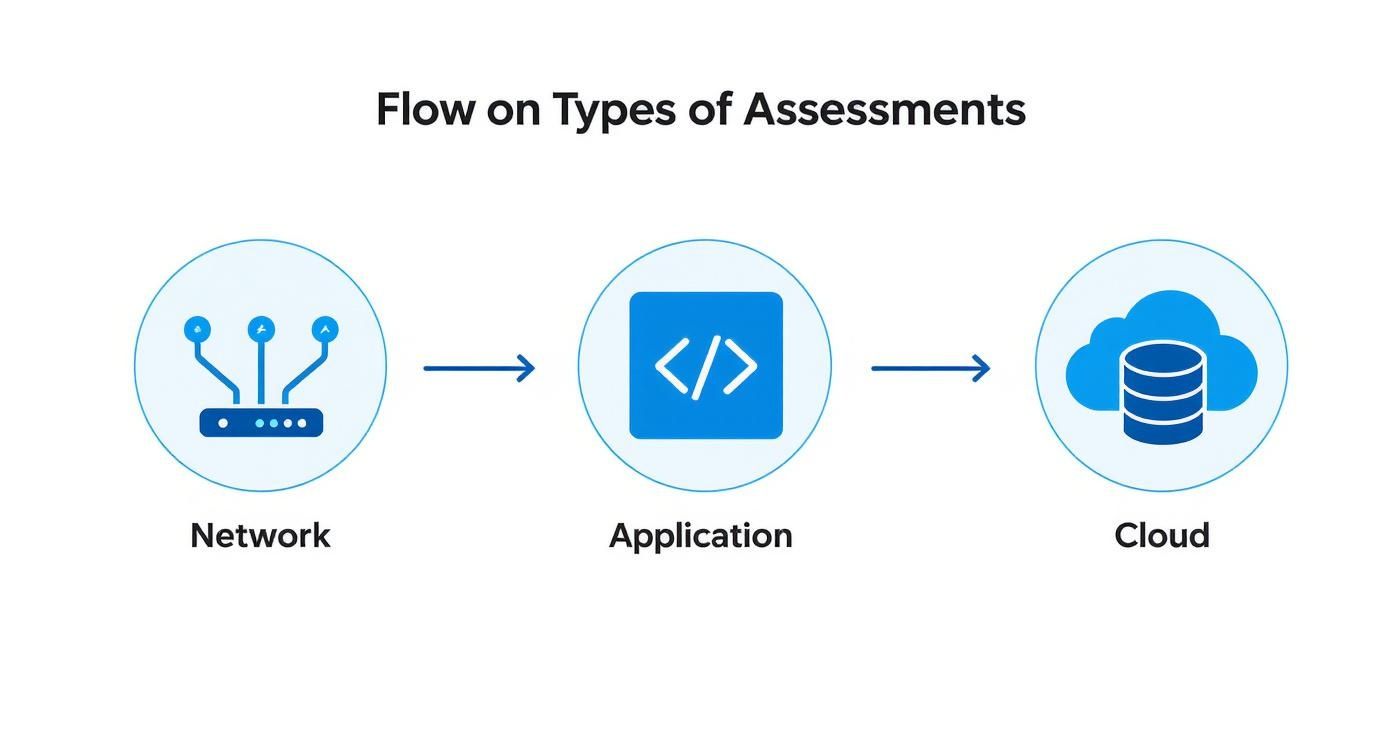
Each of these areas requires a slightly different approach. You have to use the right tools and techniques to uncover the specific weaknesses unique to network hardware, application code, or cloud setups.
Stage 1: Planning and Discovery
The first stage is all about preparation. Before we even think about launching a tool, we need to define the scope. What exactly are we testing? Which systems, applications, and cloud services are on the list? Getting this right ensures we focus our efforts on the assets most critical to your business without causing any disruptions.
Once the scope is locked in, we move to the Discovery phase. This is the active scanning part of the job. Automated tools, sometimes enhanced with AI to spot emerging patterns, carefully probe your IT environment to identify potential weaknesses. The main goal here is to build a complete inventory of vulnerabilities across every asset we defined in the planning stage, from missing software patches to insecure cloud configurations.
Stage 2: Analysis and Remediation
With a list of potential vulnerabilities in hand, the next stage is Analysis. This is where human expertise really comes into play. A raw list of technical flaws doesn't do much good on its own. Each finding has to be analyzed to figure out its real-world risk to your business. We prioritize the list based on how severe a vulnerability is and the potential damage it could cause if a hacker exploited it.
A vulnerability assessment report should do more than just list problems. Its true value lies in translating technical findings into business context, creating a prioritized roadmap that tells you exactly what to fix first for the greatest security gain.
Finally, we get to the most important part: Remediation. This is where we actually fix the problems. We'll work through the prioritized list, which could involve installing security patches, reconfiguring cloud settings, or strengthening who has access to what. After the fixes are applied, we often run a follow-up scan to verify that the vulnerabilities have been successfully closed for good.
This methodical approach—Plan, Discover, Analyze, and Remediate—is a crucial piece of any effective cyber security risk management strategies. It gives your business a repeatable framework for systematically shrinking your attack surface and strengthening your defenses over time.
Vulnerability Assessment vs. Penetration Testing
This is easily one of the most common points of confusion in cybersecurity, so let’s clear it up. The best way to think about it is with a simple analogy.
Imagine a vulnerability assessment is like a security inspector walking through your office building after everyone’s gone home. They’ll be methodically checking every single possible way in.
They’ll jot down notes on every unlocked window, every door with a flimsy lock, and every security camera that has a blind spot. What you get back is a comprehensive report—a prioritized checklist of every single weakness they found. It’s a complete map of your potential security risks.
A penetration test (or pen test) is what happens after that. The same inspector takes that list of weaknesses and actively tries to break in. Can they actually jimmy that window open? Can they get past the front desk and into your cloud server room? A pen test doesn’t just ask, "What are our weaknesses?" It answers the real question: "What could a determined attacker actually do with them?"
This fundamental difference in goals—finding weaknesses versus exploiting them—drives everything else. A vulnerability assessment aims to be broad and comprehensive, while a pen test is usually narrow and targeted on a specific objective.
Comparing Goals and Methods
While both are absolutely essential for a strong security posture, they serve very different purposes and you can't just substitute one for the other. A vulnerability assessment is a proactive, wide-angle "discovery" process. In contrast, a penetration test is an active, focused "exploitation" exercise.
To make it even clearer, let's break down the key differences side-by-side.
Comparing Vulnerability Assessment and Penetration Testing
This table highlights how these two critical security practices differ in their goals, scope, and execution.
| Aspect | Vulnerability Assessment | Penetration Testing |
|---|---|---|
| Primary Goal | To identify and catalog all known potential weaknesses across your systems. | To actively exploit vulnerabilities to determine the real-world impact of an attack. |
| Scope | Typically very broad, covering a wide range of systems, networks, and cloud applications. | Usually very targeted, focusing on a specific system or a particular attack scenario. |
| Methods | Heavily reliant on automated scanning tools to find known flaws quickly and efficiently. | A mix of automated tools and significant manual, human-led effort and creativity. |
| Frequency | Should be performed regularly (quarterly or annually) to maintain security hygiene. | Conducted less frequently, often annually or before a major system launch. |
Seeing them laid out like this makes the distinction obvious. One gives you the map of potential problems; the other tells you which roads could lead to a real disaster.
A vulnerability assessment gives you a complete map of your potential security risks. A penetration test tells you which of those risks could lead to a real disaster.
Ultimately, these two practices aren't competitors. They are powerful, complementary tools in your cybersecurity toolkit. An assessment finds the problems, and a pen test confirms just how serious they are, helping you put your time and money into fixing the issues that truly matter.
Why Assessments Are a Smart Business Investment

Alright, so we know what a vulnerability assessment is and how it works. But the real question for any business owner is a simple one: Why should I spend money on this?
The answer cuts right to the core of your company’s financial health, its reputation, and its ability to grow. It’s about being proactive instead of reactive, especially when it comes to securing your cloud solutions and critical data.
Think of it this way: finding and fixing a security flaw before a hacker finds it is the difference between patching a small leak in a pipe and rebuilding your entire ground floor after a flood. The costs of a data breach—regulatory fines, legal fees, and days of being completely shut down—are staggering for any small or midsize business.
Meeting Compliance and Building Trust
For many small and midsize businesses, compliance isn't just a suggestion; it's the law. If you're in healthcare, you have HIPAA. If you handle credit card payments, you have PCI DSS. These regulations demand that you protect sensitive data, and a vulnerability assessment is the documented proof that you’re taking that responsibility seriously.
This isn't just a niche IT task anymore. Assessments have become a mainstream business requirement, driven by these compliance mandates and the simple fact that cyber threats are getting more sophisticated every day. It’s a major reason why the vulnerability assessment market continues to grow as more businesses wake up to the risks.
A strong security posture, proven through regular assessments, is no longer just an IT feature—it's a powerful competitive advantage. It tells your clients that you take their data seriously, building the kind of trust that fosters loyalty and supports sustainable growth.
Turning Security Into a Competitive Edge
Ultimately, the goal here is to strengthen your defenses as part of an effective data breach prevention strategy. When your clients and partners see that you’re proactive about securing your cloud environment and their data, they feel more confident doing business with you. It instantly positions your company as a more reliable and trustworthy choice in a crowded market.
Investing in an assessment delivers real, tangible returns by:
- Protecting Your Reputation: A public security incident can do lasting damage to your brand. An assessment helps you avoid that.
- Reducing Financial Risk: You sidestep the crippling costs of data recovery, fines, and remediation after an attack.
- Ensuring Business Continuity: It drastically minimizes the risk of disruptive downtime that can bring your operations to a halt.
When you look at it this way, a vulnerability assessment isn't just another line-item expense. It's a strategic investment in your business’s resilience, credibility, and future success.