Choosing the right IT Managed Service Provider (MSP) is one of the most strategic moves you can make for your small or medium-sized business. It’s about much more than just outsourcing tech support—it’s about finding a strategic partner to help you grow securely and efficiently. For most SMBs, the process breaks down into three key stages: first, an honest internal assessment of what you actually need; second, diligent research to vet potential providers; and third, a careful evaluation of proposals before signing on the dotted line.
Why Your MSP Choice Is a Critical Business Decision
For small and midsize businesses here in Western Pennsylvania and Eastern Ohio, technology isn't a background utility. It's the engine that runs your daily operations, powers customer relationships, and fuels your growth. When that engine sputters because of downtime, a security breach, or outdated systems, the entire business feels the impact.
This is where a great MSP changes the game.
As a trusted advisor to SMBs, I understand the process can feel overwhelming. You’re not just buying a service; you're trusting a critical part of your company to an outside team. It's a decision that affects every corner of your business:
- Productivity: You need assurance that your team has reliable access to the tools they depend on, day in and day out, without frustrating interruptions.
- Security: In a world of sophisticated ransomware and phishing attacks, you’re looking for a partner to protect your sensitive data and your hard-earned reputation.
- Budgeting: It's about moving away from unpredictable break-fix bills and into a stable, monthly investment you can plan around, eliminating financial surprises.
- Strategy: You need more than just a helpdesk. You need expert guidance to make smart technology decisions that align with where you want to take your business in the next three to five years.
To make this journey less daunting, we can simplify it into three clear-cut stages.
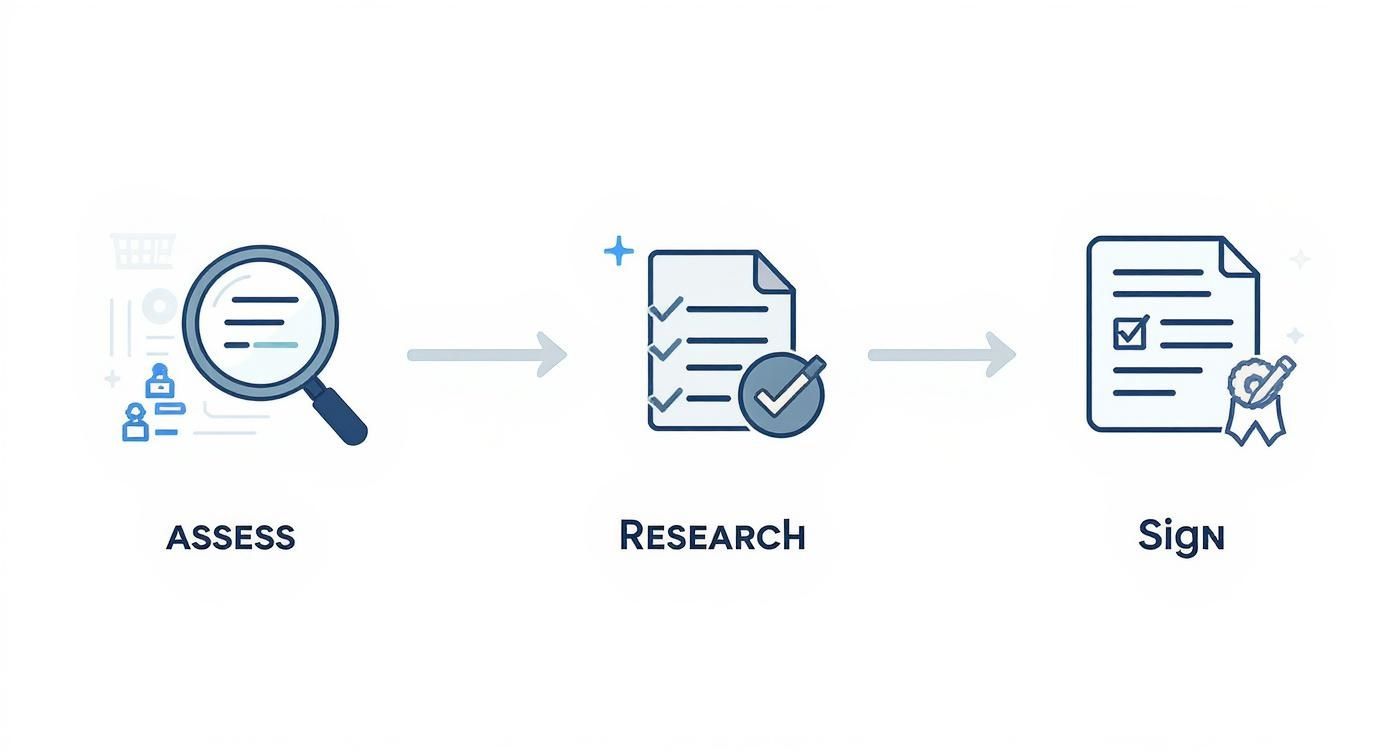
This visual drives home a key point I always make to business owners: a successful partnership begins long before you ever see a proposal. It starts with truly understanding your own organization first.
To get a high-level view of how this all comes together, here's a quick look at the major phases involved.
| Quick Overview of the MSP Selection Process |
| :— | :— | :— |
| Phase | Key Objective | Primary Action Item |
| 1. Assess Your Needs | Define your current IT challenges, goals, and budget. | Create an internal "needs document" or a preliminary Request for Proposal (RFP). |
| 2. Research & Vet | Identify and shortlist potential MSPs that fit your criteria. | Conduct initial calls and check references to narrow down the field. |
| 3. Evaluate & Sign | Compare proposals, interview finalists, and negotiate the contract. | Select the best-fit partner and finalize the Service Level Agreement (SLA). |
Each of these phases has its own set of critical tasks, but seeing them laid out like this helps simplify the entire journey.
Understanding the Broader Context
Before you jump into the nuts and bolts, it helps to put this decision into a larger business context. At its core, hiring an MSP is a specialized form of business process outsourcing. Taking a moment for some background reading on understanding business outsourcing can give you a solid foundation for evaluating partners and setting the right expectations from the start.
This guide will walk you through each step, making sure you end up with a partner who gets not just your technology, but your vision. For a closer look at what a comprehensive partnership looks like, you can explore our overview of managed IT services and see how they’re built to support SMBs just like yours.
Step 1: Define What Your Business Actually Needs
Before you even think about calling a managed service provider, the most important conversation you can have is an internal one. I’ve seen it time and again: a business owner jumps into calls with potential IT partners without a clear picture of their own needs. It’s like starting a road trip without a destination in mind. You’ll burn a lot of fuel and end up frustrated, nowhere near where you wanted to be.
This isn’t just about making a quick list of your servers and software. It’s about digging deeper to find the real friction points in your day-to-day operations and translating those vague frustrations—"the internet is slow" or "this program is always crashing"—into specific, concrete requirements that an IT partner can actually solve.
Moving Beyond the Obvious Problems
Most businesses start looking for an MSP because of a nagging, visible problem. Maybe it's the sluggish network performance, the printer that jams every other day, or that ancient piece of software that reliably crashes right before lunch on Fridays. These are all valid concerns, but they’re usually just symptoms of a much bigger issue. To find the right partner, you need to look at the business impact behind the technical glitch.
Get your key people in a room—and I mean people from different departments. Talk to your sales team about their CRM access on the road. Ask the finance department how reliable their accounting software is during the end-of-month crunch. For manufacturers, check in with operations about the connectivity on the production floor.
Ask questions that get to the core of their daily work:
- What technology issue wastes the most time each week? This pinpoints the productivity drains that have a real, tangible cost.
- What process would be significantly easier if our systems were faster or better integrated? This uncovers opportunities to make your business more efficient through smart technology like automation or AI.
- Is there any task you avoid because the technology is too frustrating to deal with? This can reveal shadow IT or outdated tools that are secretly holding you back.
When you document these real-world pain points, you shift from simply buying "IT support" to investing in solutions that directly improve your bottom line.
Aligning Technology with Your Business Objectives
Once you’ve got a handle on the current headaches, it’s time to look ahead. Where is your business going in the next one, three, or even five years? Your technology has to support that vision. If it can’t, you risk pouring money into an IT setup that will be obsolete before you see a return on it.
An MSP shouldn't just be there to fix what's broken today. They should be a strategic partner who helps you build the technology foundation you’ll need for tomorrow. Your IT goals need to be a direct reflection of your business goals.
For instance, a manufacturing firm in Youngstown planning to roll out a new ERP system has completely different IT needs than a healthcare clinic in Pittsburgh focused on maintaining HIPAA compliance.
Think through these kinds of goal-oriented scenarios:
- Growth Goal: "We plan to open a second location in Erie within 18 months."
- IT Need: A scalable and secure network, cloud-based applications accessible from multiple sites, and a solid plan for standardizing hardware.
- Efficiency Goal: "We need to slash manual data entry by 30%."
- IT Need: Better integration between existing software, exploring automation tools (like AI-powered data extraction), and ensuring rock-solid data backup.
- Security Goal: "We work with government contractors and need to meet CMMC requirements."
- IT Need: Advanced cybersecurity services, expert guidance on compliance documentation, and ongoing security training for employees.
Documenting these connections is absolutely critical. It ensures that when you choose a managed service provider, you're judging them based on their ability to support your specific journey—not just their knack for fixing a slow computer. This foundational work transforms your search from a tactical fix into a strategic investment in your future.
Step 2: Research and Vet Potential Partners
You’ve got your needs mapped out. Now comes the real legwork: finding the right MSP.
How do you cut through the slick sales pitches and find a partner who can genuinely deliver? This is where you roll up your sleeves and do some serious vetting. It’s all about looking past the marketing jargon to find solid proof of their expertise, reliability, and local understanding.

Let’s be honest—the market is flooded with companies calling themselves "MSPs." But the ones who can truly handle complex cybersecurity, navigate tricky compliance like CMMC, and think strategically about AI and cloud are much rarer.
Look for Specialization and Local Experience
First things first, build a shortlist of providers who actually align with what you need. A generalist MSP might be okay for basic helpdesk tasks, but if your biggest headache is cybersecurity or you're planning a complex cloud migration, you need a specialist.
Look for providers who don’t just list these services but demonstrate deep expertise with case studies, certifications, and content that speaks your language.
For businesses here in our neck of the woods—whether you're in manufacturing in Pittsburgh or healthcare over in Youngstown—a local presence is a huge advantage. Having a provider who understands the regional business climate and can be on-site when a crisis hits offers a massive advantage over a remote, faceless national firm.
Dig into Their Track Record and Reputation
Got a few names? Great. Time to play detective. Don't just take their website as gospel. An MSP’s true colors show up in their history and what their clients have to say about them.
Here’s where to focus your investigation:
- Client Testimonials and Case Studies: Hunt for success stories from businesses that look like yours in size and industry. A case study showing how an MSP helped a local distribution company solve a logistics nightmare with a cloud solution is far more telling than a generic, one-sentence testimonial.
- Online Reviews and Industry Reputation: Check Google, LinkedIn, and third-party review sites. A consistent pattern of positive feedback about responsiveness and problem-solving is a fantastic sign.
- Requesting References: Don't be shy. Ask for a few references you can actually talk to. A confident MSP will have no problem connecting you with happy clients.
The real mark of a top-tier MSP is their ability to solve problems proactively, not just put out fires. When you talk to their references, ask for a specific time the provider caught a potential issue before it caused any downtime.
This kind of deep dive helps you see how they perform under pressure and if they truly act like a partner. Speaking of which, getting familiar with IT vendor management best practices gives you a solid framework for evaluating any tech provider you’re considering.
Verify Credentials and Technical Maturity
This is a critical step that many SMBs overlook. The managed services market is massive, but it’s not all created equal. Believe it or not, while there are up to 200,000 outfits worldwide calling themselves MSPs, only a tiny fraction—maybe 5,000 to 10,000—hold the kind of verifiable certifications that prove they’re ready for prime time.
You need to look for signs of technical depth and a real commitment to doing things the right way.
- Industry Certifications: Credentials from heavy hitters like Microsoft (look for titles like Solutions Partner) or respected cybersecurity organizations (like CompTIA Security+) prove they’re serious about ongoing training.
- Security and Compliance Expertise: If you’re in an industry with strict regulations like HIPAA or CMMC, you need more than a pinky promise. Ask for hard proof of their experience in your specific regulatory world.
- Vendor Partnerships: Strong ties with hardware and software vendors often mean better pricing and faster support escalations for you when you need it most.
It's also smart to think about their approach to the entire technology lifecycle, right down to getting rid of old gear. The same logic used to choose a reliable IT equipment disposal service applies here—it shows whether they’re diligent and can manage your assets securely from cradle to grave.
By researching and vetting potential MSPs this way, you can build a shortlist of partners who are truly qualified, letting you head into the proposal phase with total confidence.
Step 3: Evaluate Proposals and Technical Expertise
Once you’ve narrowed down your list of potential MSPs, the proposals will start rolling in. This is where the real evaluation begins. A good proposal is far more than a price list; it’s a strategic document that should prove the provider actually listened to and understood the unique challenges you laid out. It's time to look past the bottom line and dig into the real value each one is offering.
The demand for managed IT services is exploding, driven by the non-stop need for stronger cybersecurity, cloud management, and now, AI integration. As of 2024, the industry was valued at over USD 335 billion, and forecasts show it more than doubling by the early 2030s. Knowing this helps you understand if a potential partner is keeping up with the technology your business will need to stay competitive down the road. You can see the full breakdown of the growth of the MSP market on marketgrowthreports.com.
Deconstructing the Service Level Agreement
The Service Level Agreement (SLA) is the absolute heart of any MSP proposal. Think of it as the contractual promise that sets the rules of the game. A vague SLA is a massive red flag. You need one that is specific, measurable, and clearly tied to your business's real-world needs.
A solid SLA will spell out things like:
- Response Time: How fast will they acknowledge your ticket?
- Resolution Time: How long until the problem is actually fixed?
- Uptime Guarantees: Look for a hard number, like 99.9% guaranteed system availability.
- Prioritization Levels: How do they classify issues? Is there a clear path for emergencies versus minor annoyances?
Pay very close attention to the fine print here. I’ve seen SLAs that guarantee a "four-hour response," which only meant an automated email would be sent. The details are everything.
Evaluating Their Security and Compliance Posture
For any business today, especially those in manufacturing, healthcare, or professional services, security isn't just a feature—it's everything. The proposal needs to detail a multi-layered security strategy, not just wave its hands and say "antivirus and a firewall." This is how you spot the true security pros.
Look for specifics on their approach. How do they handle proactive threat hunting? What’s their incident response plan when something goes wrong? A proposal should clearly outline their security toolset and explain how those tools are managed. It gives you a clear window into their technical depth and how seriously they take protecting your company.
If your business is in manufacturing or healthcare, you need to see proof that they understand regulations like CMMC or HIPAA. For a better sense of what a robust defense looks like at the device level, it’s worth reviewing what’s involved in comprehensive endpoint security management.
Assessing the Technology Roadmap and vCIO Services
A great MSP doesn't just put out fires; they help you build a fireproof strategy for the future. This guidance, often delivered by a Virtual Chief Information Officer (vCIO), is what turns an IT vendor into a genuine business partner.
The best proposals will include a section outlining a potential 12- to 36-month technology plan. This demonstrates that they’ve thought beyond your immediate pain points and are considering your long-term business goals.
This roadmap should connect directly to the goals you defined earlier, showing how technology investments will support your plans for growth or efficiency. If a proposal is all about break-fix support and lacks this strategic vision, it’s a good sign they aren't equipped to grow with you.
To keep everything organized as you compare these detailed proposals, a checklist can be a lifesaver. It forces you to compare apples to apples and score each provider systematically.
Practical Tip: MSP Proposal Evaluation Checklist
| Evaluation Criteria | Provider A | Provider B | Provider C |
|---|---|---|---|
| SLA Specificity (Response/Resolution Times) | |||
| Uptime Guarantee Percentage | |||
| Detailed Cybersecurity Strategy | |||
| Compliance Expertise (HIPAA/CMMC) | |||
| vCIO Services & Strategic Roadmap | |||
| Client References & Case Studies | |||
| Pricing Model Clarity (All-inclusive vs. Tiered) | |||
| Alignment with Business Goals | |||
| Overall Score |
Using a matrix like this moves the conversation from "Who's the cheapest?" to the much more important question: "Who will be the best long-term partner for our business?" It’s a crucial step toward making a choice you’ll be happy with for years to come.
Step 4: Make the Final Decision and Negotiate the Contract
You’ve put in the hard work—you’ve vetted providers, painstakingly compared proposals, and checked references. At this point, you're likely down to one or two top contenders. This final stage isn't just about the technical details anymore. It’s about confirming the human fit and finalizing a partnership that will truly protect your business for the long haul.

This decision is a big one, and you’re not alone in making it. Businesses are relying on external expertise more than ever. In fact, nearly two-thirds (66%) of MSP adoption in the U.S. is now focused on outsourcing IT infrastructure. That’s a clear signal that companies are prioritizing efficiency and resilience. With remote and hybrid work now standard practice, a provider’s agility has become a non-negotiable part of the deal. You can discover more insights about U.S. MSP adoption trends on infrascale.com.
Confirming the Cultural Fit
Before you even glance at a contract, take one last gut check on the human element. You're not just buying a service; you're bringing a new team into your company’s inner circle. Does this provider feel like an extension of your own team?
Think back to your interactions. Did they communicate clearly, without hiding behind a wall of jargon? When you pushed them with tough questions, did they give you straight answers or just another sales pitch? This cultural alignment is often the invisible thread that holds a great partnership together—and its absence can cause a seemingly good one to unravel.
Demystifying the MSP Contract
Once you’ve made your choice, the spotlight shifts to the Master Service Agreement (MSA) and the Service Level Agreement (SLA). Don't let your eyes glaze over. This isn't just legal boilerplate; it's the official rulebook for your entire relationship. A well-written contract is a sign of a transparent provider, building trust and setting clear expectations from day one.
A trustworthy partner won't just slide the document across the table. They’ll walk you through it, explain the legalese, and be open to reasonable negotiations.
Here are the key clauses you absolutely need to scrutinize:
- Scope of Services: This needs to be an exhaustive list of exactly what is and is not covered. Look for specifics on everything from helpdesk support hours and after-hours policies to cybersecurity monitoring and vCIO meetings.
- Term Length and Renewal: Most contracts run for one to three years. For a new relationship, a one-year term is a fantastic starting point. It gives both of you a chance to prove the fit without a long-term lock-in. Watch out for those auto-renewal clauses!
- Liability and Indemnification: This is the "what if" section. It defines who is on the hook if something goes wrong, like a data breach. Make sure the liability limits are reasonable and the terms are fair to both sides.
- Exit Strategy and Termination Clause: What happens when the contract ends or if you need to part ways early? A good contract will clearly define the offboarding process, including how your data is handed back to you and any fees involved.
The real goal of negotiation isn't just to get the lowest price—it's to achieve total clarity. You should sign that contract feeling 100% confident that there are no hidden fees or "gotcha" clauses waiting to surprise you.
Negotiating for a True Partnership
Your goal in this final phase is to build a partnership based on shared success, not just a transactional service agreement. Come to the table with a collaborative mindset. Be ready to discuss your concerns and propose adjustments that make sense for your business.
And don't forget to ask about onboarding. A great MSP will have a detailed, documented plan to transition your systems with minimal disruption to your team. They should be able to tell you exactly who your points of contact will be and what the first 30, 60, and 90 days will look like.
Taking the time to get these final details right ensures your new IT partnership starts on the strongest possible foundation, setting your business up for security, stability, and growth.