For small and mid-sized businesses in Western Pennsylvania and Eastern Ohio, the cloud offers incredible flexibility and scalability. But this shift also introduces new security challenges that can feel overwhelming, especially with limited IT staff and competing priorities. The constant threat of ransomware, compliance missteps, and simple human error makes it difficult to know if your defenses are strong enough. Are you truly secure, or just hoping for the best?
This guide cuts through the noise. We're skipping the enterprise-level theories and abstract advice to deliver a practical, prioritized checklist of the most impactful best practices for cloud security that businesses like yours can implement. From controlling who accesses your data in Microsoft 365 to ensuring you can recover from a disaster, we will cover the foundational steps that protect your critical information, maintain operational continuity, and build trust with your clients.
Think of this as your roadmap to turning cloud infrastructure from a potential liability into a secure, strategic business asset. We will explore actionable strategies for identity management, data protection, network segmentation, and continuous monitoring. While securing your digital assets is paramount, it's also important to remember that physical security plays a role. Gaps in your overall security posture can lead to issues like data breaches from improper equipment disposal, illustrating the need for a comprehensive approach. This list will provide the clarity and direction needed to build a resilient and secure cloud environment for your organization.
1. Implement Strong Identity and Access Management (IAM)
Identity and Access Management (IAM) is the foundational layer of any robust cloud security strategy. It’s the digital equivalent of a building’s security desk, keycard system, and access roster all rolled into one. At its core, IAM is a framework of policies and technologies that ensures the right individuals have the appropriate access to your technology resources. For a small manufacturing company in Western Pennsylvania, think of it as controlling who can access your sensitive customer data in Microsoft 365 or who can spin up a new virtual server in your cloud account.

This framework is built on the Principle of Least Privilege, meaning employees are only given access to the information and tools absolutely necessary to perform their jobs. An accountant doesn't need access to engineering source code, and an HR manager doesn't need to modify firewall rules. This simple but powerful approach dramatically reduces your attack surface, limiting the potential damage from a compromised employee account or an insider threat. Without a solid IAM policy, you're essentially leaving every door in your digital office unlocked.
Practical IAM Steps for SMBs
For businesses in Eastern Ohio that are just beginning, implementing IAM doesn't have to be an overwhelming, enterprise-level project. You can achieve significant security gains with these high-impact steps:
- Audit Existing Access: Begin by reviewing who currently has access to what. It's common to find former employees with active accounts or current team members with permissions far beyond their job requirements.
- Enforce Multi-Factor Authentication (MFA): This is non-negotiable and one of the most effective security controls available. Immediately require MFA for all users, especially those with administrative privileges, to protect against password theft.
- Use Role-Based Access Control (RBAC): Group users by their job function (e.g., "Sales Team," "Accounting," "IT Admin") and assign permissions to the group, not the individual. This simplifies onboarding and offboarding and ensures consistency.
- Conduct Regular Reviews: Schedule quarterly or semi-annual access reviews to ensure permissions are still appropriate as roles change. This helps prevent "privilege creep," where users accumulate unnecessary access over time.
2. Encrypt Your Data, Both In Transit and at Rest
If IAM is the digital security desk for your cloud environment, then data encryption is the reinforced steel vault where you store your most valuable assets. Encryption is the process of converting sensitive information into an unreadable code, making it useless to anyone without the specific key to unlock it. For a healthcare provider in Eastern Ohio, this means that even if a cybercriminal accesses your cloud storage, your patient records and financial data remain a jumbled, inaccessible mess, helping you meet HIPAA compliance requirements.
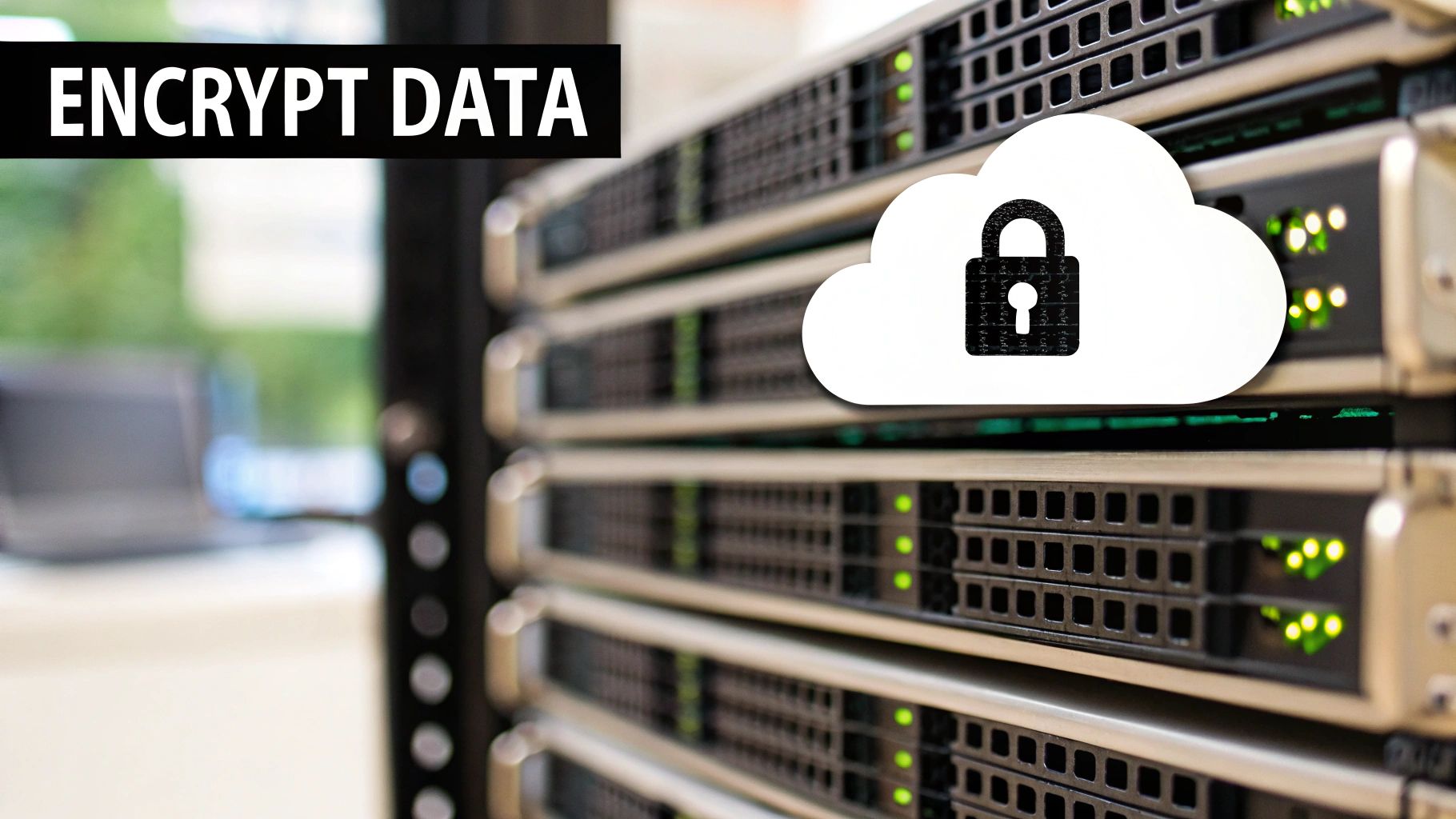
This best practice involves two critical components: encryption in transit and encryption at rest. In transit, data is protected as it travels between your users and cloud services (like uploading a file to Microsoft 365). At rest, it's protected while being stored on a server or in a database. Implementing both creates a dual-layer defense that is fundamental to modern cybersecurity and a core requirement for many compliance standards. Neglecting encryption is like sending your company secrets through the mail in a clear envelope.
Practical Encryption Steps for SMBs
For SMBs, your cloud provider already offers powerful, built-in encryption tools. The key is to ensure they are enabled and correctly configured. Focus on these practical first steps:
- Enable by Default: Go into your cloud storage settings (like AWS S3 buckets or Azure Blob Storage) and enable server-side encryption by default. This ensures any new data is automatically protected without manual intervention.
- Enforce Secure Connections: Mandate the use of modern transport protocols like TLS 1.2 or higher for all traffic to and from your cloud services. This secures data while it's in transit.
- Leverage Managed Key Services: Use your provider's key management service, such as AWS KMS or Azure Key Vault. These services handle the complex and critical work of creating, storing, and rotating encryption keys, which is far more secure than trying to manage keys yourself.
- Establish Key Rotation Policies: Set up an automated policy to rotate your encryption keys at regular intervals, typically at least annually. This limits the window of opportunity for an attacker if a key were ever compromised.
3. Conduct Regular Cloud Security Audits and Assessments
Think of your cloud environment as a commercial building. Even with the best locks and access controls, you still need to walk the perimeter, check the windows, and test the alarm system periodically. Cloud security audits and assessments serve this exact purpose, providing a systematic evaluation of your configurations, access controls, and data handling practices. For a manufacturing company in Western Pennsylvania, this means ensuring its cloud-based design files are properly secured and only accessible to authorized engineers, protecting valuable intellectual property.
This process is critical for identifying vulnerabilities, misconfigurations, and security gaps before a malicious actor can exploit them. Over time, settings can drift, new services are added without proper review, and old permissions linger, creating unseen risks. A regular audit helps you maintain a strong security baseline, provides essential documentation for compliance, and is one of the most effective best practices for cloud security. Without scheduled assessments, you are essentially flying blind, hoping your initial setup remains secure forever.
Practical Audit Steps for SMBs
For an SMB in Eastern Ohio, conducting a full-scale audit might seem daunting, but you can start with manageable and high-impact actions. The goal is to make security assessment a continuous business rhythm, not a one-time event.
- Establish a Baseline: Your first audit creates the benchmark. Use native cloud tools like AWS Trusted Advisor or Microsoft Defender for Cloud to get an initial report card on your environment. For a more detailed look, our cybersecurity risk assessment template can provide a structured starting point.
- Automate Continuous Monitoring: Consider a Cloud Security Posture Management (CSPM) tool. These platforms continuously scan your environment for misconfigurations and compliance violations, providing real-time alerts between your formal audits.
- Schedule Formal Reviews: At a minimum, conduct a thorough internal audit on a quarterly basis. Supplement this with an annual third-party penetration test to get an unbiased, external perspective on your defenses.
- Track and Remediate: An audit is only useful if you act on the findings. Create a remediation plan for every issue identified, assigning clear ownership and deadlines. Track progress in a shared dashboard to ensure accountability.
4. Deploy Unified Multi-Cloud and Hybrid Cloud Security
Few businesses today rely on a single cloud provider. It’s far more common for a manufacturing company in Western Pennsylvania to use Microsoft 365 for productivity, AWS for a specific application, and still maintain some physical servers on-premises for legacy systems. This mix of multi-cloud and hybrid environments creates complexity, and without a unified security plan, it can leave dangerous gaps for attackers to exploit.
A cohesive multi-cloud and hybrid security strategy is about applying consistent rules, monitoring, and controls across all your digital assets, regardless of where they live. It prevents you from having strong security in Microsoft 365 but weak, unmonitored defenses for your on-premise servers. This approach centralizes your security posture, giving you a single pane of glass to view threats and manage policies, which is one of the most effective best practices for cloud security in a modern IT landscape.
This unified framework is built on the Principle of Consistency, ensuring a security policy applied in one environment is mirrored in all others. For example, your data encryption standards should be the same for information stored in Google Cloud as they are for data on a local file server. This prevents attackers from finding and targeting the weakest link in your technology stack, dramatically reducing your overall risk profile.
Practical Multi-Cloud Steps for SMBs
For a growing business in Eastern Ohio, unifying security across different platforms might seem daunting, but you can start with manageable and impactful actions. The goal is to reduce complexity and improve visibility.
- Establish a Unified Asset Inventory: You can't protect what you don't know you have. Start by creating a comprehensive inventory of all your assets—servers, applications, data stores—across every cloud and on-premise environment.
- Centralize Identity and Access: Use a single identity provider, like Microsoft Entra ID (formerly Azure AD), to manage user authentication and authorization across all platforms. Implementing Single Sign-On (SSO) simplifies user access and ensures offboarding is clean and complete everywhere.
- Use Cloud-Agnostic Security Tools: Instead of relying only on the native security tools of each provider, consider platforms that work across all environments. A Cloud Access Security Broker (CASB) or a multi-cloud security information and event management (SIEM) tool can provide consistent monitoring and policy enforcement.
- Standardize Security Configurations: Use Infrastructure as Code (IaC) tools like Terraform or Bicep to deploy resources with consistent, pre-approved security configurations no matter the cloud provider. This eliminates manual errors and ensures your security baseline is always met.
5. Implement Robust Cloud Network Segmentation
If Identity and Access Management (IAM) is the keycard system for your digital office, then network segmentation is the equivalent of building reinforced walls between departments. It's the practice of dividing your cloud network into smaller, isolated zones or segments. This architectural approach, when combined with cloud-native firewalls, ensures that traffic can only flow between these zones in a controlled and deliberate manner. For a manufacturing company in Western PA, this means your sensitive production control systems on the cloud are completely isolated from your public-facing web server, preventing a breach in one area from spreading to another.

The core principle here is containing the blast radius. In the event of a security breach, segmentation limits an attacker's ability to move laterally across your network to find and steal valuable data. By default, nothing can communicate with anything else unless you explicitly permit it. This "default deny" posture is a fundamental concept in creating a Zero Trust environment and is one of the most effective best practices for cloud security you can adopt. Without it, a single compromised server could give an intruder free reign over your entire cloud infrastructure.
Practical Network Segmentation Steps for SMBs
Implementing segmentation doesn't require a complete network overhaul. For small and midsize businesses, a phased approach using your cloud provider's built-in tools is highly effective and budget-friendly.
- Map Your Traffic: Start by creating a simple diagram of your cloud environment. Identify which applications and servers need to communicate with each other and which don't. This will be the blueprint for your segments.
- Segment by Risk: Group your resources based on their sensitivity and function, not just by department. Create separate segments for public-facing web servers, internal application databases, and development environments.
- Use Cloud-Native Controls: Leverage tools like AWS Security Groups or Azure Network Security Groups (NSGs). These act as virtual firewalls to enforce a "default deny, allow by exception" rule set for your virtual machines.
- Deploy Web Application Firewalls (WAF): For any public-facing applications, implement a WAF to protect against common web-based attacks like SQL injection and cross-site scripting that standard firewalls might miss.
- Log and Monitor Network Traffic: Ensure you are logging all allowed and, more importantly, all denied network traffic. These logs are invaluable for detecting intrusion attempts and for forensic analysis after an incident.
6. Establish Comprehensive Cloud Backup and Disaster Recovery
Relying on the cloud doesn't automatically protect you from data loss. Cloud backup and disaster recovery (DR) act as your ultimate safety net, ensuring your business can recover from anything from a crippling ransomware attack to accidental data deletion by an employee. Think of it as an insurance policy for your most critical asset: your data. For a professional services firm in Western Pennsylvania, this means having a plan to restore your client files and project management system after a server failure, minimizing costly downtime and reputational damage.
This strategy protects your operations against a wide range of threats, including hardware failures, software corruption, cyberattacks, and even outages at the cloud provider's data center. It involves creating secure copies of your data (backups) and having a clear, tested plan (disaster recovery) to restore services quickly. Without a robust backup and DR plan, you're gambling with your business's ability to survive an unexpected incident. The ROI of a solid backup plan becomes immediately clear the first time you need to use it.
Practical Backup & DR Steps for SMBs
For a small business in Eastern Ohio, building a DR plan might seem daunting, but starting with foundational steps makes it manageable. Focus on protecting your most critical systems first and expand from there.
- Define Your RTO and RPO: Determine your Recovery Time Objective (RTO), how quickly you need to be back online, and your Recovery Point Objective (RPO), how much data you can afford to lose. These metrics will dictate your backup frequency and technology choices.
- Automate and Encrypt Backups: Schedule your backups to run automatically and consistently using tools like Microsoft 365 Backup or Azure Backup. Crucially, ensure all backups are encrypted both in transit and at rest to prevent unauthorized access.
- Test Your Recovery Plan Regularly: A backup is useless if it can't be restored. Schedule quarterly tests to perform a full system restore. This validates your procedures, builds muscle memory for your team, and ensures you're prepared for a real event.
- Maintain Offsite and Immutable Copies: Follow the 3-2-1 rule: three copies of your data on two different media types, with at least one copy offsite. In the cloud, this means storing backup copies in a separate geographic region. Use immutability features to protect backups from being altered or deleted by ransomware.
Developing these procedures is a core component of a resilient IT strategy. To understand how this fits into a larger framework, you can learn more about building a business continuity plan for IT systems.
7. Implement Continuous Cloud Security Monitoring and Logging
If Identity and Access Management is the keycard system for your cloud environment, then monitoring and logging are the 24/7 security cameras and detailed entry logs. This practice involves capturing a comprehensive record of all activities within your cloud services: who logged in, what data they accessed, which configurations they changed, and every API call made. For a professional services firm in Western Pennsylvania, this means having an undeniable audit trail of every action taken in your cloud environment.
Without effective logging and monitoring, a security breach could go completely undetected for weeks or even months, allowing an attacker to cause catastrophic damage. By centralizing and analyzing these logs, you can detect suspicious behavior in near real-time, investigate security incidents with forensic accuracy, and prove compliance with regulations like HIPAA. This is one of the most critical best practices for cloud security, transforming your defense from a passive barrier into an active surveillance system.
Practical Monitoring Steps for SMBs
Implementing a robust monitoring strategy doesn't require an enterprise-sized budget. For small businesses in Eastern Ohio, the key is to start with foundational, high-impact logging and alerting.
- Enable Logging by Default: Turn on logging services like AWS CloudTrail or Azure Monitor for all your cloud resources from day one. You cannot retroactively log past events, so it's crucial to capture this data from the beginning.
- Centralize Your Logs: Send logs from all your different services (servers, applications, firewalls) to a single, secure location. This makes analysis and correlation possible, allowing you to connect seemingly unrelated events into a potential attack pattern.
- Configure High-Priority Alerts: You don't need to watch every log entry. Set up immediate, automated alerts for high-risk activities, such as a login from an unusual geographic location, changes to administrator accounts, or attempts to disable security controls.
- Establish a Retention Policy: Determine how long you need to keep logs. For compliance, a 90-day minimum is common, but for critical systems, a year or more is recommended. Balance your security needs with storage costs.
8. Enforce Secure Cloud Configuration Management
Manually configuring cloud environments is like building a house without blueprints; it's slow, prone to costly errors, and nearly impossible to replicate perfectly every time. This is where secure configuration management becomes a critical security practice. It ensures that all your cloud services, like virtual servers and databases, are set up according to a secure, predefined standard. For a manufacturing company in Western Pennsylvania, this means every new server is deployed with the correct firewall rules and user access policies automatically applied, eliminating human error.
This approach introduces consistency and predictability, two cornerstones of the best practices for cloud security. By standardizing your configurations, you eliminate "configuration drift," where manual, undocumented changes create security gaps over time. Every system adheres to a secure baseline, creating a transparent and auditable environment. This turns your infrastructure into a well-documented, repeatable asset instead of a fragile, manually-tended system.
Practical Configuration Steps for SMBs
For a small business in Eastern Ohio, enforcing secure configurations can seem complex, but you can start with simple, powerful actions. The goal is a secure, repeatable foundation.
- Use Secure Templates: Instead of creating cloud resources from scratch, use pre-built, hardened templates provided by your cloud provider or security organizations like the Center for Internet Security (CIS).
- Automate with Infrastructure as Code (IaC): Use tools like Terraform or Bicep to define your infrastructure in code. This allows you to track changes, enforce standards, and deploy identical, secure environments every time.
- Implement "Policy-as-Code": Before deploying any infrastructure, use automated tools to scan your code for misconfigurations, such as public storage buckets or unrestricted firewall rules. This is part of a "shift left" security mindset, catching problems before they ever reach production.
- Conduct Regular Scans: Use Cloud Security Posture Management (CSPM) tools to continuously scan your live environment for any configurations that have drifted away from your secure baseline and alert you to fix them.
9. Secure Your Development and Deployment Pipelines
For businesses in Western Pennsylvania that develop their own software, the path from a developer's machine to the cloud is a critical security checkpoint. Secure Development and Deployment Pipelines, often called CI/CD (Continuous Integration/Continuous Delivery) pipelines, automate the process of building, testing, and deploying applications. Integrating security directly into this automated workflow is a practice known as DevSecOps, and it’s essential for catching vulnerabilities before they ever reach production where they are much more expensive and risky to fix.
This process involves embedding automated security checks at every stage. Instead of waiting for a final security review, tools automatically scan code for flaws, check software dependencies for known vulnerabilities, and analyze container images for security misconfigurations. Adopting a shift left security approach is paramount for identifying and mitigating security vulnerabilities early in your cloud development and deployment pipelines. This proactive stance ensures security isn't an afterthought but a core component of your development lifecycle.
Practical Pipeline Security Steps for SMBs
For an SMB in Eastern Ohio, securing your development pipeline doesn't require a massive investment. You can start by integrating readily available tools and establishing clear processes. This is one of the most effective best practices for cloud security when developing cloud-native applications.
- Integrate Automated Code Scanning: Use tools like Snyk or GitHub Advanced Security to automatically scan your code and its dependencies for known vulnerabilities every time a change is made.
- Scan Container Images: Before deploying any application container, use a scanner like Aqua Security's Trivy to check the image for security weaknesses. This prevents you from deploying a vulnerable foundation.
- Implement Secure Credential Management: Stop storing passwords or API keys in code where they can be accidentally exposed. Use a dedicated service like AWS Secrets Manager or Azure Key Vault to manage and inject secrets securely at runtime.
- Establish Policy Gates: Configure your pipeline to automatically block any deployment that fails a critical security scan. This ensures vulnerable code cannot accidentally make it into your live environment.
10. Foster Security Awareness and Plan Your Incident Response
Even the most advanced technological defenses can be bypassed if an employee unknowingly clicks a malicious link in a phishing email. This human element is a critical component of your overall security posture, making it essential to pair technology with education and preparation. Establishing a formal security awareness training program and a documented incident response plan are two of the most effective best practices for cloud security, transforming your team from a potential liability into your first line of defense. For a manufacturing company in Western PA, this means ensuring every employee, from the shop floor to the executive suite, can spot a phishing attempt and knows exactly who to notify.
Security awareness training equips your staff to recognize and report threats like phishing, social engineering, and business email compromise. An incident response (IR) plan provides a clear, step-by-step guide for your organization to follow when a security event occurs. This plan minimizes panic and chaos, enabling a swift and organized response to contain the threat, mitigate damage, and restore operations. Without these two elements, you are reacting in the dark during a crisis, often leading to costly mistakes and extended downtime.
Practical Training and Response Steps for SMBs
Building a resilient security culture doesn't require an enterprise-sized budget. For small and midsize businesses in Eastern Ohio, the focus should be on consistency and preparedness.
- Implement Regular Training: Use platforms like KnowBe4 or Proofpoint to conduct mandatory annual security awareness training. More importantly, run monthly or quarterly phishing simulations to keep skills sharp and identify areas needing improvement.
- Create a Documented IR Plan: You cannot improvise during a breach. Document a formal plan that outlines roles, responsibilities, and communication protocols. Clearly define what constitutes an incident and the immediate steps to take for detection, containment, and recovery.
- Establish a Response Team: Designate a core incident response team that includes members from IT, management, and legal. Ensure everyone knows their role and has the authority to act quickly.
- Practice with Tabletop Exercises: Regularly conduct tabletop exercises where you simulate a security incident, such as a ransomware attack. This helps your team practice the IR plan, identify gaps, and build confidence before a real event occurs. Explore different incident response plan examples to find a framework that fits your business needs.
Your Next Step Towards a More Secure Cloud
Navigating the landscape of cloud security can feel overwhelming, especially for small and midsize businesses in Western Pennsylvania and Eastern Ohio who are busy managing daily operations. You've just explored a comprehensive checklist covering everything from foundational Identity and Access Management to advanced development security. The sheer volume of these best practices for cloud security isn't meant to intimidate but to illuminate a clear path forward. The journey to a truly secure cloud environment is not a single leap; it's a series of deliberate, strategic steps.
The key takeaway is that progress, not immediate perfection, is the goal. You don’t need to implement all ten practices overnight. Instead, view this guide as a strategic roadmap. Start by tackling the most critical vulnerabilities first. For most SMBs, this means tightening control over who can access your data (IAM) and ensuring you can recover from a disaster with a robust backup plan. These two pillars alone can dramatically reduce your risk profile.
From Knowledge to Action: Your Practical Security Checklist
Once those foundational controls are in place, you can build momentum. Think of each practice as a reinforcing layer in your defense. Here's a quick, actionable checklist to get you started:
- [ ] Review Admin Access: Who has the "keys to the kingdom"? Audit all administrator accounts and remove any that are not absolutely necessary.
- [ ] Enforce MFA Everywhere: Turn on multi-factor authentication for all users across all your cloud services, starting with email and critical applications.
- [ ] Test Your Backups: Don't just assume your backups work. Perform a test restore of a critical file or server this week to validate your recovery process.
- [ ] Schedule Your Next Security Review: Put a quarterly security check-in on the calendar now to ensure it doesn't get pushed aside by competing priorities.
This proactive approach is what transforms security from a reactive, stressful expense into a strategic business advantage. A secure cloud environment is a stable and reliable one, fostering customer trust, ensuring operational uptime, and protecting the intellectual property that drives your company's growth. Mastering these best practices for cloud security isn't just about avoiding a data breach; it's about building a resilient, modern business that can confidently leverage the power of the cloud.
Making It Manageable for Your Business
For many business owners, the primary obstacles are not a lack of will but a lack of time, resources, and specialized expertise. You’re an expert in your industry, not necessarily in cloud firewalls or IAM policies. That’s precisely where a strategic partnership can make all the difference. Instead of trying to become a cybersecurity expert overnight, you can leverage a team that already is.
The ultimate goal is to create a security culture where these best practices become second nature. This involves not just technical controls but also training your team to be your first line of defense against phishing and other threats. By combining robust technology with an educated workforce, you create a powerful, multi-layered defense that is far more effective than any single tool. Your journey toward a more secure cloud begins with the next right step. Choose one area from this list, commit to improving it, and build from there.
Ready to turn this checklist into an actionable plan without overburdening your team? As a dedicated IT and cybersecurity partner for SMBs across Western PA and Eastern OH, Eagle Point Technology Solutions specializes in implementing these best practices for cloud security in a way that fits your budget and business goals. Schedule a complimentary consultation today to get a clear, no-obligation roadmap for securing your cloud environment.