For business owners in Western Pennsylvania and Eastern Ohio, the term 'AI' can sound expensive, complex, and better suited for large enterprises. You're focused on managing daily operations, serving customers, and keeping your data secure—not chasing the latest tech trend. But what if AI wasn't just a buzzword? What if it was a practical tool you could use today to solve real challenges like preventing costly downtime, securing your business from cyber threats, and freeing up your team from repetitive tasks?
This article demystifies AI, breaking down 10 tangible AI use cases in business that are accessible, affordable, and deliver a real return on investment for companies just like yours. To truly understand how AI delivers tangible value, it's essential to explore various real-world AI use cases that extend beyond the hype. We'll skip the jargon and focus on actionable strategies that can help your manufacturing, healthcare, or professional services company operate more efficiently, make smarter decisions, and gain a competitive edge.
1. Predictive Maintenance and Infrastructure Monitoring
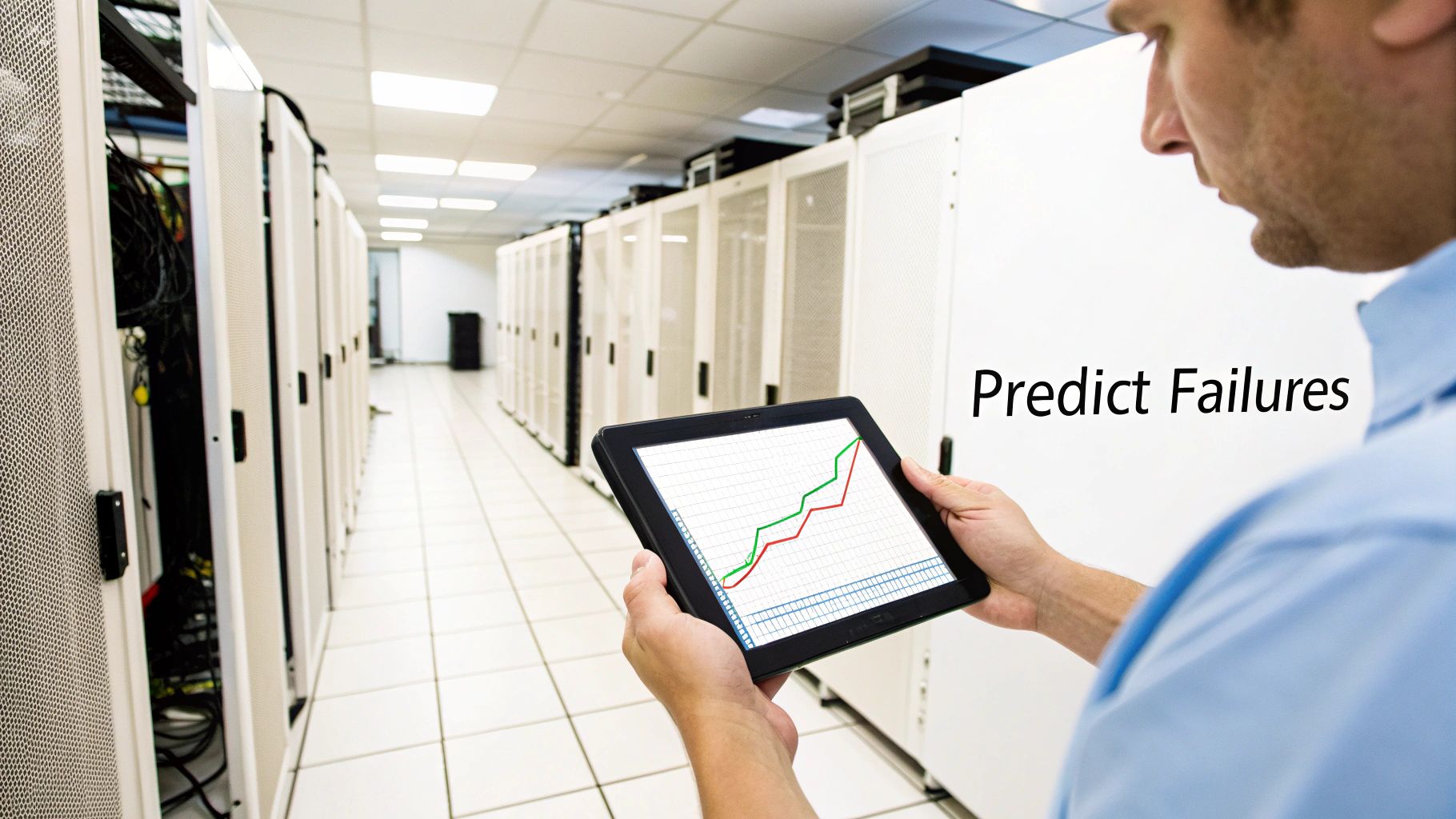
One of the most impactful AI use cases in business is the shift from reactive to proactive IT management. For a manufacturer in Erie or a distribution center in Youngstown, unexpected equipment failure means lost production and revenue. Predictive maintenance uses AI algorithms to analyze performance data from your servers, network hardware, and critical applications. It identifies subtle anomalies that signal a potential failure long before it happens, allowing your team to perform maintenance during scheduled, low-impact windows instead of scrambling to fix a crash during peak business hours.
Why It Matters for Your Business
Instead of waiting for a critical server to fail during your busiest shift, this approach uses machine learning to forecast issues. For small and midsize businesses, preventing even a few hours of downtime can translate into thousands of dollars in saved revenue and productivity. This proactive stance is a core component of modern system monitoring strategies.
Practical Steps for SMBs
Integrate AI with Your Helpdesk: Connect AI-driven alerts directly to your IT helpdesk ticketing system. This automates the creation of a work order when the AI flags a potential issue, ensuring no alert gets missed.
Define Smart Alert Thresholds: Work with your IT partner to establish clear thresholds. Differentiate between a "warning" that requires monitoring and a "critical" alert that needs immediate action to avoid overwhelming your team.
Start with Baseline Data: For the AI to be effective, it needs a historical baseline of normal operations. Begin by collecting at least a few months of performance data before fully deploying the predictive models.
2. Intelligent Cybersecurity Threat Detection
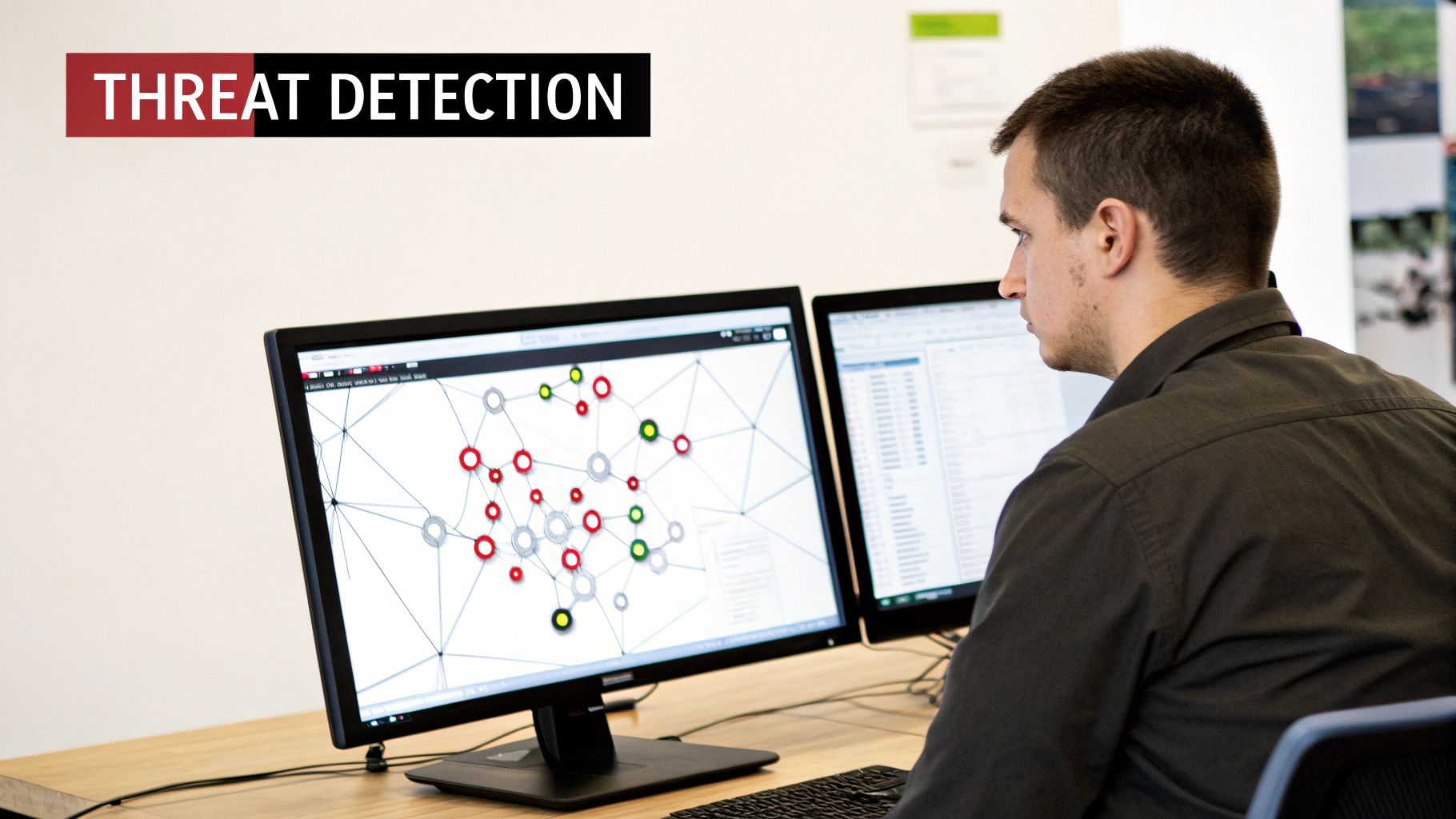
Beyond traditional antivirus and firewalls, one of the most critical AI use cases in business is fortifying your digital defenses. AI-powered cybersecurity systems learn the unique rhythm of your business operations. They identify suspicious patterns and behaviors that deviate from this normal baseline, allowing them to spot advanced threats like zero-day exploits and insider attacks that rule-based systems would otherwise miss. This is crucial for any business, whether you're protecting patient records in a healthcare clinic or proprietary designs at a manufacturing plant.
Why It Matters for Your Business
This approach shifts security from a reactive posture to a proactive, predictive one. Instead of just blocking known viruses, AI analyzes user behavior and data flows to uncover the subtle tactics of modern attackers. For an SMB, detecting a sophisticated threat early can be the difference between a minor incident and a catastrophic data breach. This is a foundational element of modern cybersecurity solutions for businesses.
Practical Steps for SMBs
Establish Baseline Profiles: Work with your IT partner to allow the AI system to learn your normal network activity for several weeks. A clear baseline is essential for the AI to accurately distinguish between legitimate business activity and a genuine threat.
Centralize Your Monitoring: Connect your AI threat detection platform to a Security Information and Event Management (SIEM) system. This provides a single view for monitoring, correlating alerts, and streamlining incident response.
Automate First Response: Use automated "playbooks" to handle common, low-level alerts, such as temporarily isolating a potentially infected device from the network. This frees up your IT team to focus on investigating more complex threats.
3. AI-Powered IT Helpdesk and Ticket Routing
Another one of the most practical AI use cases in business involves streamlining IT support. AI-powered helpdesk systems use natural language processing (NLP) to understand a support ticket and machine learning to automatically categorize, prioritize, and route it to the right technician. This dramatically cuts down on manual triage and speeds up resolution times, getting your employees back to work faster.
Why It Matters for Your Business
Instead of a manager manually reading and assigning every ticket, AI automates the initial workflow. For an SMB with a limited IT staff (or none at all), this means problems get solved faster. Faster routing to the correct expert improves first-contact resolution rates, boosting both employee productivity and satisfaction with IT support. Accessible tools like those in Microsoft 365 or dedicated helpdesk platforms now offer these features for SMBs.
Practical Steps for SMBs
Define Technician Skills: Before implementation, create and assign clear skill tags to your IT support staff (e.g., "Network," "Microsoft 365," "Hardware"). This is crucial for the AI's routing accuracy.
Start with High-Volume Issues: Begin your AI deployment by focusing on high-volume, repetitive issues like password resets or software access requests. This provides a quick win and a large dataset for the AI to learn from.
Clean Your Historical Data: The AI's effectiveness depends on the quality of your past ticket data. Work with your IT provider to clean and standardize historical information to ensure the machine learning model is trained on accurate examples.
4. Vulnerability Management and Patch Prioritization
Manually tracking and prioritizing software vulnerabilities is overwhelming, especially for a small IT team. This is another area where AI use cases in business deliver significant security value. AI systems analyze vulnerabilities across your IT infrastructure, using machine learning to determine which threats pose the most immediate risk based on factors like exploit likelihood, asset criticality, and active threat intelligence. This intelligence-driven approach allows your team to focus on fixing the most dangerous holes first.
Why It Matters for Your Business
Instead of relying on a generic severity score, AI provides context. It might flag a "medium-risk" vulnerability on your company's most critical server as more urgent than a "high-risk" one on a less important workstation. For SMBs, whose limited IT resources must be used efficiently, this strategic prioritization is crucial. It transforms vulnerability management from a chaotic guessing game into a precise, risk-based security operation.
Practical Steps for SMBs
Map Your Critical Systems: Work with your IT provider to identify and tag your most critical assets (e.g., finance servers, primary databases). This context allows the AI to correctly weigh the business impact of a vulnerability.
Establish Patching Timelines: Define clear timelines for patching based on AI-driven severity levels. For example, "critical" vulnerabilities must be patched within 7 days, while "low" can be scheduled for the next monthly cycle.
Automate Low-Risk Patching: For routine and low-risk patches identified by the AI system, use automated deployment tools. This frees up your IT team to handle more complex or sensitive updates that require manual intervention.
5. Network Traffic Analysis and Anomaly Detection
One of the most critical AI use cases in business for cybersecurity involves moving beyond traditional firewalls. AI-driven systems actively analyze your network traffic patterns in real-time to detect malicious behavior that often slips past perimeter defenses. These tools establish a baseline of what "normal" activity looks like and then flag subtle deviations that could signal an unauthorized access attempt, a malware infection, or an employee exfiltrating sensitive data.