A datacenter managed service is the strategic answer to finally ending the endless cycle of reactive IT firefighting. For small and medium-sized businesses, it’s like hiring a world-class property management team for your company's digital infrastructure. You get enterprise-grade security and reliability without that painful enterprise price tag.
Moving Beyond The Server Closet IT Chaos
If you're an SMB owner in Western Pennsylvania or Eastern Ohio, you’ve probably spent more than a few nights worrying about server updates, security patches, or surprise hardware failures instead of focusing on growing your business. It's an all-too-common dilemma that forces you to constantly react to problems rather than proactively building for the future. That server closet, once a symbol of self-sufficiency, often becomes a major source of anxiety and unexpected costs.
This reactive approach isn’t just stressful; it’s a direct threat to your operations. A single hardware failure can halt production. A missed security patch can expose sensitive customer data. Every minute spent troubleshooting is a minute you're not serving your clients. For companies in manufacturing, healthcare, or professional services, this kind of instability is simply not an option.
The Shift To Strategic IT Outsourcing
This is precisely why things are changing. Over the last decade, managed data center services have gone from a niche option to a mainstream strategy for smart SMBs. This trend is backed by the explosive growth of the global data center market, which is expected to climb from about $418.2 billion in 2025 to $691.6 billion by 2030. A deep dive into the data center market shows a clear trend: organizations are tired of the headaches of owning and operating all their infrastructure in-house.
When you decide it's time to bring on a partner for a datacenter managed service, you’re effectively offloading the daily burden of maintenance, monitoring, and security to a team of dedicated experts. It's a fundamental move away from managing physical boxes and toward managing business outcomes.
To really see the difference, it helps to put the two approaches side-by-side.
Comparing In-House IT vs Datacenter Managed Service
| Aspect | Traditional In-House IT | Datacenter Managed Service |
|---|---|---|
| Cost Structure | High upfront capital expense (servers, etc.) plus unpredictable repair costs. | Predictable, fixed monthly operational expense. No surprise hardware bills. |
| Expertise | Relies on a small internal team, often stretched thin with broad duties. | Access to a deep bench of specialists in security, networking, and systems. |
| Security & Compliance | Security is one of many tasks; staying compliant is a constant struggle. | Dedicated security focus; built-in compliance and proactive threat management. |
| Focus | Internal team is bogged down fighting fires and performing routine maintenance. | Your team is freed up to work on strategic projects that actually grow the business. |
The table makes it pretty clear. The old way of doing things keeps you stuck in a reactive loop, whereas a managed service model allows you to be proactive and strategic.
This strategic shift allows your internal team—whether it's a small IT department or a tech-savvy employee—to focus on high-value projects that drive revenue, instead of getting bogged down by routine system administration.
The goal here is to transform your IT from a cost center into a reliable, secure, and predictable asset. Instead of waking up wondering if your backups ran correctly last night, you can focus on your next business goal, confident that your foundational technology is solid. You can learn more about how we handle the core of your operations through our approach to managed servers and network infrastructure. This model provides a clear path to stability and, most importantly, peace of mind.
What Your Business Actually Gets From This Service
So, when you hear the term "datacenter managed service," what does that really mean for your day-to-day operations? It’s easy to think you’re just renting some server space in a secure building, but that's barely scratching the surface. What you're actually getting is a full-fledged operational partner dedicated to weaving reliability, security, and predictability into the very fabric of your company.
Think about it like this: you could buy an empty office building, which gives you four walls and a roof. Or, you could hire a professional property management team that ensures the lights are always on, the plumbing works, security is on patrol, and the roof is leak-free. You’re not just handing over your hardware; you're adopting a complete, proactive framework that frees you up to run your business instead of worrying about the tech that runs it.
This visual perfectly captures the shift from the IT chaos so many small businesses wrestle with to the calm, stable environment a true managed service partner provides.
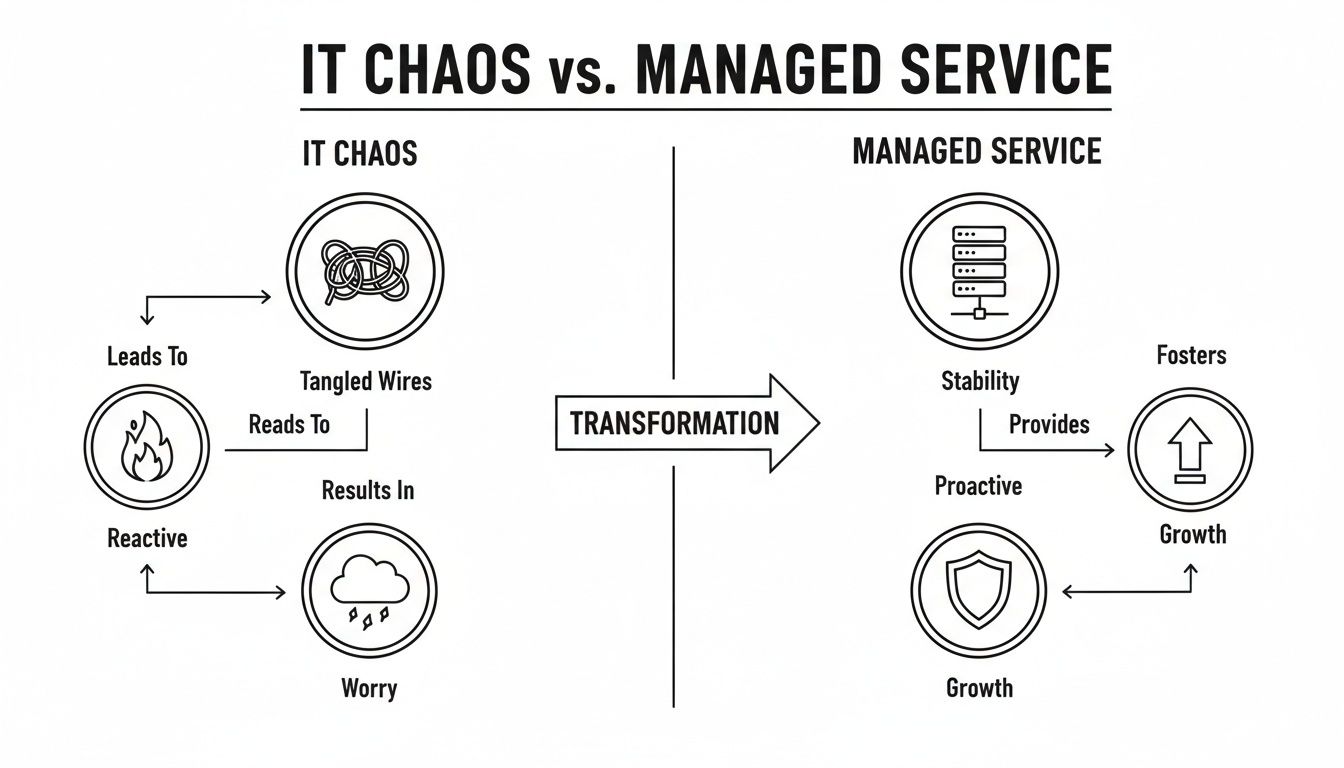
The real takeaway here is moving from a constant state of putting out fires to a proactive, strategic position that actually fuels your growth.
Proactive Infrastructure Management
One of the biggest game-changers is the proactive management of your entire technology infrastructure. This isn't about waiting for a server to crash or an application to freeze. It's about preventing those things from happening in the first place. A trusted partner handles all the tedious but absolutely essential tasks that your team is often too busy to get to.
- System Patching and Updates: We take charge of the never-ending cycle of security patches and software updates for your operating systems and key applications, effectively shutting the door on vulnerabilities before cybercriminals can find them.
- Firmware and Hardware Health: Your servers, network switches, and firewalls all run on their own internal software (called firmware) that needs regular updating. We manage this while also keeping a close eye on the physical hardware for any early warning signs of failure.
- Performance Tuning: Our team is always looking for ways to optimize your systems. We fine-tune settings and allocate resources to make sure everything runs at peak efficiency, preventing the kind of slowdowns that kill productivity.
This constant, behind-the-scenes vigilance is what separates a stable, dependable IT environment from a chaotic one.
24/7 Monitoring And Alerting
Your business doesn’t clock out at 5 PM on a Friday, and neither do potential IT problems. A core pillar of any real datacenter managed service is 24/7/365 monitoring. We use sophisticated tools that act as a nervous system for your environment, watching everything from server CPU load and network traffic to the physical temperature in the datacenter.
These systems are designed to spot anomalies long before they escalate into full-blown outages. If a server's memory usage suddenly spikes or a hard drive starts showing error signals, our team gets an immediate alert—whether it's 2 PM on a Tuesday or 2 AM on a Sunday. This allows us to jump in and fix the problem, often before your team even knows there was a risk.
By the time an employee reports that "the system is down," it’s already too late—the damage is done and downtime has begun. Proactive monitoring is all about catching and fixing issues in the minutes or hours before they ever impact your business.
Robust Backup And Disaster Recovery
Ask yourself this: what would happen if your most critical business data simply vanished tomorrow? For most SMBs, it would be a catastrophic, potentially business-ending event. A managed service provider designs, implements, and manages a robust backup and disaster recovery (BDR) plan that serves as your ultimate insurance policy.
This is a world away from just plugging in an external hard drive once a week. A professional BDR strategy includes:
- Automated and Verified Backups: We set up regular, automated backups of your crucial data and systems. More importantly, we test these backups to make absolutely sure they can be restored when you need them most.
- Geographic Redundancy: Your backup copies are stored in a completely separate, secure location. This protects you from a localized disaster like a fire, flood, or power outage at the primary site.
- Clear Recovery Plans: We create a documented, step-by-step playbook for restoring your operations. In an emergency, there's no guesswork—just a clear plan to get you back up and running fast.
For instance, picture a manufacturing firm here in Western PA whose main server fails, taking their entire order processing and inventory system offline. With their managed BDR plan, we can restore operations from a recent, verified backup in a fraction of the time it would take to rebuild from scratch. This simple service could prevent tens of thousands in lost revenue and save them from crippling shipping delays. It’s all about making sure your business can survive the unexpected.
Why Modern IT Management Is Now Security Management
In the past, managing your IT infrastructure was mostly about keeping the lights on—making sure servers were running and applications were accessible. But that's not the world we live in anymore. Today, every single IT decision, from a hardware refresh to a simple software update, has to be looked at through a security lens. For small and midsize businesses across Western Pennsylvania and Eastern Ohio, the line between IT management and security management has completely vanished.
The hard truth is that cyber threats aren't just occasional risks; they are constant, automated, and getting smarter by the day. A modern datacenter managed service provider understands this. Their job has fundamentally shifted from just preventing downtime to actively defending your company's most critical asset: its data.

Building A Layered Defense
Real security isn't a single product you just install and forget. It’s a multi-layered defense that’s woven directly into the fabric of your infrastructure. A dedicated managed service partner builds these layers to create a resilient shield around your entire operation.
This proactive approach isn't just about reacting to problems; it's about getting ahead of them. This includes:
- Advanced Firewall Management: We're talking about configuring and constantly monitoring your firewalls to block malicious traffic before it even gets a chance to knock on your network's door.
- Intrusion Detection Systems (IDS): These systems are like digital watchdogs, actively scanning network activity for suspicious patterns that could signal an attack in progress.
- Proactive Threat Hunting: This goes a step beyond automated alerts. It involves experts actively searching for hidden threats that might have snuck past your initial defenses.
- Consistent Patching: Keeping every system updated with the latest security patches is non-negotiable. It’s one of the most critical and effective security measures you can take, as we detail in our guide to effective patch management.
Adopting this security-first mindset is absolutely essential. With the growing sophistication of cyber threats, understanding challenges like the rising threat of infostealer malware is crucial for protecting your sensitive business and customer data.
Navigating The Complex World Of Compliance
If you're in an industry like manufacturing or healthcare, trying to meet strict compliance standards like CMMC or HIPAA can feel like a full-time job in itself. The regulations are dense, the stakes are incredibly high, and one wrong move can result in serious penalties.
This is another area where a datacenter managed service provides tremendous value. Instead of you having to become a compliance expert overnight, your MSP partner helps you navigate these complex and often confusing obligations.
An experienced MSP translates complex regulatory frameworks into practical, actionable security controls. They help you build a compliant environment, generate the necessary documentation for audits, and maintain the required security posture over time.
What was once a massive business risk and administrative headache becomes a managed, predictable process. Security and risk management have become the top reasons businesses are turning to these services. In fact, managed security is the market's fastest-growing segment, expanding at a 15.78% CAGR through 2030. With ransomware incidents costing an average of $4.5 million, even smaller companies are looking for partners who combine rock-solid infrastructure management with robust, layered security.
Ultimately, choosing a managed service provider is no longer just an IT decision—it’s a core business security strategy. It’s about finding a partner who understands that protecting your business is every bit as important as keeping it running.
How Managed IT Drives Real Business Growth
Tech specs and feature lists are important, but let's be honest—they don't really tell you what you need to know. As a business owner or manager in Western Pennsylvania or Eastern Ohio, what you really care about are the results. How does a datacenter managed service go from being a line item on the budget to something that actually fuels your company's growth? This isn't about speeds and feeds; it's about what this kind of partnership makes possible.
Let’s set the technology aside for a minute and focus on the four business advantages that truly move the needle for SMBs. Each one hits on a common pain point and helps you shift your energy from IT maintenance to actual business innovation.

From Unpredictable Expenses To A Stable Budget
One of the biggest headaches of handling IT in-house is the financial rollercoaster. One month, things are humming along. The next, a critical server dies, and you're suddenly staring down a five-figure emergency replacement cost that you never saw coming. This capital expenditure (CapEx) cycle makes any kind of financial planning a guessing game.
A managed service flips this model on its head entirely. Your IT spending moves from that reactive, unpredictable CapEx model to a stable, predictable operational expense (OpEx). You pay a flat monthly fee that covers all the monitoring, maintenance, security, and support you need. Simple as that.
This shift lets you:
- Forecast with Confidence: You know exactly what your core IT costs will be every single month, making your budgeting process straightforward and accurate.
- Eliminate Surprise Bills: No more gut-wrenching invoices for emergency repairs or hardware failures.
- Preserve Capital: Keep your cash free for investments that directly drive growth, like a new piece of equipment for your manufacturing floor or a much-needed marketing campaign.
From Costly Downtime To Enhanced Reliability
Every minute your systems are down is a minute your team isn't working and your customers aren't being served. Downtime isn't just an annoyance; it's a direct blow to your revenue and your reputation. This is where you'll see one of the most immediate benefits of a datacenter managed service.
With 24/7 monitoring and proactive maintenance, we spot potential issues and fix them before they can ever cause an outage. Instead of your team walking in at 8 AM on a Monday to discover a major problem, our team has likely already handled it overnight.
Example in Action: Think about a distribution company in Eastern Ohio that relies on its server to process and ship every order. A critical failure at 2 AM could grind the entire next day's operations to a halt, causing expensive delays and angry customers. With our managed service, automated alerts would notify our on-call engineer, who could jump on the issue remotely. By the time the morning shift clocks in, the system is stable and business continues as usual. That company just avoided a major operational crisis.
From A Stretched Team To Instant Expertise
Hiring, training, and keeping a skilled senior IT professional is both expensive and incredibly difficult, especially for an SMB. Finding a single person who is a true expert in networking, cybersecurity, server management, and cloud integration is like finding a unicorn.
When you partner with an MSP, you get instant access to a whole team of certified specialists for less than the annual salary of one senior-level hire. You get a deep bench of expertise on demand, ready to tackle any challenge that comes up—without the overhead of another full-time employee. This means you always have the right expert for the right problem.
From IT Firefighting To Strategic Focus
This is the most important benefit of all. When you and your key people are constantly pulled away from your real jobs to deal with IT problems, you lose your most valuable resource: focus.
Every hour someone spends troubleshooting a printer or worrying about a server update is an hour they're not spending on customer service, product development, or strategic planning. By handing off the daily grind of IT management, you get that focus back.
Your team is finally free to work on the business instead of just in it. This is where the real growth happens. A datacenter managed service isn't just an IT solution; it’s a business strategy that empowers you to put your best people on the activities that will truly drive your company forward.